

The Blue Hour in the Kornati
The transition between day and night in the Kornati archipelago is rarely a soft fading of light. As the sun dips behind the jagged limestone ridges of Žut, the sea turns the color of hammered pewter, and the silence of the Adriatic descends with a sudden, gravitational weight. We were holding position on a 50-meter Perini Navi, its masts silhouetted like charcoal sketches against the violet bruise of the horizon. There is a specific threshold here—the moment when the bridge console dims and the cockpit lamps flicker to life—where the yacht ceases to be a vessel of transport and becomes a living, breathing creature of light.
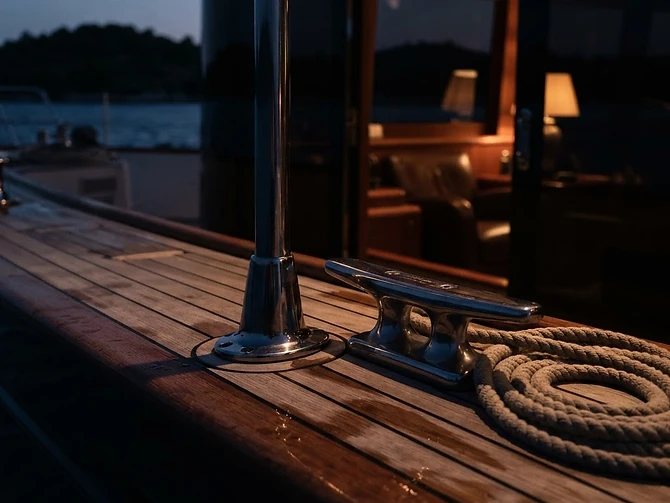
Standing on the aft deck, I watched the deck lights bloom in warm, recessed sequences. It is a calculated choreography. On a boat of this pedigree, illumination is not merely functional; it is structural. The light is designed to soften the harshness of the salt-crusted environment, drawing the eye toward the deliberate grain of the teak deck and the seamless, polished joinery of the gunwales. We were preparing for a night crossing toward the southern reaches of the archipelago, and the stewardess brought out a light plate of local Pag cheese and salted anchovies. The sharp, mineral tang of the brine mixed with the metallic ozone of the approaching night, a sensory reminder that we were guests of a wilderness far removed from the neon sprawl of the mainland.
Architecture on the Water
To inhabit a yacht during a night passage is to inhabit a masterclass in modern architecture, where the interior must remain fluid even as the horizon pitches. Looking back into the saloon, the vessel reads as a house afloat, structured with the same rigour as the villas clinging to the cliffs of the nearby Hvar coastline. Designers—much like the spatial masters at Vitruvius Yachts—understand this dual requirement: the light must be low enough to allow the eyes to adjust to the sea’s ink-black surface, yet warm enough to sustain the domestic illusion of a home grounded in the bay. When the interior glow spills onto the deck, it creates a perimeter of safety—a glowing island that defies the void.
Inside, the interplay of light on the bulkheads, often finished in muted oak or brushed titanium, mirrors the sophisticated spatial planning of an architecturally significant waterfront residence. One feels the kinship between the yacht’s salon and the cantilevered balconies of a contemporary villa perched on the rocks above. They are both structures designed to frame the environment, whether the view is of a passing headland or the wake churning into phosphorescent fire. The light does not just illuminate the space; it defines the scale of our existence against the immense, indifferent geography of the Kornati islands.
The Quiet Vigil
As we cleared the shadow of the islands and moved into the open, the navigation lights cast rhythmic, scarlet and emerald arcs across the foredeck. There is a profound stillness in a night passage that forces one into a state of heightened observation. Each creak of the hull becomes a conversation; each flicker of the instrument panel, a pulse of data in the darkness. We didn't speak much. There was no need. The captain, his face bathed in the soft, amber luminescence of the radar screen, adjusted the throttle with the steady, practiced hand of someone who has spent his life reading the language of the swell.
We watched the coastline of Dugi Otok vanish into the haze, the occasional, rhythmic pulse of a distant lighthouse serving as our only punctuation. The yacht became a singular, glowing construct of glass and steel, an architectural anomaly moving through the liquid dark. As I turned to head below, the light from the interior spilled across the stern, catching the churning white of the propeller wash. It was a fleeting, perfect image—a transient home of light and warmth, carving a solitary path through the quiet, endless expanse of the Croatian night.






