

The Quiet Anchorage of Loch Scavaig
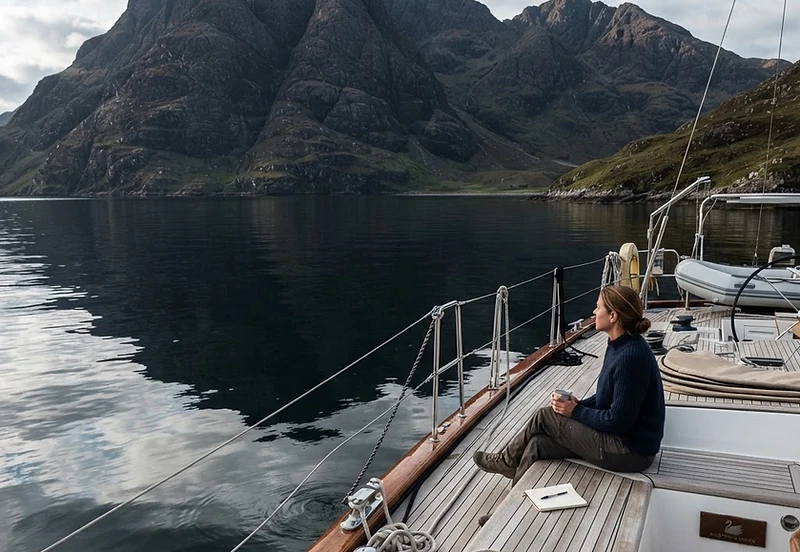
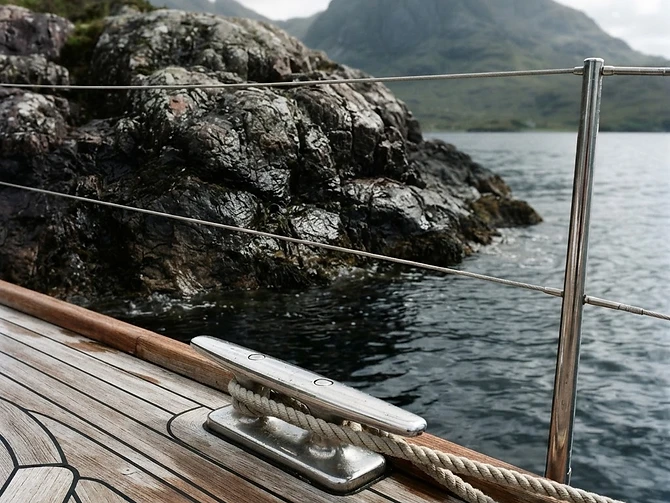
The wind died in the lee of the Cuillin, leaving the water of Loch Scavaig as flat and dark as a pane of obsidian. Our Nautor’s Swan 78 held her station with an inherent grace, the chain rattling softly against the hawsepipe before settling into the deep, peaty silt of the seabed. It is a specific kind of silence that defines this reach—not an absence of sound, but a layering of it: the distant, percussive slap of a grey seal surfacing near the stern, the rhythmic groan of the halyards in the cooling air, and the scent of damp bracken and salt drifting down from the mountains.
From the cockpit, looking toward the southern rise of the cliffs, a single structure breaks the wild, treeless horizon. It is a long, low villa built from local grey stone, its roofline mimicking the jagged pitch of the surrounding crags. There is an architectural honesty to the residence that mirrors the engineering of the vessel beneath us. Where the Swan utilizes carbon fiber and vacuum-bagged teak to negotiate the energy of the Atlantic, this house uses dry-stacked granite and recessed, floor-to-ceiling glass to negotiate the climate rather than defy it. It perches on a plinth of rock that drops vertically into the dark, swirling water, effectively tethering the building to the sea’s own rhythm.
Thresholds and Transitions
We took the tender ashore, the outboard motor cutting a sharp, white scar through the mirror-finish of the bay. As the bow kissed the slipway—a narrow, barnacle-encrusted path carved into the cliff—the connection between the two spaces became tactile. Moving from the deck of a sailing yacht into the living area of the villa is a study in shifting densities. On the water, luxury is measured by the efficiency of space, the hidden joinery of the cabinetry, and the way a bulkhead can be both structural and aesthetic. In the house, designed by the architects at Dualchas, the same philosophy persists: wide, unadorned vistas framed by untreated timber, with the interior blurring into the exterior through the expansive, frameless apertures of the gallery.
Standing on the terrace, a cup of strong, black coffee in hand, I watched the crew prepare the Swan for the evening. The yacht looked impossibly small against the crushing scale of the Cuillin, yet it was the only piece of the landscape that felt truly animate. A conversation drifted up from the beach: the deckhand was discussing the scope of the anchor in the soft, silty bottom—a technical concern that felt miles away from the permanence of the stone walls. It is the hallmark of a great cruising ground that the land exists only to provide a necessary, anchored contrast to the life led at sea.
The Evening Drift
As the sun dipped behind the peaks, the sky bruised into a metallic purple. The villa glowed from within, a single yellow lantern fixed to the cliffside. Onboard, the navigation lights were flicked on, casting a soft, rhythmic pulse of red and green across the glassy surface. We returned to the Swan just as the tide began to turn, the boat swinging slowly on her chain to face the incoming North Atlantic swell. There is no better way to conclude a day of passage-making than to sit in the lee of a landscape so monumental, feeling the gentle, rhythmic lift of the vessel as she finds her own balance in the dark.
By midnight, the only light remaining was the faint reflection of the stars in the ink-black water, mirrored by the dim, silent silhouette of the house on the hill. We were guests of both the ancient geology and the shifting wind, tethered to a stone foundation, yet forever prepared to weigh anchor at the first suggestion of a new tide.