
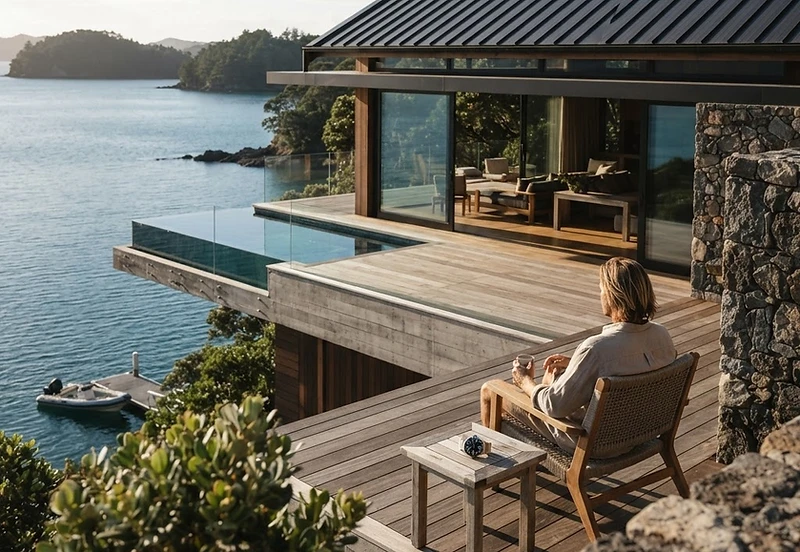
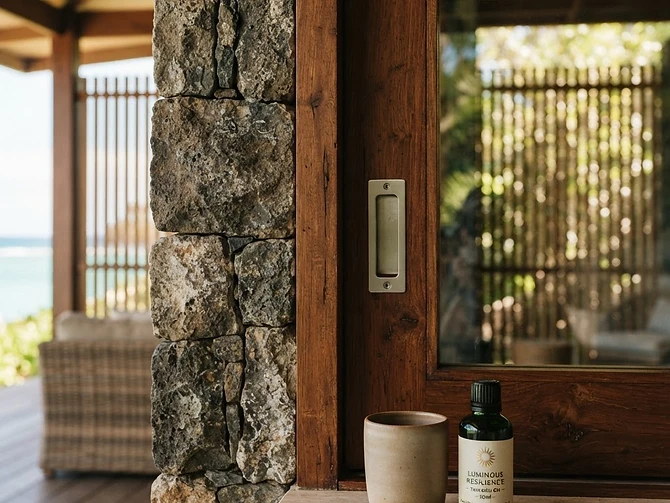
In the expansive silence of the South Pacific, architecture rarely seeks to dominate. Instead, it must negotiate a fragile peace with the unrelenting power of the sun and the salt-laden trade winds. Moored off the leeward side of an unnamed islet in the Tuamotus, our Royal Huisman schooner serves as the essential threshold between the deep, obsidian waters of the Pacific and the architectural vision anchored on the shore. The villa does not sit upon the landscape; it breathes with it. Constructed from a palette of reclaimed ironwood and high-performance, bird-safe glass, the structure serves as a vessel for capturing light, effectively blurring the distinction between the curated interior and the untamed horizon.
The Architecture of Autonomy
The primary mandate of the retreat was one of absolute off-grid efficiency, an ethos mirroring the self-sufficiency required during a long-range passage across the doldrums. Rather than burdening the structure with visible technology, the solar array is integrated into the villa’s extended, cantilevered roofline—a design choice that echoes the sleek, functional lines of a modern sailing yacht. These photovoltaic filaments are calibrated to track the sun’s arc, feeding a discreet subterranean battery array that powers the entire residence. Sustainability here is not an industrial endeavor but an aesthetic one, where the energy required for climate control and desalination is rendered entirely invisible. As I stepped off the tender that morning, the only sounds were the rhythmic percussion of the Pacific swell against the reef and the soft, cooling draft of cross-ventilation moving through the great room.
The beauty of the isolated island lies in the realization that one requires very little to live with total clarity.
A Dialogue with the Meridian
The layout follows a modular, open-plan geometry that prioritizes the shifting shadow patterns of the day, much like the changing light on a teak deck as the sun traverses the mast. Walls are treated as permeable membranes; large pivot doors allow the house to open fully to the trade winds, negating the need for artificial cooling. During a quiet breakfast of fresh papaya and local citrus, watching the mast of our yacht sway against the cerulean backdrop, I noted the raw concrete floors. They act as a thermal sink during the heat of midday, absorbing the fierce intensity of the tropics and slowly releasing a gentle warmth into the living quarters as the stars emerge.
There is a profound quietude in these spaces, born from the knowledge that every utility consumed is a product of the sun above. It is a sensory experience defined by the absence of the mechanical hum typical of modern dwellings. The transition from the yacht—a machine of motion—to this island retreat—a machine of stillness—is seamless. By decoupling the home from the grid, the inhabitants have found a sharper connection to the diurnal cycle, mirroring the way sailors must respect the wind and the tide. It is a reminder that the most luxurious indulgence of the modern age is not total connectivity, but the ability to exist entirely in balance with one’s surroundings.
Ultimately, this Pacific retreat offers more than just environmental stewardship; it offers a return to a more intentional way of occupying space. As we hauled the anchor and prepared for the next leg toward Fakarava, the villa receded into the foliage, a masterclass in integration. We left behind a structure that exists as a mirror to the sea, illuminated and sustained by nothing more than the day’s first light, standing as a silent, sun-drenched sentinel in the vastness of the archipelago.






