
The Convergence of Water and Timber
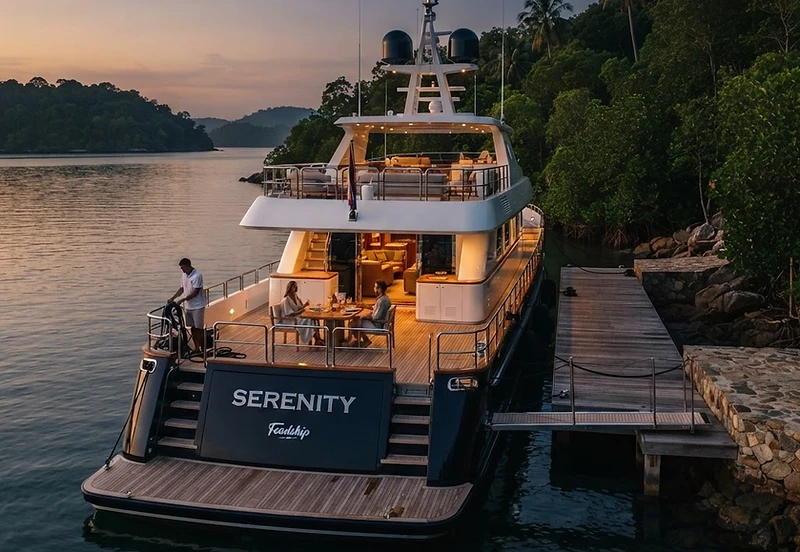
The dawn in the Koh Rong archipelago does not break so much as it dissolves. As the mist lifts from the Gulf of Thailand, the silhouette of a 30-meter Feadship rests in the shallows, her lines mirrored perfectly in the obsidian surface of the bay. Beside her, a structure emerges—not a dock in the conventional, utilitarian sense, but a low-slung, timber-clad pavilion that seems to have grown organically from the mangroves. This is the terminus of a journey, a private quay where the rigid, polished geometry of the yacht’s hull meets the sprawling, untamed architecture of the Cambodian shoreline.
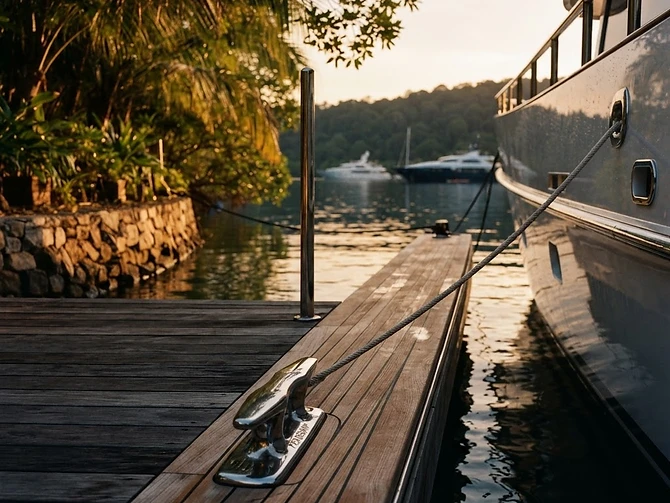
We had made the run up from Sihanoukville under the grey, pre-monsoon sky, the salt spray crusting on the stainless steel stanchions. There is a specific cadence to dropping anchor here; the depth sounder sings a frantic song until the silt of the seafloor offers a firm bite. Yet, this morning, the process was simplified. The yacht slipped into the berth with the precision of a key finding its lock. The pavilion, constructed of reclaimed teak and local stone, was designed by a firm that treats land-based living as a mere extension of life at sea. The proportions of the deck mimic the sweep of an aft cockpit, and the eaves of the pavilion are tuned to the same pitch as the yacht’s sun canopy.
A Life Lived in Transit
Stepping off the passerelle onto the quay, the change is almost imperceptible. The sensation of the deck beneath one’s feet remains consistent; the transitions are seamless, erased by the deliberate alignment of the teak planking. Inside the pavilion, the air is cooled not by glass-enclosed climate control, but by the natural draughts pulled off the water by the strategic orientation of the louvers. We sat with a bowl of fresh sea grapes and a glass of iced jasmine tea, watching the crew handle the lines with the rhythmic, practiced efficiency that defines a well-run vessel. There is no urgency here, only the constant, slow-motion adjustment to the changing light.
The owner of this berth once told me that he didn’t want a house that looked out at his yacht; he wanted a house that functioned like one. Every drawer in the pavilion is latched with a marine-grade brass fitting; the dining table is gimbaled to accommodate the minor swells that occasionally ghost into the bay. It is a strange, beautiful thing to observe—the way a residence can be built to mimic the buoyancy of a ship. We spent the afternoon watching the tide push against the pilings, the water beneath us so clear that we could trace the anchor chain as it stretched out toward the deep, an umbilical cord connecting the stationary pavilion to the open sea.
As evening falls, the ambient noise of the archipelago takes over—the distant, rhythmic thrum of a longtail boat engine and the soft rustle of palms. The pavilion glows with a low, amber warmth, an island of stillness in the vast, darkening water. We boarded the tender for a final run around the headland to Koh Rong Samloem, but the memory that persists is not of the distant islands or the open horizon. It is the image of the yacht resting against the quay, the two structures locked in a quiet, structural embrace, waiting for the tide to turn and the sea to call them both away once more.






