
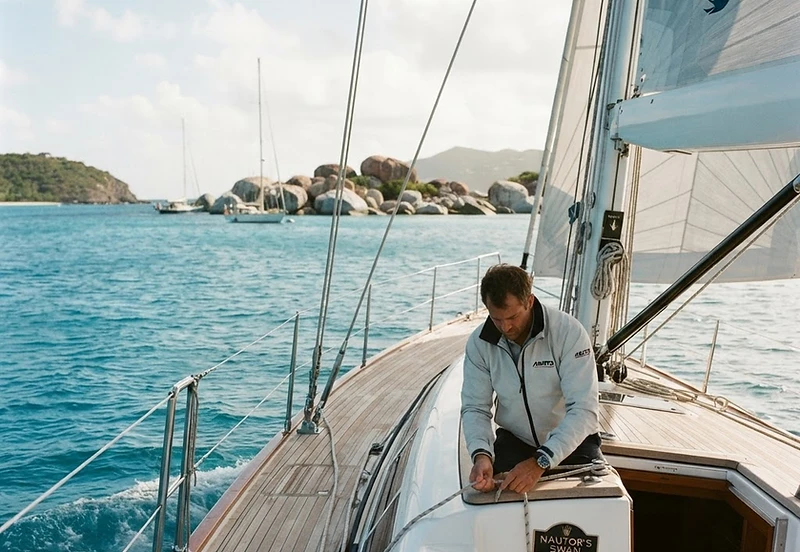
There is a specific cadence to moving through the British Virgin Islands by catamaran that defies the urgency of modern transit. Unlike the singular, aggressive push of a monohull, the twin-hulled architecture of a luxury charter craft—particularly when aboard a performance-minded Lagoon or a sleek Sunreef—offers a spatial stability that feels almost domestic. The deck becomes an extension of the living room, a sprawling, salt-rimmed terrace that moves in concert with the trade winds rather than fighting against them. As we cut a wake through the Sir Francis Drake Channel, the vessel seems to hover above the surface, a testament to the engineering that prioritizes grace over pure, unbridled speed.
The Geometry of the Archipelago
Between the jagged, boulder-strewn profiles of The Baths at Virgin Gorda and the secluded, palm-fringed anchorages of Jost Van Dyke, the act of sailing becomes a practice in light and depth. Because a well-appointed catamaran draws remarkably little water, one is granted an intimate proximity to the reef—a privilege often denied to deeper, performance sailing yachts. One watches the color of the water shift from a deep, pressurized indigo to a translucent, electric turquoise, a transition that signals the narrowing distance between the keel and the coral shelf. Precision matters here. The navigation is less about the arrival at a port and more about the alignment of the hull with the incoming swell, ensuring that the vessel rests at the precise angle where the morning light hits the interior teak paneling. I recall a Tuesday morning off the coast of Cooper Island where the sun seemed to liquify against the varnish, turning the saloon into a prism of soft, golden reflection as we prepared for a short hop toward the wreck of the Rhone.
Tactile Repose at Anchor
To anchor well is to understand that the vessel is not merely a vehicle, but a temporary structure in a shifting environment.
When the sails are finally furled and the boat settles into a cove—perhaps tucked behind the limestone sentinels of Norman Island—the true character of the design emerges. The wide beam allows for a seamless, level transition between the galley and the exterior lounge, blurring the distinction between indoor rigor and outdoor expanse. There is a profound ritual to this hour; the crew handles the lines with practiced, silent competence, and as the anchor bites into the sandy bottom, the sudden cessation of engine noise acts as a reset for the senses. Dinner is served under a soft canvas canopy that filters the waning tropical sun, turning the sky into a bruised palette of violet and gold. A chilled glass of white wine rests on the table, condensation blooming against the glass as the first stars begin to puncture the evening haze. The meal, a simple assembly of fresh snapper and locally sourced lime, tastes distinctly of the sea that surrounds us. In these moments, the silence is not empty; it is punctuated by the rhythmic, percussive lap of water against the hulls and the distant, cooling breath of the trade winds migrating over the ridges.
This is the luxury of the charter: the ability to edit the world until only the essential remains. The map is no longer a set of rigid coordinates or a line to be crossed on a plotter, but a sequence of sensations—the temperature of the water at 6:00 AM, the cooling grit of white sand, the precise tension of a line under strain, and the profound, weighted stillness of a boat at rest in a protected bight. It serves as an essential reminder that when we remove the noise of the mainland, what remains is the simple, honest architecture of the sea and the freedom of the horizon.






