
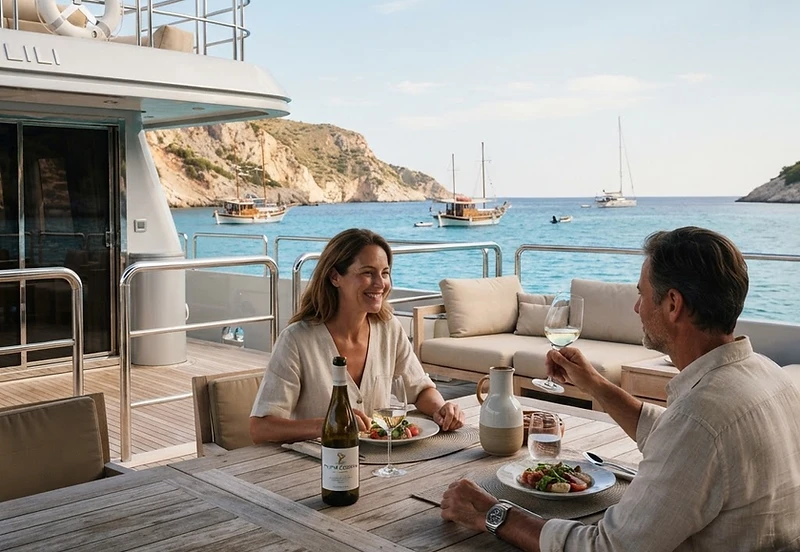
When the anchor chain finally settles into the sandy seabed of the Ionian, the vessel undergoes a profound metamorphosis. It ceases to be a machine of transit and becomes a singular, floating point of reference in a vast, blue expanse. The aft deck, extending gracefully over the cobalt water, serves as the stage for a ritual that defines the very essence of the yachting life: the long, languid lunch. As the yacht pivots gently on its mooring, catching the subtle thermal winds that drift off the Greek islands, the horizon remains a constant, rhythmic oscillation. Here, one is never quite stationary; the sea continues its conversation with the hull, ensuring that even at rest, the journey persists in spirit.
The Spatial Logic of the Aft Deck
To dine on the aft deck is to participate in an exercise of architectural precision. On a vessel like the Custom Line Navetta, the structure—an interplay of brushed teak, polished stainless steel, and expansive, floor-to-ceiling glass—functions less like a boat and more like a floating, curated pavilion. The shade provided by the hardtop overhang creates a deliberate, cooling threshold between the blistering heat of the sun-drenched exterior and the quiet, climate-controlled sanctuary of the salon. In this space, the separation between the vessel's engineering and the natural environment dissolves entirely. The yacht acts as a deliberate extension of the landscape, framing the limestone cliffs of the coastline as if they were the curated walls of a private, water-bound villa. I recall a Tuesday off the coast of Ithaca where the light reflected off the water played against the white overhead panels, turning the entire deck into a soft, glowing lantern as we sat down to a simple lunch of grilled octopus with wild oregano and cold-pressed olive oil, sourced just miles away at a small press in Vathy.
Terroir and the Tide
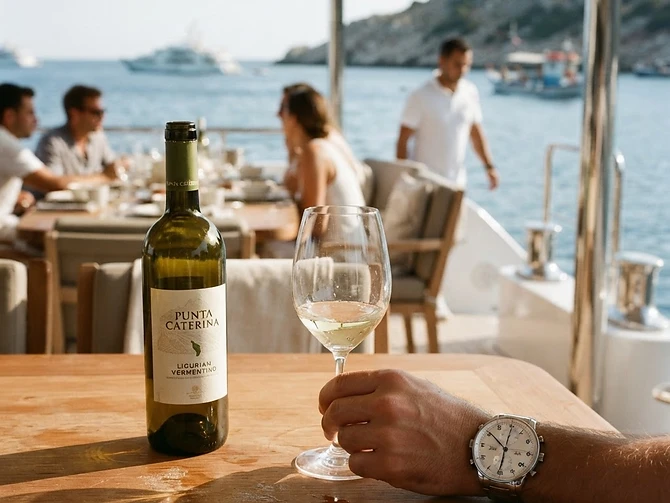
A lunch of this caliber requires a sensory pairing that respects the volatility of the sea. While the chef balances the Mediterranean salinity of the day’s catch, the steward brings forth a selection that mirrors the mineral complexity of the surroundings. Pouring a crisp, flinty Vermentino, the liquid hits the crystal with a precision that defies the subtle, perpetual roll of the hull. This is not merely dining; it is a curation of terroir at zero knots. The wine—with its distinct notes of crushed stone and brine—connects the guest directly to the rugged slopes visible through the polarized lenses of our sunglasses. It is the yachtsman’s unique privilege to trace the lineage of a bottle from the galley table back to the very vineyards that cling to the hillsides overlooking the anchorage. To sit there, feeling the faint, rhythmic pulse of the ocean beneath the teak planks while tasting the literal harvest of the coast, is to understand the true luxury of proximity.
The Chronology of the Afternoon
As the afternoon transitions into the golden hour, the urgency of the modern world fades entirely. Far removed from the rigid, artificial constraints of digital schedules, time aboard is measured only by the movement of the sun and the shifting tide. The day is defined not by notifications, but by the salt on one's skin and the hum of the auxiliary systems. As the light begins to soften, deepening the indigo of the Ionian, the conversation shifts to the navigation plans for the morrow—perhaps a push toward the crystalline bays of Kefalonia or a quiet night tucked into a private cove. The yacht remains a suspended monument to the art of stationary exploration, a place where the deliberate choice to do nothing becomes a highly refined pursuit.
Ultimately, the beauty of the anchored lunch lies in its transient nature. One day, the vessel occupies these precise coordinates, a temporary home carved out of the wilderness; the next, it is a ghost, leaving only a fading ripple in the wake of the departing tender as it disappears toward the horizon.






