
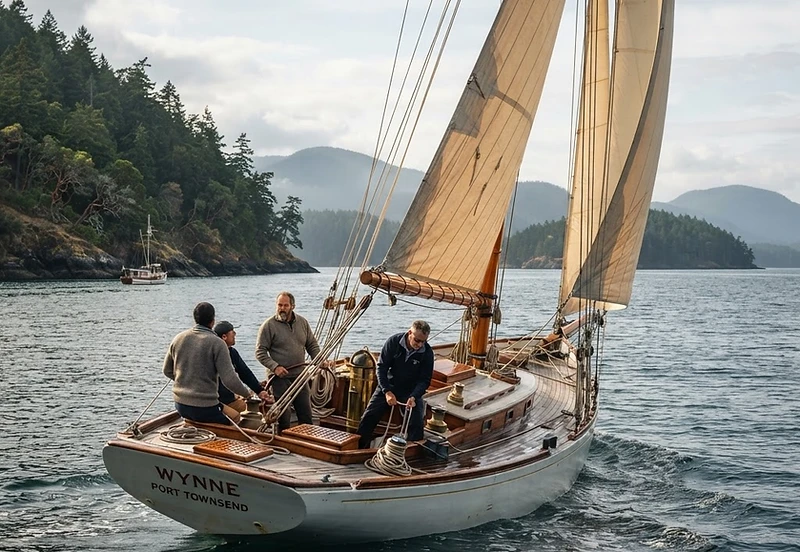
The morning fog in the San Juan Islands possesses a particular weight, a damp, grey curtain that muffles the sharp cries of gulls and turns the surrounding fir-clad islets into mere suggestions of land. I stood on the foredeck of Wynne, a 1912 pilot cutter recently restored by the craftsmen at Haven Boatworks, feeling the vibration of the flood tide beneath the hull. The air smelled of cold salt and damp cedar—a scent that seems to permeate the marrow of anyone who spends time in these northern reaches. As the mist began to fracture, revealing the serrated outline of Spieden Island, the vessel’s heavy gaff-rigged mainsail caught the first real breath of wind, pulling us toward the open expanse of Haro Strait. This is sailing in its most primordial form: no electronic clutter, just the tactile conversation between the tiller and the currents of the Salish Sea.
The Architecture of Tradition
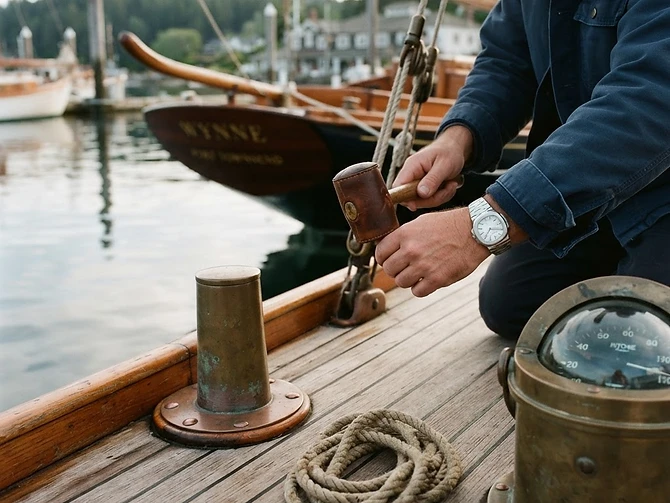
Restoring a vessel of this pedigree is an exercise in structural integrity, much like the preservation of the historic landmarks that dot the Pacific Northwest coastline. Walking through the saloon, one notices the deliberate geometry of the oak ribs, exposed and varnished to a warm, honeyed glow. There is an architectural honesty to Wynne; every dovetail joint and brass fitting serves a structural purpose, echoing the clean lines found in the modernist coastal homes designed by Tom Kundig. To live aboard here is to exist within a kinetic space where the interior layout is governed by the necessity of balance and the rhythmic, sometimes violent, pitch of the hull against a cross-sea. The restoration team at Haven Boatworks understood that to honor a pilot cutter is not merely to refinish the brightwork, but to respect the specific weight of its history. They have replaced rot with seasoned timber and recalibrated the standing rigging, ensuring the vessel handles the unpredictable swells of the Pacific with the same grace it possessed over a century ago.
Midday Calibration at Anchor
By noon, we made for the quiet reach of Westcott Bay. The ritual of dropping anchor requires a different kind of focus than the haste of a modern marina. As the chain rattled through the hawsepipe—a metallic, rhythmic sound that marks the transition from passage-making to stillness—we secured the vessel against the gentle drift of the bay. We broke for lunch, unpacking supplies sourced from the local harvest. We sat on deck, the sun finally burning through the grey, watching the small tenders dart toward the docks of the Westcott Bay Shellfish Company. The simple pleasure of eating fresh oysters on the deck of a century-old boat, with the water lapping against the hull, is a luxury that no modern yacht club can replicate. We watched the rhythm of the tide gently rotate our bow toward the western horizon, the boat finding its own equilibrium in the sheltered cove.
Life aboard a vessel such as this is not a pursuit of convenience, but an engagement with the physics of the sea. As the sun dipped toward the Vancouver Island range, turning the surface of the water into a sheet of hammered copper, we tightened the lines and secured the hatches. There is no urgency in the San Juans when you are traveling at the speed of the current, only the deep, resonant satisfaction of a hull that was built to last, and has, against all odds, been given the chance to do so again. In the hush of the evening, as the anchor light flickers to life, the Wynne feels less like a boat and more like a bridge between eras.






