

The Drake Passage is not a place for fragile things, yet as we pressed south aboard our Nautor's Swan 98, the yacht’s custom-built wine cellar remained an island of absolute order. The ship groaned under the rhythmic heave of the Southern Ocean, the carbon-fiber hull flexing with a satisfying, stiff resilience that only a vessel of this pedigree provides. Beside me, the captain kept his gaze locked on the radar, his eyes scanning the grey horizon for the tell-tale white of growlers. There is a specific, metallic clarity to the air here that makes every sensory input feel sharpened; the scent of salt is replaced by the sterile, ancient perfume of moving ice, a crystalline purity that seems to scrub the lungs with every breath.
The Logistics of the Coldest Cellar
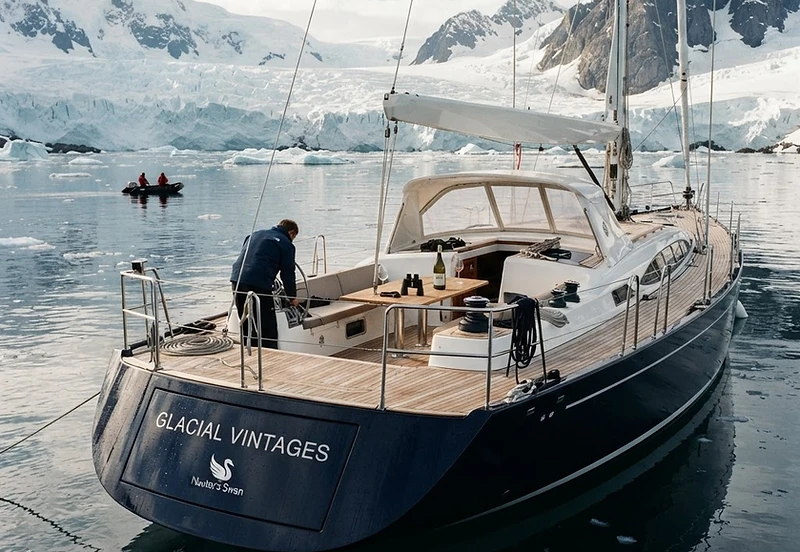
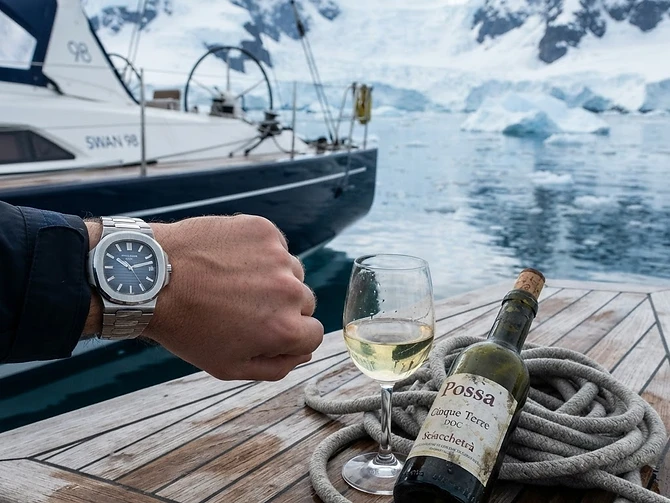
Maintaining a cellar in such extremes requires a level of engineering that borders on the obsessive. We rely on bespoke climate-control systems integrated directly into the yacht’s structural ribs, ensuring the humidity and temperature remain constant despite the violent fluctuations of the Southern Ocean. Our arrival at Neko Harbour was signaled by the low, guttural crack of a calving glacier, a sound like artillery echoing across the bay. Dropping anchor in waters that mirrored the sky with uncanny, ink-black precision, the transition from heavy-weather sailing to the stillness of the anchorage felt like a shift in state. We brought a curated collection of vintages from the remote Ligurian coastal vineyards of Possa, those daring, terraced plots that cling to the near-vertical cliffs of Riomaggiore. It seemed a strange, poetic irony: pouring a Sciacchetrà born from the heat of Italian sun-drenched stone while anchored beneath the towering, blue-veined ice walls of the Antarctic continent.
Rituals of the Southern Anchorage
In the quietude of the evening, we moved to the cockpit. The wind had died, leaving the surface of the water as glass. The stewardess laid out the glasses, her movements deliberate and devoid of the frantic energy common to a Mediterranean port; she moved with the grace of someone who understands that in this latitude, haste is a liability. We poured the nectar-like wine, the amber liquid glowing against the monochromatic backdrop of the Antarctic dusk. The taste was an unexpected collision of histories—the briny, sun-warmed earth of the Mediterranean contrasting against the profound, geological cold surrounding us. There is no urgency in a place that has existed for eons; the yacht, a masterpiece of modern naval architecture, felt like a deliberate, fragile intruder in a landscape that neither knows nor requires humanity.
As the stars began to emerge—sharp, cold, and blindingly bright—the silence of the Antarctic night settled over the teak deck. We were thousands of miles from the vineyards that birthed our drink, yet the connection remained, bridged by the grace of the hull beneath us and the discipline of the voyage. We sat long into the sub-zero night, watching the slow dance of ice floes drifting past our beam, illuminated by the soft, warm ambient glow of the cockpit lighting. To sail this far is to understand that the true luxury of the sea is not merely the destination, but the ability to carry one’s own sanctuary—a library, a cellar, a home—into the furthest, most unforgiving reaches of the map. It is the art of being entirely self-contained while at the edge of the known world.






