

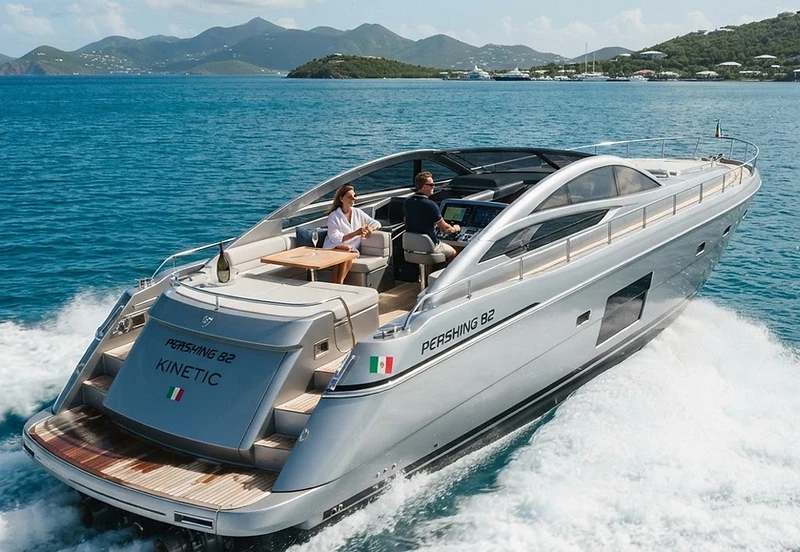
The morning light over the Sir Francis Drake Channel is not the soft, honeyed gold of travel brochure cliché; it is a sharp, blinding white that turns the Caribbean into a vast sheet of hammered silver. Stepping onto the aft deck of the Pershing 82, one is immediately struck by the sensation of latent kinetic energy. Unlike the towering, voluminous displacement yachts that hold their ground with heavy steel and cathedral-like stability, this vessel is a predator of the planing variety. Her twin MTU engines hum with a low-frequency, visceral vibration that settles directly into the soles of one's feet, a rhythmic reminder that the hull is engineered to lift, to rise, and to skim, rather than merely plow through the resistance of the sea.
The Geometry of Speed
As we clear the breakwater at Nanny Cay Marina, the captain nudges the throttles forward with a measured confidence. The transition is both violent and strangely graceful—the bow rises, the stern digs in, and suddenly the hull is no longer floating in the traditional sense but suspended, skipping across the chop at a sustained thirty-five knots. The design, penned by Fulvio De Simoni, is less about maximizing interior volume and more about the aggressive, aerodynamic purity of lines; she is an arrow pointed toward the horizon. The salt spray leaves a fine, crystalline residue on the glass of the cockpit, which we clear with a swift movement, our eyes fixed on the distant, hazy silhouette of Norman Island. At this speed, the world blurs into a horizontal plane; the usual maritime bureaucracy of port calls and slow, rolling swells is replaced by a direct, tactical relationship with the water.
Refinement at High Velocity
Life aboard a planing yacht requires an entirely different set of rituals compared to the slow-cruising trawlers or traditional ketches. There is no sprawling, cavernous formal dining room here, but rather a compact, efficient galley and a saloon that integrates seamlessly with the aft deck, turning the transition from salon to swim platform into a single fluid motion. By noon, we have dropped anchor in the protected lee of The Indians, the water beneath us so startlingly clear that the dark shadow of our hull appears to be hovering over the white sand bottom like an apparition. We retreat to the shaded lounge, where the heat of the passage is tempered by the shade of the bimini and a cold, crisp serving of chilled nectarines and local mahi-mahi ceviche. There is a profound, meditative contrast in finding such absolute stillness in the wake of such intense mechanical exertion; the engines are silenced, leaving only the gentle lap of water against the fiberglass hull.
As the afternoon wanes, we point our bow toward Gustavia. The harbor at St-Barthélemy is a theater of both intense wealth and deep-rooted maritime tradition, but from the low-profile, predatory vantage point of our Pershing, we feel more like observers of the architecture of the port than participants in its congested display. We anchor near the iconic curve of Shell Beach, watching the sun dip behind the headlands as the sky turns a bruised, electric violet. The day has been a study in essential contradictions: the raw, mechanical roar of the engines in the morning, the exhilarating defiance of gravity at speed, and finally, the quiet, controlled temperature of the evening as we prepare to take the tender into town for dinner at Bonito, watching the lights of the harbor shimmer against the dark, restless expanse of the Atlantic.
As the anchor chain rattles out for the final time tonight, the silence of the anchorage feels heavy and earned. The Pershing 82 is not a vessel for those who seek the slow crawl of a trawler; it is a machine for those who understand that in the Leeward Islands, the journey is not merely about reaching a destination, but about the exquisite, fleeting geometry of the boat between the sea and the sky.






