
The Geometry of the Morning Tide
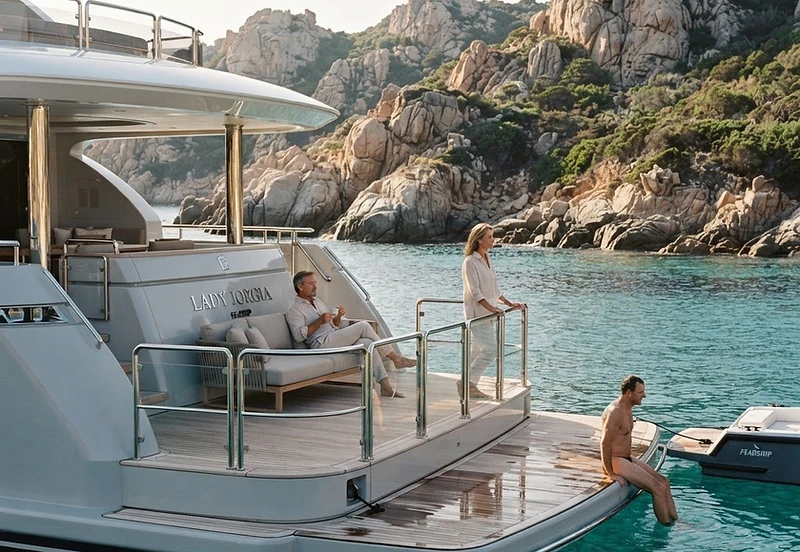
The dawn air off the coast of Porto Cervo possesses a particular clarity, one that strips the granite outcrops of their soft, hazy midday mystery and reduces them to sharp, uncompromising polygons. Sitting on the aft deck of a 60-meter Feadship, I watched the light rake across the water, catching the tumblehome of the hull—a curve so subtle it felt more like a suggestion than a structural necessity. This is the hallmark of a vessel designed not to impose itself upon the sea, but to exist as a continuation of the coastline’s own rugged architecture. The naval architect does not merely draft a buoyant shell; they construct a house afloat, one that must negotiate the same spatial constraints as a clifftop villa in Romazzino while contending with the chaotic, shifting reality of the Tyrrhenian Sea. As the espresso machine hissed in the galley, the steam vanished into the crisp breeze, leaving me to contemplate how these vessels inhabit the water with the permanence of a coastal residence, despite the constant pull of the tides.
Sculpting the Floating Pavilion
To design the exterior profile of a superyacht is to engage in a rigorous exercise of spatial management. Much like the architects of the Mediterranean vernacular—those who understand how to tuck a terrace into the lee of a rocky headland—the naval architect must curate the flow between protected interior volumes and exposed exterior voids. Walking the perimeter of the sundeck, one notices the deliberate placement of glass and stainless steel, positioned not to mirror the horizon, but to frame it. The vessel becomes a kinetic pavilion, its decks shifting in relation to the sun much as a well-designed beach club adjusts its awnings to catch the prevailing breeze. There is no distinction here between the naval engineering of the ballast and the architectural intent of the sightlines; both serve the singular, quiet purpose of comfort at anchor. On this deck, the transition from the salon to the swim platform mirrors the threshold of a hillside home, where the transition from living room to terrace is a matter of blurred boundaries and deep, deliberate shade.
The Weight of the Horizon
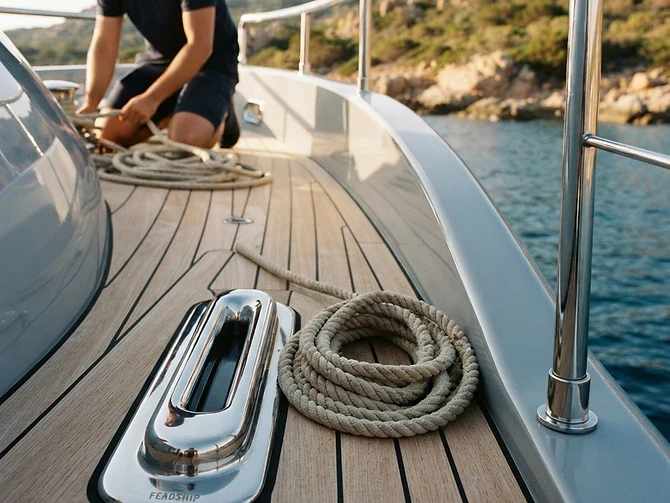
By late afternoon, we weighed anchor to slip toward the sheltered bays near Cala di Volpe, the engine’s low hum a barely perceptible vibration through the teak deck. The yacht moved with a deliberate gravity, a testament to the thousands of hours spent calculating the intersection of waterline and superstructure. It is a strange, profound realization to look back at the wake and understand that the yacht’s silhouette is as much a part of the Sardinian landscape as the jagged granite spires themselves. We anchored just as the sun began to dip behind the headland, casting long, ochre shadows across the water. The yacht settled into the basin, its lights beginning to glow with a warmth that rivaled the golden hour on the shore. In that moment, the distinction between the built environment of the land and the engineered elegance of the vessel dissolved. The smell of wild rosemary drifted from the island slopes, mingling with the salt spray on the glass. There was no longer a separation between the structure I stood upon and the land that had cradled it; there was only the cooling water and the quiet rhythm of the ship’s own breathing, waiting for the evening tide to pull at the anchor chain once more.






