
The Verticality of the Drift
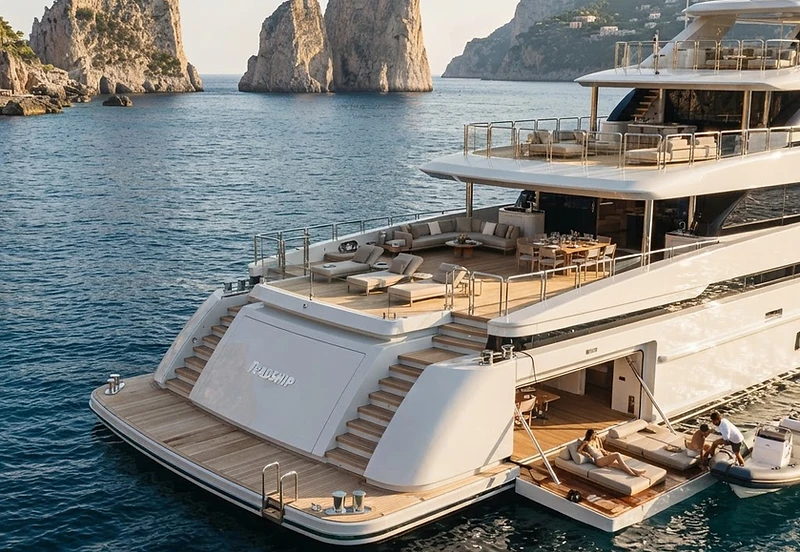
The dawn air off the southern coast of Capri holds a specific, bruised violet hue, a shade that seems to rise directly from the deep Tyrrhenian trench. We were anchored in the lee of the Faraglioni, the silence of the morning broken only by the rhythmic, muted slap of a light swell against the hull of the Feadship. From the main deck aft, the world did not feel like a vehicle, but a residence. The vessel’s stern had been articulated as a series of cascading tiers, each terrace pulling the eye downward toward the waterline, echoing the sheer, jagged architecture of the limestone cliffs that loomed above us.
This arrangement is more than mere deck space; it is a profound reimagining of marine habitation. Where traditional yacht design once corralled guests into monolithic saloons, these terraced platforms create a porous threshold between interior volume and the external environment. Standing on the bridge deck aft, looking down toward the swim platform, the geometry feels distinctly residential. It mirrors the cascading villas of Positano, where stone stairs and bougainvillea-strewn patios bridge the gap between mountain and sea. Here, the weathered teak decking acts as a bridge between the climate-controlled stillness of the interior and the vast, untamed expanse of the Italian coastline.
The Architecture of the Open Air
By mid-morning, as the sun began to sharpen the silhouettes of the islands, we moved fluidly between the levels. The transition from the shaded dining alcove on the main deck to the exposed, sun-drenched sunpads on the upper terrace felt seamless. There is a precise, architectural logic to this flow. By using cantilevered overhangs and recessed, warm-spectrum lighting, the naval architects have softened the transition from the mechanical nature of a ship to the domestic serenity of a house. The sea-level lounge, often dismissed in older vessels as a simple storage or tender bay, has become the anchor of the experience—a private beach club suspended just inches above the crystalline water.
I remember sitting with the captain over an espresso as he pointed toward a villa perched precariously on the cliff-face near Marina Piccola. He remarked that the yacht was essentially a kinetic extension of that Mediterranean vernacular. We were looking at a living space that possessed the fluidity of a vessel but the structural intent of a house. The way the aft decks stepped back created protected, intimate pockets of shade while keeping the wider horizon constantly in view. It is an exercise in restraint; there are no unnecessary flourishes, only the functional elegance of levels that descend like ancient stone steps into the blue.
The Quiet Descent
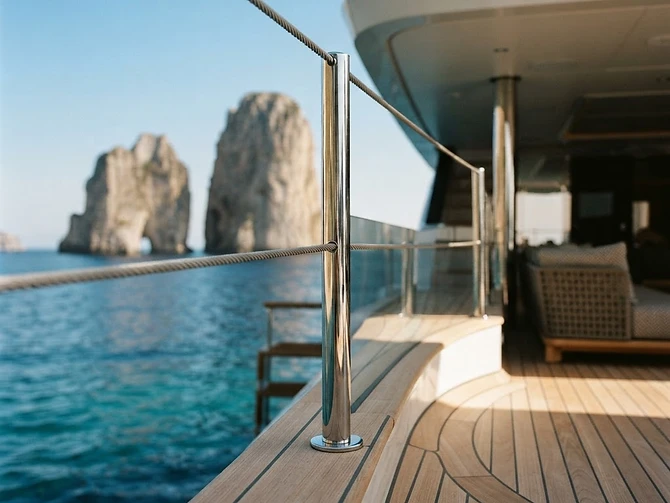
As the afternoon light softened and the gozzi began their rhythmic return to the port, the decks became places of profound stillness. The heat of the Italian sun had soaked into the teak, and the air was thick with the scent of salt and the distant, herbaceous smell of the island’s gardens—a mixture of wild fennel and drying jasmine. There is a particular intimacy in being on the lowest terrace as the light fails, watching the waterline rise and fall against the polished stainless-steel rails. The distinction between the structure of the yacht and the surrounding sea begins to dissolve.
We remained there long after the last tenders had departed for the quay, listening to the water move beneath the transom. In that stillness, the yacht felt less like a machine designed for transit and more like a permanent, foundational element of the Amalfi coast. It was a place of arrival, a home built not of stone or mortar, but of light, air, and the patient, rolling cadence of the Mediterranean tide.






