
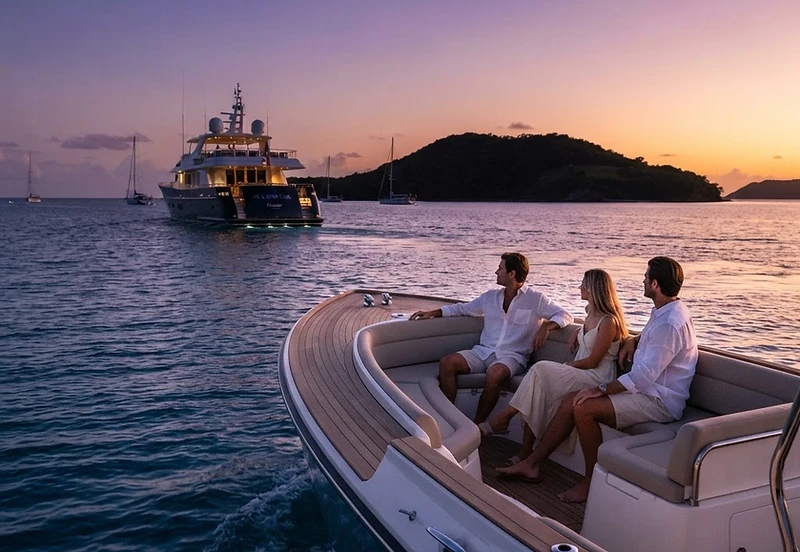
The Feadship rests in the sheltered lee of the Tobago Cays, her white hull rendered a ghostly, luminous blue by the final, bruised purple of the fading Caribbean light. From the aft deck, the water is a glass sheet, interrupted only by the rhythmic, muscular splash of the crew prepping the Hinckley Talaria tender. We descend the passerelle, the sea-salt air already cooling against our skin as the sun dips below the western horizon, marking the formal conclusion of a day spent tracing the shallow, neon-hued contours of the Horseshoe Reef. There is a particular stillness to this hour, a moment when the mechanical pulse of the vessel seems to harmonize with the slow, eternal respiration of the Atlantic.
The Threshold of Salt and Sand
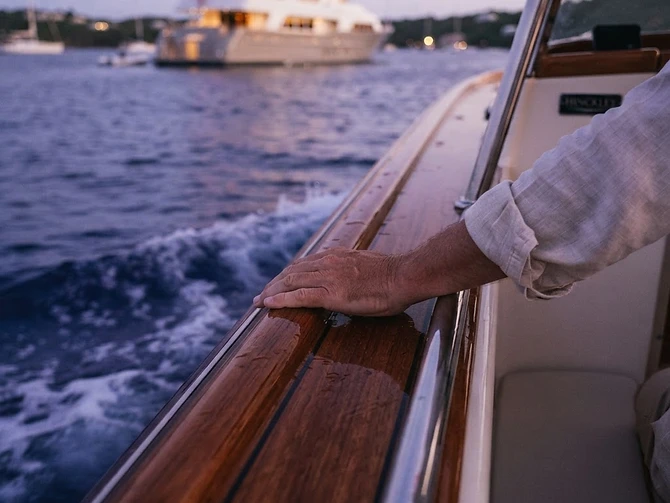
Steering the Hinckley toward the dark, imposing silhouette of Mayreau, the hum of the Hamilton jet drives provides a steady, reassuring vibration beneath my palm. Navigation in these waters requires an intimate, almost tactile understanding of the charts; we weave through the shifting shallows with the precision of a practiced hand. The navigation lights of neighboring yachts bob like low-hanging fireflies, while the dark mass of the island rises to meet us, smelling of damp earth and crushed frangipani. We are not merely moving toward land; we are transitioning from the climate-controlled serenity of our home at sea to the raw, humid, and exhilarating vitality of the Grenadines. As the spray breaks over the bow, one feels the thin, invisible line that separates the sanctuary of the yacht from the untamed reality of the coast.
A Ritual of Earth and Tide
We beach the tender on the fine, powdery sand at Saline Bay, the hull grounding with a soft, familiar crunch that signals the end of the transit. The path upward is steep and worn, leading us toward a small, rough-hewn stone terrace that overlooks the narrow channel. Here, the architecture is elemental—open-air, wood-framed, and deliberately designed to capture the persistent draft of the trade winds. It is a place that demands little and gives much; the table is set simply, and the atmosphere is defined by the absence of the engine’s drone. The host brings out a plate of freshly caught grilled snapper, spiced with the heat of scotch bonnet peppers and tempered by a side of local plantain. The flavor is sharp, bright, and deeply rooted in the geography of these islands. It is a moment of total stillness, the yacht visible from the terrace as a single, illuminated jewel resting in the vast, velvet-black expanse of the Caribbean, waiting patiently for our eventual return.
As the stars begin to pin themselves against the indigo sky with startling clarity, the ritual of the return journey starts to take shape in the mind—the quiet, measured crawl back to the anchorage, the final climb up the boarding ladder, and the inevitable settling of the ship for the night. The sea is a vast, interconnected grid of currents and coordinates, yet tonight, it is defined only by this short, salt-sprayed transit between the refined comfort of our life afloat and the rugged, unpretentious hospitality of the shore. We leave behind the humidity of the island for the conditioned stillness of the master cabin, feeling the weight of the day lift as the anchor chain hums softly beneath us.






