
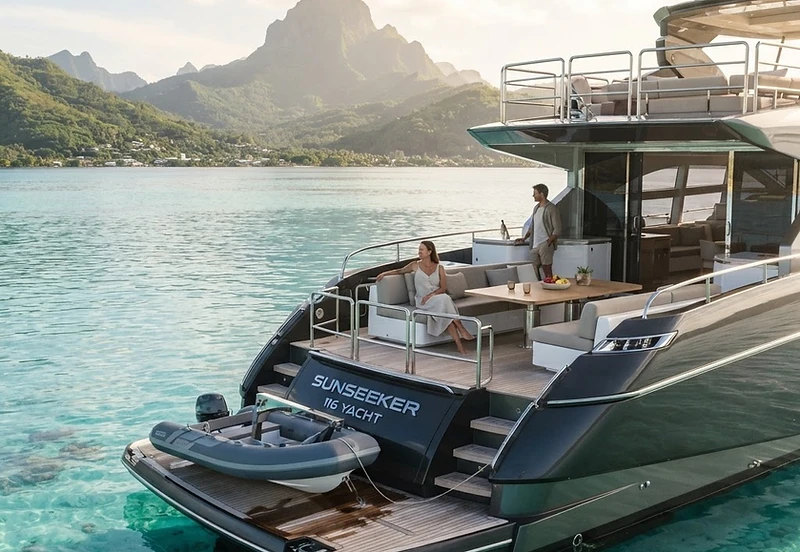
The morning begins not with a bell, but with the rhythmic, hypnotic slap of water against the fiberglass hull of the Sunseeker 116. We are anchored in the deep, protected lee of Raiatea, the sacred cradle of Polynesian culture, where the lagoon water possesses a transparency so profound it renders the depth-sounder redundant. From the flybridge, the horizon is a singular, infinite line of cerulean, interrupted only by the jagged, emerald silhouette of Mount Temehani rising through the dissolving mist. There is a specific quality of stillness here, a heaviness of tropical air and light that forces a deliberate deceleration of the pulse, reminding every soul on board that we are merely guests in a theater of ancient geography.
The Geometry of the Aft Deck
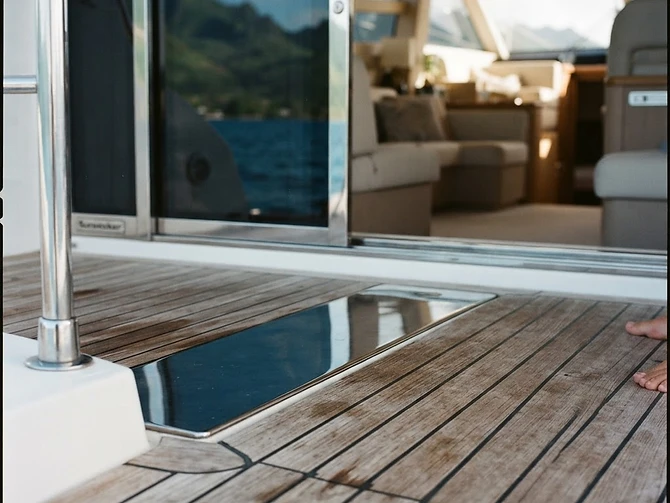
Life aboard a vessel of this scale is an exercise in intentional movement. The aft deck, executed with the signature fluid grace of Sunseeker naval architects, functions as a seamless extension of the sea itself—a floating pavilion that effectively erases the boundary between interior luxury and the untamed expanse of the South Pacific. We sit at the wide teak table, the wood cool and silver-grey beneath our palms, watching local outrigger canoes carve silent paths toward the reef. In this setting, the yacht reveals itself as a piece of kinetic architecture; its sleek, white superstructure mimics the stark geometry of the coastal cliffs, yet it remains tethered to the seabed, a transient, mobile sanctuary in a place that has held its own integrity for millennia.
Calibration Under a Polynesian Sun
As the sun climbs toward its zenith, the day demands a refined sort of attention to detail that only the sea can extract. The heat begins to shimmer off the chrome stanchions, and the conversation shifts from the logistical navigation of the pass to the sensory nuances of the environment. Lunch is served in the shade: a simple, perfect ceviche of mahi-mahi cured in coconut milk and lime, accompanied by chilled crisp vegetables that shatter with every bite. The crew moves with a practiced, near-invisible efficiency, maintaining the deck and tending to the water toys with a quietude that respects the solitude of the anchorage. There is a profound elegance in this restraint; the mechanical hum of the yacht is barely a whisper, leaving the stage clear for the calls of sea birds and the distant, thunderous roar of the swells breaking against the outer reef, a constant reminder of the volatile world held just beyond our tranquil circle.
The Evening Descent
When the light shifts to a bruised gold, the social topography of the bay evolves. The tender is lowered with a quiet hydraulic sigh, ready to shuttle us toward the shoreline near Uturoa, where the heavy, intoxicating aroma of roasting breadfruit and native vanilla drifts across the cooling water. We reflect on the day’s transit—the effortless navigation through the reef, the exploration of the hidden motus, and the quiet satisfaction of being the only vessel in this particular reach of the lagoon. To be here is to inhabit a liminal space, where the vessel serves as both a secure home and an adventurous vantage point, a masterclass in living well at the edge of the map. As the southern stars ignite, the Sunseeker transforms into a lantern, casting a warm, soft glow against the darkening Pacific—a quiet, enduring testament to the art of cruising in the Society Islands.






