
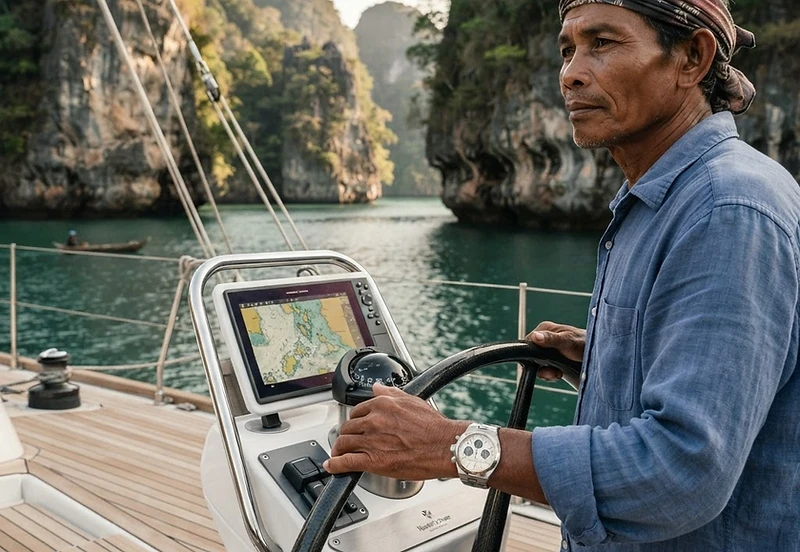
The mist hung low over the Andaman Sea as our Nautor’s Swan 98, Driftwood, slipped through the narrow, treacherous throat of the Mergui Archipelago. Here, where over eight hundred islands emerge like ancient, jagged teeth from the depths, the sea is not merely a path but a shifting architecture of limestone, tide, and memory. On the bridge, the silence was absolute, save for the rhythmic, hollow lap of water against the composite hull. Our captain, a man who views the chart plotter as a mere suggestion rather than a command, adjusted the course by a fraction of a degree, his hand steady on the carbon-fiber wheel. On his wrist, a Vacheron Constantin Overseas Chronograph caught the fragile morning light—a tool of stark, mechanical beauty whose deep-sea blue dial seemed to mirror the ink-dark, mysterious shadows of the Burmese coast.
The Geometry of a Remote Passage
Steering through the Mergui requires more than digital navigation; it demands a visceral, rhythmic understanding of time. The passages between these limestone monoliths are constrained by radical, unpredictable tidal shifts. Arrive too early, and the current churns violently against the hull; arrive too late, and the shallows become a sudden, unforgiving wall. We had departed our anchorage near Lampi Island shortly after dawn, the air thick with the scent of damp jungle, decaying mangroves, and pervasive, cooling salt. As the sun climbed, the watch became our primary instrument for timing the intervals between headlands. Its flyback function allowed us to track the drift with a tactile, mechanical precision that the digital displays simply could not replicate. There is a profound, quiet elegance in relying on a mechanical movement when navigating a region so untamed that GPS signals often flicker into insignificance against the towering, forested cliffs that rise hundreds of feet above the waterline.
A Ritual of Precision and Repose
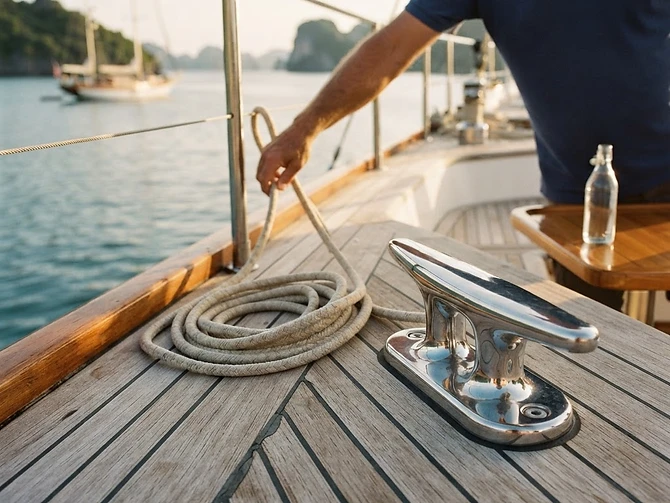
By midday, the depth sounder signaled we had reached the shelter of a hidden, unnamed bay near Thayawthadangyi. As the anchor chain rattled through the hawsehole and the vessel swung into the current, the sudden silence shifted our collective mood from the tension of navigation to the grace of repose. On the aft deck, the crew moved with practiced, soft-footed efficiency, preparing a light lunch of fresh, line-caught snapper seasoned with sharp lime and local chili. We served it alongside a crisp, chilled bottle of Domaine Leflaive Puligny-Montrachet, whose bright, flinty mineral profile served as the perfect, bracing counterpoint to the sweltering heat radiating off the turquoise water. The captain unbuckled his timepiece, setting it on the varnished teak table—a small, gleaming, stainless-steel artifact of human ingenuity resting against the vast, raw, geological scale of the archipelago.
In these waters, where the Moken sea nomads once navigated by the subtle movement of the stars and the color of the silt, the watch acts as a tether. It grounds our modern, high-tech voyage in the ancient, cyclical reality of the tide. We watched as the sun dipped behind the western karst, turning the sky to a bruised, magnificent violet, and the rhythm of the vessel returned to the gentle, hypnotic lull of the rising water. The watch, now back on the wrist, ticked with a steady, reassuring cadence, marking the hours until our passage toward the next reef. It is a quiet contract between the sailor, the sea, and the mechanical pulse, keeping us in sync with a world that refuses to be measured by anything other than the encroaching horizon.






