
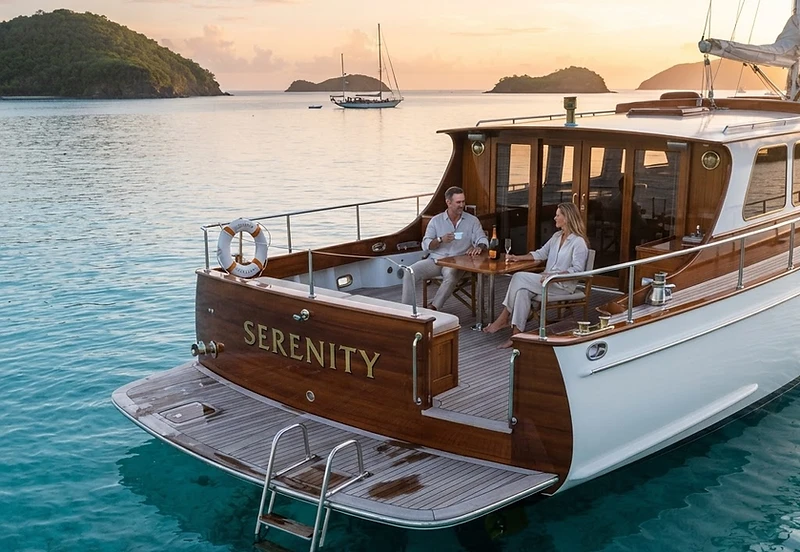
The morning light in the Tobago Cays does not merely brighten; it saturates the horizon in shades of aquamarine and liquid sapphire. Standing on the aft deck of Monara, a 1964 Feadship of legendary pedigree, one feels the hum of the Caribbean waking up. The wood beneath my feet—teak planks that have been restored to a satin finish through months of obsessive, artisanal labor—retains a ghost of the previous evening's warmth. She is a vessel of deliberate, modest proportions, her profile a low, elegant silhouette that feels less like a modern factory-built product and more like a floating extension of the 1960s architectural ethos: clean, functional, and unapologetically honest in her use of fine mahogany and steel. Here, amidst the protected waters of the Grenadines, she sits with a poise that modern, high-volume superyachts often struggle to emulate.
A Study in Mid-Century Buoyancy
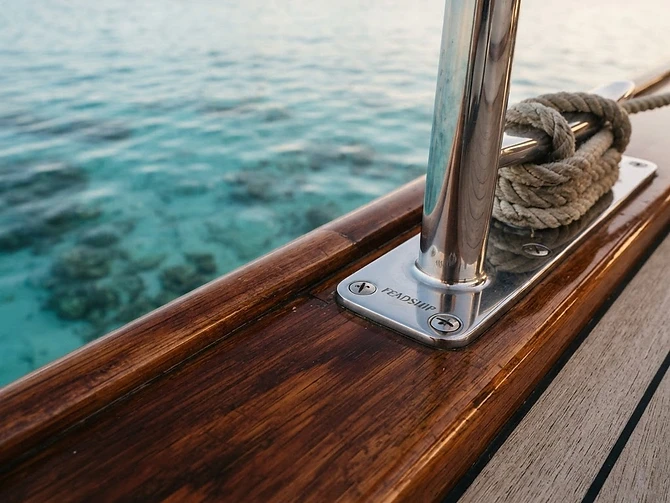
Restoring a vessel of this vintage is an act of architectural preservation as much as it is a feat of marine engineering. Much like the mid-century villas found perched on the dramatic hills of Mustique, Monara relies on open sightlines and a seamless, almost tactile transition between the interior saloon and the aft deck. The current owner, a true devotee of maritime heritage, resisted the siren call of modern interior fads, choosing instead to reupholster the seating in deep, sun-bleached linens that reflect the shifting palette of the surrounding shallows. As I watched the crew meticulously polishing the brass fittings, I was reminded of how much of a yacht’s soul is defined by the quality of its joinery. The binnacle catch, original to the ship and polished to a mirror shine, possesses a physical weight and haptic satisfaction that modern composites and polymers simply cannot replicate. It is a vessel designed for an era when the journey itself was considered the destination, not merely a transit between ports.
The Ritual of the Passage
We weighed anchor shortly after a breakfast of fresh papaya and locally roasted coffee, timing our departure to navigate the crystalline shallows near the Mayreau reef. There is a specific, measured rhythm to life aboard a vintage motor yacht that contrasts sharply with the frenetic, electronic pace of contemporary charter vessels. On Monara, the engine room is not a hidden mechanical closet but a site of constant, quiet devotion; the faint, earthy scent of oil and polished metal is a constant companion—a visceral reminder that we are moving through the water thanks to machinery that demands a symbiotic relationship with its operator. As we cleared the gap in the reef, the captain advanced the throttles with a gentle touch. The yacht did not lunge; she settled, finding a steady, rhythmic gait that felt entirely in harmony with the swell of the Atlantic. We spent the mid-morning hours simply observing the water, the lack of digital interference allowing for a rare, uninterrupted conversation about the challenges of sourcing period-correct hardware for a vessel of this significance.
The Alchemy of the Sea
By midday, the heat became a tangible presence, reflecting off the white-sand seabed to create a shimmering, ethereal glare. We retreated to the shade of the bridge deck, where the breeze created a natural cooling effect that rendered air conditioning unnecessary—a luxury in its own right. The experience of cruising these waters on Monara is an exercise in stripping away the unnecessary. When the islands finally drifted into the hazy distance, the yacht felt less like a machine of transport and more like a sanctuary. It is a profound privilege to exist in a space where every seam, every curve, and every brass bulkhead tells the story of a different decade, yet remains perfectly suited for the requirements of the present day. In the Grenadines, where the horizon is the only true boundary, Monara proves that the finest way to traverse the sea is to do so with a deliberate respect for the lines that came before us.
As the sun began its long descent, casting long, golden shadows across the mahogany rails, we turned back toward the anchorage, the vessel cutting a silent, clean path through the salt-heavy air. There is no urgency in a boat like this; there is only the tide, the wind, and the enduring beauty of a classic design performing exactly as it was intended to half a century ago.






