
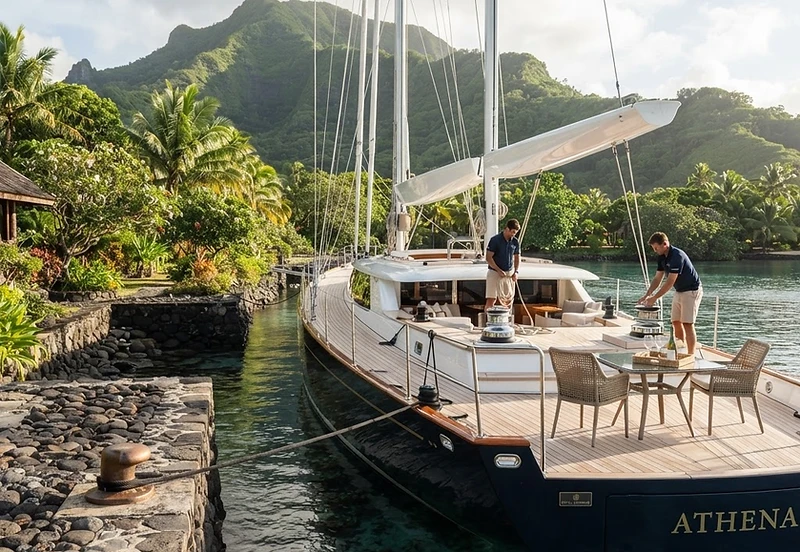
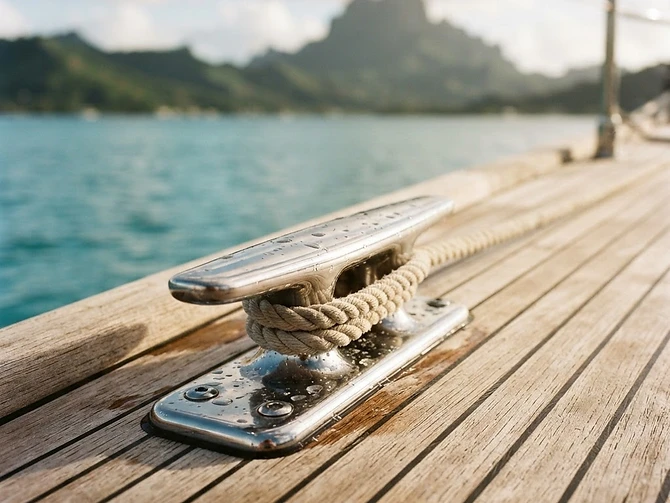
The mooring lines of the Athena, a formidable Royal Huisman ketch, hum with the tension of the incoming tide against the private quay of a secluded residence on Taha’a. This is not merely a berthing point; it is a carefully calibrated threshold where the terrestrial architecture of the Society Islands meets the nomadic precision of deep-sea sailing. The pavilion, designed with the same open-plan fluidity as the yacht’s own main deck, features volcanic stone floors that seem to bleed directly into the turquoise shallows of the lagoon. Sitting on the terrace at dawn, the air carries the heavy, sweet scent of vanilla from the interior plantations, punctuated by the rhythmic, sharp slap of water against the ketch’s white hull, a sound that serves as the heartbeat of this quiet anchorage.
The Geometry of the Approach
Steering into the narrow pass of Rauto’a requires a focus that borders on the meditative. There is a profound synchronization between the navigational data flickering on the bridge and the steady, unhurried pace of the island life outside the glass. Unlike the bustling, engine-heavy energy of the Marina Taina in Tahiti, the anchorage here demands a quiet respect for the coral heads and the shifting, unpredictable depth of the reef. The pavilion serves as an extension of this navigation; its cantilevered roof offers a vantage point not unlike a flybridge, allowing one to track the silhouette of the mast against the jagged, verdant profile of Mount Ohiri. One feels the transition from the chaotic currents of the open Pacific to the sheltered stillness of the lagoon, a moment of profound relief that can only be understood by those who have spent days contending with the swell.
Living at the Interface
Life aboard the Athena is defined by the discipline of the sea, yet the pavilion offers a rare, tethered repose. By mid-morning, the deck crew is busy with the brightwork, their movements fluid and rehearsed, while from the shade of the pavilion’s volcanic stone terrace, one can observe the intricate dance of the lagoon’s ecosystem. It is here that the boundary between the vessel and the estate vanishes. A small, cold dish of poisson cru—freshly caught mahi-mahi cured in citrus and coconut milk, sourced from the morning market in Uturoa—is served on the terrace. The flavor is sharp, clean, and perfectly suited to the salt-heavy air. The conversation among the crew and guests is rarely about the technical specifications of the rig; instead, it settles into the rhythm of the water, discussing the way the light catches the varnished caprails as the ketch swings gently on her anchor. The architecture here does not compete with the vessel; it cradles it, providing a stable, stone-clad sanctuary for the traveler who understands that luxury is found in the ability to move freely between the infinite and the fixed.
As the afternoon light begins to soften, turning the lagoon into a sheet of hammered copper, the transition from the yacht to the shore is a matter of only a few steps. It is a rare privilege to wake up in a house that feels like a ship, and to board a ship that feels like a home. As the sun dips behind the jagged horizon of the reef, the boundary between the two is entirely erased. The lines are set, the final check of the mooring is complete, and the lagoon settles into its nightly, crystalline stillness, the architecture of the shore and the engineering of the mast finally united in the quiet, dark expanse of French Polynesia.






