

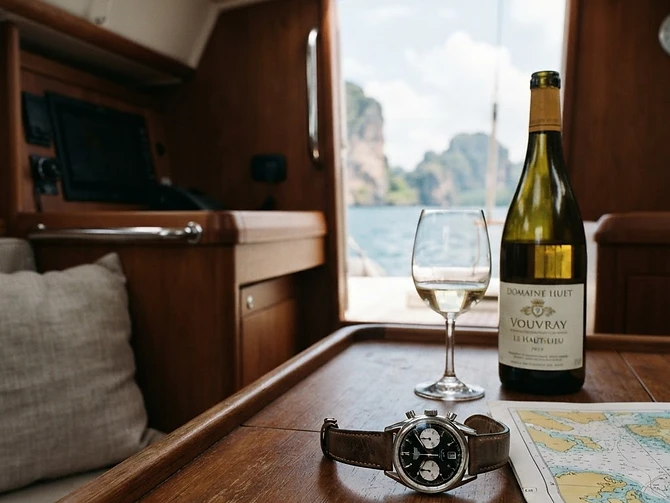
The mist clung to the limestone towers of Phang Nga Bay like a damp shroud, only beginning to lift as the morning sun ignited the emerald water. Aboard the Nautor's Swan 78, the stillness was absolute, save for the rhythmic lap of the Andaman Sea against the teak decking. In the cockpit, the air held the faint, sweet scent of crushed jasmine drifting from the shore, mingling with the sharp, clean salt of the incoming tide. Before me, resting on the cockpit table, lay two documents of record: the vessel's heavy, leather-bound logbook and a 1968 Heuer Carrera, its silver dial capturing the pale, early light.
The Geometry of the Andaman Tides
The logbook, meticulously inscribed by the captain during our transit from Phuket Boat Lagoon, was a map of intention. It detailed every turn, the specific depth of each anchorage beneath the limestone spires, and the precise moment of slack water. Looking at the entries, I was struck by how much a vessel is a piece of architecture in flux; it creates a transient domesticity wherever it drops anchor. Much like the structure of a grand villa on the cliffs of a wine estate, a yacht relies on the integrity of its foundation—here, the keel and the anchor chain—to ground the life lived within its boundaries. We spent the previous evening anchored near the shadow of Koh Panyee, sharing a bottle of Domaine Huet Le Mont Vouvray, its crisp acidity cutting through the heat of a local curry, the wine itself a tether to a different geography, kept in the galley's temperature-controlled cellar until the perfect hour of dusk.
Synchronization at Sea
I adjusted the chronograph's crown. The Heuer, with its Valjoux 72 movement, felt remarkably dense against my wrist—a weight of history. Its provenance was traced back to a collector who had once used it to time races in the Mediterranean, a far cry from the humid, slow-moving currents of the Thai coast. Yet, the mechanical necessity remains the same. Whether timing the arrival of a tender or the exact window for traversing a narrow channel between the karst islands, the watch demanded a tactile engagement with time. It is a dialogue between the observer and the passing minute. Unlike the logbook, which serves as a static memory, the watch provides the pulse of the present. As I watched the second hand sweep across the dial, I thought of the sailors who came before us, navigating these same intricate channels before the aid of GPS, relying solely on the stars, the sextant, and the unfailing sweep of a mechanical heart.
As the anchor chain groaned, signaling our departure for the open water toward the Surin Islands, the dual nature of our transit became clear. We were moving through space with the precision of a watch, while documenting our existence with the permanence of the log. The bay began to widen, the limestone giants retreating into the haze, leaving us with nothing but the rhythm of the swell and the steady, ticking cadence of a morning well spent.






