
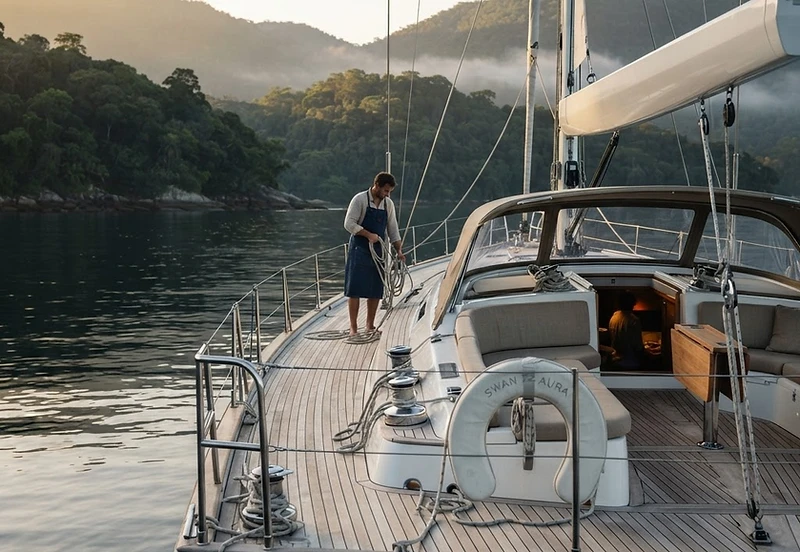
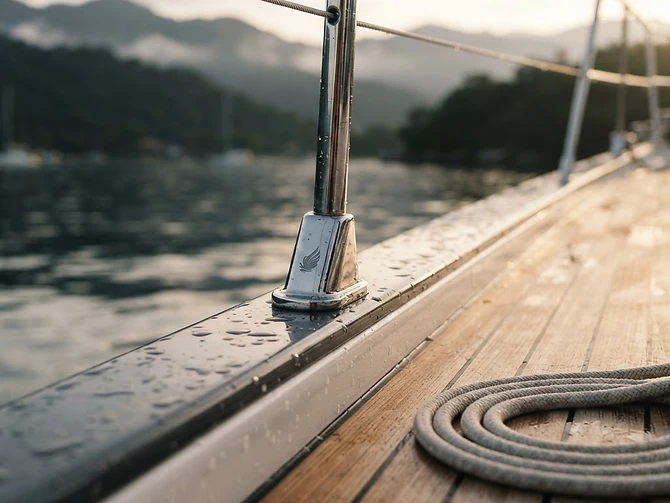
There is a specific density to the air in Ilha Grande Bay at first light. It is heavy with the scent of damp Atlantic forest—wet bromeliads and warm, dark earth—drifting from the steep, emerald hills that spill directly into the sea. Aboard this 78-foot Nautor’s Swan, anchored in the protected glass of the Enseada de Saco do Céu, the morning begins with a ritual as disciplined as a sextant reading. The deck, polished teak that holds the humidity of the night, is still cool underfoot, and the water is so flawlessly reflective that the line between the hull and the sea seems to dissolve entirely. Here, in this hidden pocket of the Costa Verde, the world feels held in a state of suspended animation, a luxury afforded only to those who seek the quietest reaches of the Brazilian archipelago.
The Geometry of the Slow Pour
I find the coffee waiting on the foredeck, a dark, rich roast from the Sul de Minas region, poured into a heavy ceramic cup. There is a profound architecture to a moment like this—a balance of elements. As the steam curls into the still air, the silence is punctuated only by the faint, rhythmic pulse of the yacht’s systems cooling after the evening run. To sit here is to appreciate a different kind of engineering: one designed to hold the drift of time steady against the immense, shifting stillness of the Brazilian coast. The Nautor’s Swan is not merely a vessel for passage, but a house afloat, and in the Saco do Céu—literally the 'Bay of the Sky'—the sky and sea collapse into a singular, mirrored plane. It is a place where one does not simply dock; one arrives.
Reflections on the Mangrove Edge
By seven, the sun has cleared the ridge of Ilha Grande, casting long, fractured shadows across the stern. From here, we can see the reflection of the surrounding mangroves on the dark water, which takes on the characteristic tea-colored hue of this bay. It is a striking contrast to the crisp, white composite lines of the Swan, a testament to Finnish precision navigating tropical waters. This anchorage, sheltered from the open ocean, feels like a private sanctuary. The only interruption is a local saveiro, its wooden hull painted in fading blues and ochres, motor humming quietly as it heads toward the village of Abraão to deliver the day's catch. We watch it pass, a slow-moving reminder that the life of the bay has already begun, even as we remain suspended in our own quiet meridian.
Navigating the Verdant Silence
As the mid-morning thermals begin to stir, the water loses its glass-like perfection, rippling into a thousand fractured diamonds. We discuss the passage ahead—threading the needle through the islands toward the calmer stretches of Paraty. There is a palpable joy in the transition from the anchor watch to the active helm, the transition from being a guest of the bay to becoming a traveler of the sea. The sheer scale of Ilha Grande, with its history of seclusion and its modern reputation for some of the finest cruising in South America, offers a rare clarity of mind. One learns to read the tide by the way the mangroves sway and to judge the weather by the scent of the coming rain on the wind. It is an education in patience, a masterclass in the art of the slow cruise where the destination is perpetually subservient to the journey itself.
As the light shifts, bleaching the mist from the water’s surface, we prepare to weigh anchor. The solitude of Saco do Céu is a fleeting commodity, a delicate suspension that the day’s trade winds will eventually dismantle. For now, however, there is only the lingering warmth of the ceramic against my palm and the long, slow curve of the shoreline disappearing into the morning haze as we turn the bow toward the open Atlantic.






