
The Archaeology of the Wrist
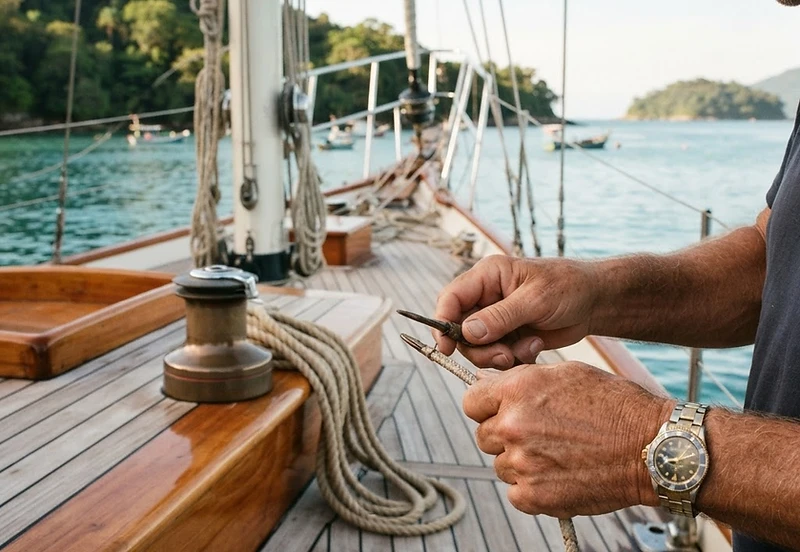
The dawn air in Angra dos Reis does not merely suggest the day; it arrives with the heavy, saturated weight of the Atlantic rainforest collapsing into the salt-crusted docks. Standing on the teak-laid aft deck of a Royal Huisman ketch as she tugs gently at her moorings, one is acutely aware of the transition between land and sea. Beside me, the owner of the vessel—a man who has spent more years navigating by the stars than by modern plotter—unbuckles his watch. It is a vintage dive watch, a tool that has long since ceased to be an accessory. Its bezel, once a sharp, commercial black, has surrendered to the relentless chemistry of the southern latitudes, softening into a ghostly, desaturated grey. The luminous indices have mellowed from their original, clinical brilliance into the deep, toasted hue of aged parchment. This is not damage; it is a biography written in salt and ultraviolet, a tactile record of every haul-up and every heavy-weather night-watch served in the lee of a headland.
Tactical Rhythms in the Ilha Grande Shallows
Life in the Costa Verde demands a peculiar, rhythmic discipline. To navigate the narrow, silt-heavy channels that thread between the mainland and the steep, jungle-clad slopes of Ilha Grande requires an intimacy with both depth and duration. As we slip the lines and move toward the quiet, protected waters of Saco do Céu, the hum of the engine is the only clock we need. Yet, the watch remains a constant, mechanical anchor. Its case is scored by the abrasive friction of anchor chain links and the occasional accidental strike against a stainless steel gunwale during a hurried sail change. When we head ashore in the tender to reach a small waterfront establishment for a lunch of camarão ao alho e óleo, the watch sits unobtrusively on the wrist, unburdened by the digital alerts that plague life back on land. It functions with a profound, mechanical honesty, measuring the progress of the tide and the duration of our shore leave with the same steady, unwavering pulse that it has maintained for decades.
The Ballast of Memory
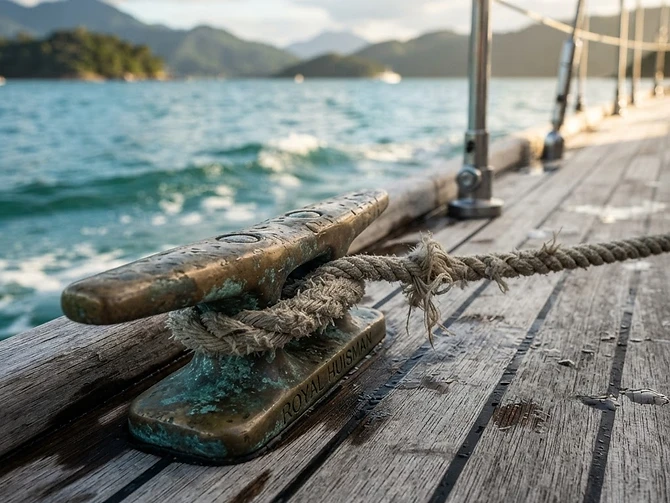
As evening descends, bruising the sky into a deep, bruised violet over the serrated peaks of the mainland, the yacht settles into her nightly swing. The ritual of the timepiece is inextricably mirrored by the evolution of the ship herself. Just as the watch has developed its unique patina—a chemical autobiography of pressure, humidity, and equatorial sun—so too has the teak deck weathered to a silvered, resilient grey, and the standing rigging seasoned under the persistent load of the trade winds. We find ourselves in the cockpit, cradling glasses of chilled local white, listening to the rigging hum a low, harmonic tension against the evening breeze. The watch is no longer merely an instrument for timing a regatta or logging a passage; it has become a form of ballast. It possesses a weight that goes beyond grams, a physical manifestation of the hours spent suspended between the shifting horizon and the solid teak beneath our feet. As the last of the light fades into the dark waters of the bay, the watch ticks on in the shadow—a quiet, constant testament to the slow, steady erosion of a life well-lived in the service of the sea.






