
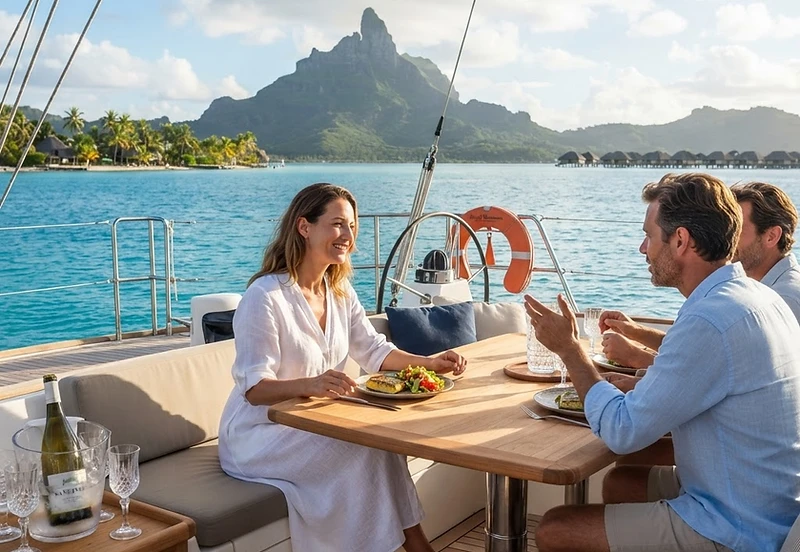
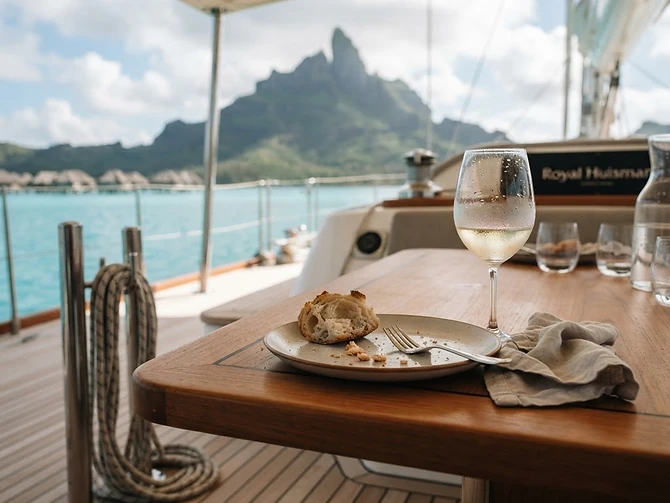
There is a specific, profound stillness that descends upon a Royal Huisman ketch the moment the anchor chain bites deep into the pristine sandy floor of the Bora Bora lagoon. The water here is not merely blue; it is a layered, living gradient of cerulean, cyan, and liquid turquoise—a visual depth that shifts with the passing of every drifting cloud over the jagged, verdant silhouette of Mount Otemanu. We had dropped the hook near Motu Piti Aau, the vessel swinging with a stately grace on a light trade wind that carried the faint, saline scent of crushed coral and open ocean. On the aft deck, the teak planks, bleached bone-white by the relentless Pacific sun, radiated a steady, grounding warmth underfoot, offering a tactile reminder of the miles already covered beneath the hull.
The Architecture of the Aft Deck
Life aboard a vessel of this pedigree is defined by the seamless transition between the interior volumes and the expansive deck space, a hallmark of Royal Huisman engineering. The design allows for an open-plan layout that mirrors the fluid, airy architecture of the finest beachfront estates in the Society Islands, yet here, the walls are the horizon itself. We moved from the shaded cockpit to the teak table, where the delicate clatter of porcelain and the soft, rhythmic lap of water against the fiberglass and steel hull provided a hypnotic cadence. The midday heat in French Polynesia is a physical weight, a tangible presence that demands respect, but under the expansive shade of the bimini, the air remained crisp, a localized micro-climate of refined ease and absolute detachment from the world beyond the reef.
A Study in Timing and Equilibrium
Lunch arrived with a deliberate simplicity that belied the immense complexity of the logistics required to source such bounty in the middle of the South Pacific. A fresh-caught mahi-mahi ceviche, marinated in the bright, acidic bite of local limes and smoothed by rich, house-pressed coconut milk, was served with a side of micro-greens gathered from the fertile soils of Raiatea. The steward moved with the silent efficiency of a shadow, his presence felt only in the refilling of glasses and the discreet removal of plates. As we sat, the conversation drifted away from the frantic pace of professional life and toward the more pressing matters of the afternoon: the clarity of the water near the outer reef, the shifting intensity of the afternoon light, and the gentle, rolling swell that beckoned us toward the Tuamotu Archipelago.
In the vast, open expanse of the Society Islands, there is no greater luxury than the ability to pause, to let the yacht find its own equilibrium, and to allow the lunch hour to expand to fill the entire day.
As the afternoon wore on, the anchorage grew even more sequestered. The St. Regis Bora Bora resort appeared as a distant, almost fragile cluster of thatched roofs on the far shore, a silhouette against the volcanic peaks that seemed to belong to a different civilization entirely. From our vantage point on the water, those structures were merely scenery, aesthetic markers in a landscape that we were currently dominating. We were not merely observers of the landscape; we were residents of the water, anchored in a transient paradise that shifted its hue with every degree of the sun’s descent. The lunch concluded with the simple, quiet ritual of finishing the last of the chilled water, the ice cubes clinking softly against the crystal—a sound that, in the immense silence of the lagoon, felt like a bell marking the passage of a truly singular day.
The thrill of such an anchorage is found not in the arrival, but in the decision to stay. As the shadows of Mount Otemanu lengthened across the lagoon, turning the turquoise to a deep, brooding indigo, the yacht felt less like a machine and more like an extension of the sea itself. It is a rare privilege to be held in such perfect stasis, suspended between the volcanic heart of the islands and the infinite, untroubled reach of the Pacific horizon.






