
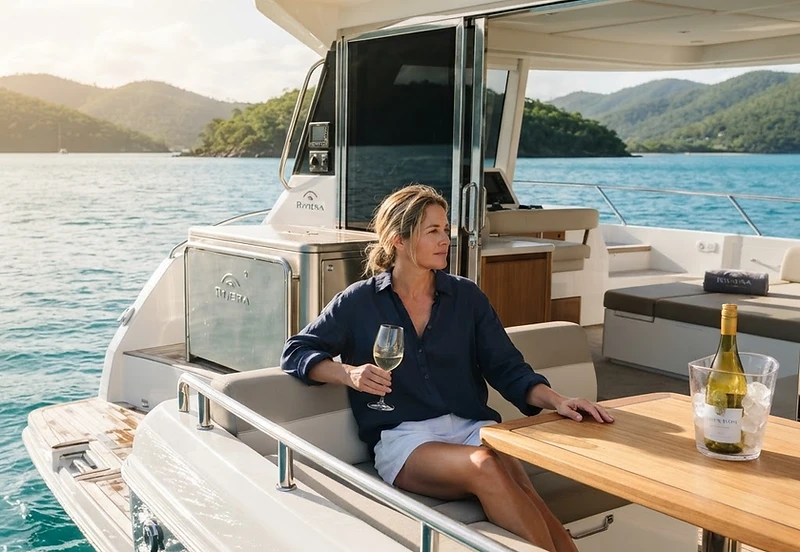
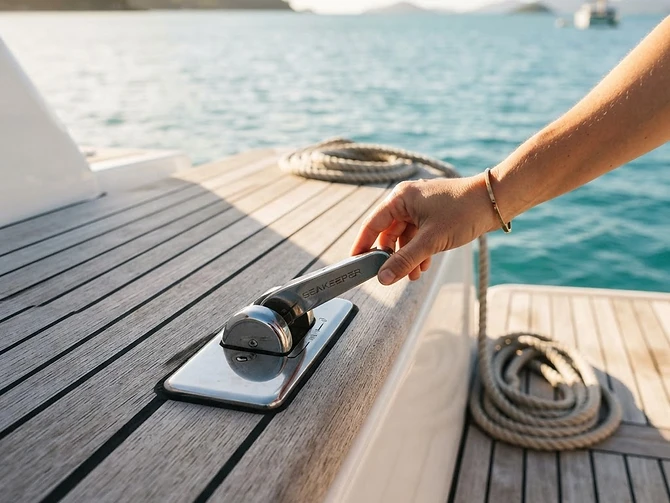
The morning at Blue Pearl Bay begins with the deliberate, low-frequency hum of a Seakeeper gyroscope settling into its rhythm beneath the deck. Anchored off the northern tip of Hayman Island, the Riviera 6000 Sport Yacht behaves less like a vessel and more like a floating pavilion, its architecture defined by a seamless flow between the shaded aft deck and the expansive, sun-drenched saloon. As the sun clears the ridgeline of the Whitsunday Islands, the water shifts from a deep, bruised indigo to an impossibly clear turquoise, a clarity that renders the hull of the yacht a bright, detached shadow against the sand. The air is thick with the scent of salt and the faint, sweet perfume of drying sea-grass, a sensory reminder that we are guests in a landscape that predates our arrival by eons.
The Architecture of the Anchorage
There is a specific, quiet industry to the morning ritual on a yacht of this displacement. The crew moves with a soft-footed efficiency, deploying the tender for a quick run toward the fringe reefs while the air remains cool. We linger in the cockpit, where the design intent of the yacht—focused on transparency and horizontal sightlines—allows the boundary between the teak decking and the Coral Sea to vanish. It is an exercise in architecture afloat; the oversized glass doors pull away, and suddenly the interior, with its walnut joinery and minimalist galley, feels like an extension of the bay itself. I watch the deckhand check the anchor chain, the metal singing against the hawsepipe—a sharp, mechanical note that anchors the soul back to the vessel's purpose. Even at rest, the 6000 Sport Yacht possesses a predatory elegance, its profile honed for open-water passages yet perfectly suited to the sheltered, labyrinthine coves of the Whitsundays.
Hydraulic Rhythms and the Reef
By midday, the heat forces a transition to the upper deck, where the retractable sunroof is left open to catch the southeasterly trades. Here, the world is measured not by hours, but by the subtle, hydraulic shift of the yacht as it pivots on its chain. I find myself observing the way the light catches the wake of a passing school of trevally, a flurry of silver motion against the darkening blue. Lunch is served in the shade—a platter of locally sourced tiger prawns, translucent and sweet, accompanied by a simple lime and chili dressing that cuts through the tropical humidity. There is a profound luxury in this isolation, a feeling that the rest of the world has been left behind the jagged peaks of the mainland. We watch the tender return, its bow cutting a crisp white wake through the glassy surface, the sound of the outboard muffled by the gentle, persistent lap of water against the swim platform. Every movement aboard feels amplified, from the clinking of porcelain to the rhythmic sigh of the ventilation, turning the act of existing into a deliberate, meditative practice.
The Transition of Light
As the afternoon light deepens, the yacht seems to settle further into the landscape, a static point of order amidst the shifting currents of the Great Barrier Reef. The sky begins its transformation, bleeding from a bleached cerulean into bruised gold and eventually a soft, lilac-tinted stillness that cloaks the bay. It is in these hours that the connection to the sea becomes most intimate; the water, cooled by the approaching dusk, seems to breathe against the hull. We remain at anchor, content to let the evening unfold without the need for navigation, finding solace in the fact that, for now, the map is irrelevant. The evening approach is not one of urgency but of alignment, a quiet reconciliation with the geography of the islands as the sun dips behind the western headlands, leaving us suspended in the cool, darkening embrace of the Pacific.
Ultimately, to inhabit the Riviera in a place as untamed as Blue Pearl Bay is to understand that the vessel is not just a mode of transport, but a lens through which to view the world. As the last light fades from the masthead, the rhythm of the ocean takes over, and the yacht, with all its power and poise, becomes nothing more than a quiet witness to the enduring, rhythmic dance of the tides.






