
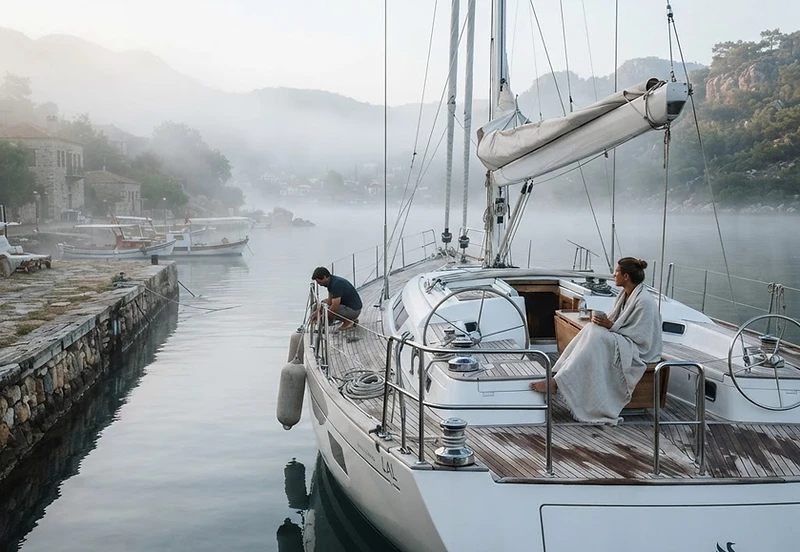
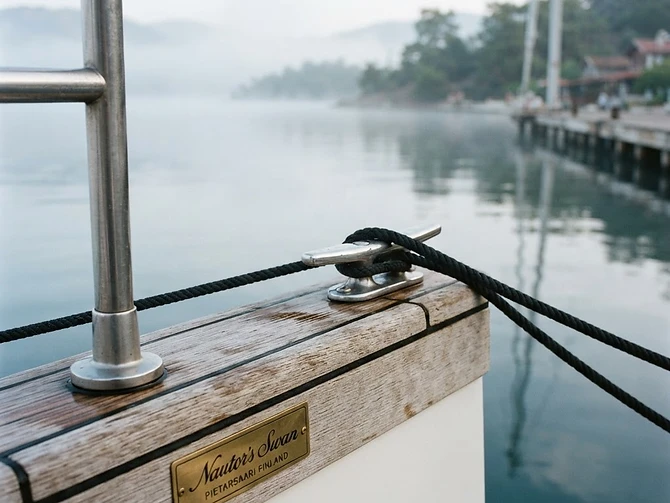
The morning in Okluk Bay does not announce itself with the clamor of a city port; it arrives in the soft, rhythmic slapping of water against the hull of our Nautor’s Swan. Here, at the eastern edge of the Gulf of Gökova, the coastline is a serrated boundary of pine-clad rock that tumbles directly into deep, crystalline cobalt. There is no sprawling concrete marina to speak of, only the intimate, ancient wooden quay that stretches toward the residence once occupied by Sadun Boro, the grandfather of Turkish blue-water sailing. To moor here is to surrender the autonomy of the open sea for the sudden, grounding stillness of a mountain-shadowed harbor.
The Architecture of the Mooring
Stepping off the passerelle, the transition is tactile. The rough, sun-bleached timber of the dock contrasts sharply with the teak decks of the yacht, a bridge between two modes of shelter. The Swan, with her Frers-designed lines, sits low in the water, her profile echoing the lean, sharp angles of the surrounding crags. One does not simply park here; one integrates. We spent the early hours adjusting the stern lines against the slight, variable pull of the thermal breeze, a ritual that demands the kind of focus usually reserved for a delicate mechanical movement. It is here that I found myself checking the time, my IWC Portugieser acting as a silent, reliable partner in the task. Its clean, oversized dial—inspired by the precision of 1930s marine chronometers—felt perfectly at home against the backdrop of a vessel built for the long passage.
Rituals of the Inlet
As the sun began to climb over the limestone peaks, the scent of wild thyme drifted down from the hills, mingling with the aroma of strong, dark Turkish coffee being prepared in the galley. We opted for a simple breakfast of local honeycomb and fresh, crusty bread sourced from a fisherman who pulls his boat alongside the quay every dawn. There is a profound luxury in this simplicity—the absence of the chaotic maritime traffic found in the Aegean’s more commercial hubs. Later, we shared a chilled bottle of Kavaklıdere Prestige, a crisp Narince that captured the mineral quality of the Turkish soil, as we watched a nearby gulet slowly unfurl its sails, preparing for a day of scouting the hidden coves of Sedir Island.
The afternoon heat settles into the water like a heavy silk blanket. We slipped into the sea directly from the swim platform, the water so clear that the shadow of the yacht traced a perfect silhouette on the sandy bottom, ten meters below. In these hours, the distinction between the life aboard and the life ashore vanishes. You are not a visitor in the Gulf; you are a component of its geography, a living feature of the harbor’s quiet architecture.






