
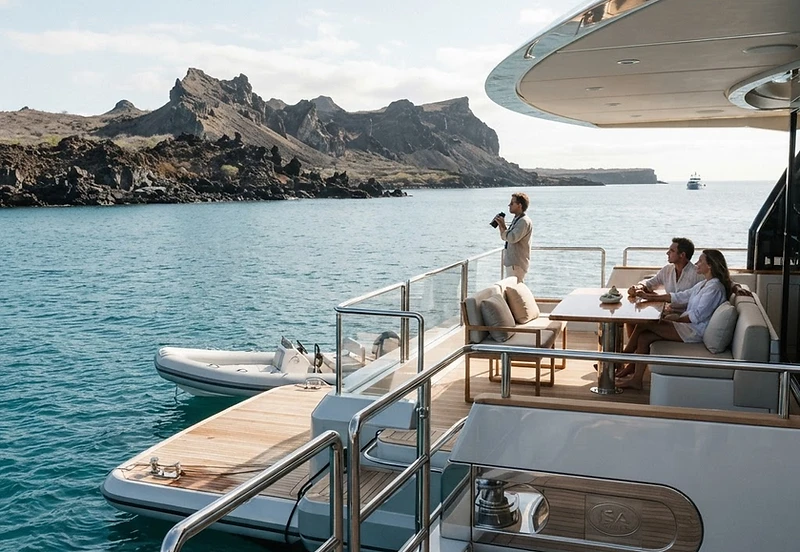
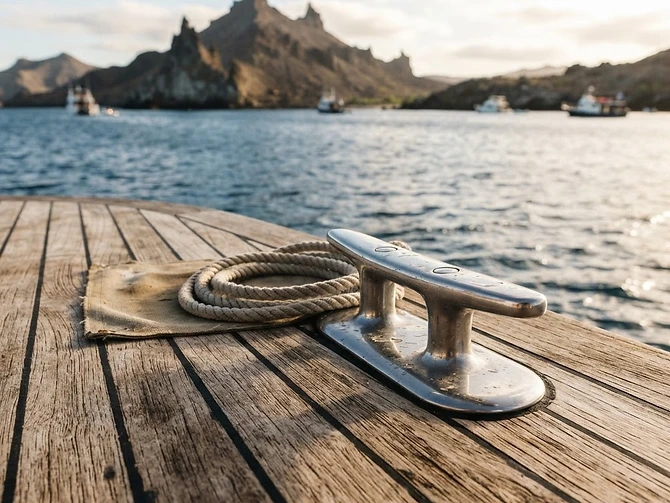
The Pacific here does not behave like the Mediterranean. It lacks the predictable, azure serenity of the Côte d’Azur; instead, the waters off Isla Santa Cruz possess a bruising, deep-indigo weight. From the aft deck of the M/Y Resilience, an ISA Yachts displacement vessel, the landscape of the Galápagos looks less like a vacation destination and more like a primordial draft of the earth itself. The volcanic rock of the shoreline rises in stark, basaltic tiers, a natural architecture that makes the teak decking beneath my bare feet feel like a precarious, floating extension of a very different, man-made order. To be here is to acknowledge the raw, unrefined power of the earth, contrasted against the meticulous, climate-controlled comfort of a vessel designed for the open ocean.
The Geometry of a Liquid Afternoon
Lunch has evolved into a quiet, three-hour affair, shedding the rigid structure of a formal itinerary for something more fluid. We are anchored in the lee of a wind-battered headland, the yacht holding its station with the calm authority only active stabilizers can provide. The heat of the equatorial sun is relentless, yet under the expansive shade of the upper deck, the air is stirred by a constant, salty draft. We eat simply: local ceviche cured in lime and spiced with charred serrano, the brightness of the citrus providing a necessary shock against the heavy, ambient heat. There is no rush to weigh anchor; the charter schedule has been dissolved by the sheer gravity of the volcanic stillness. The vessel feels less like a boat in these moments and more like a private island, a floating sanctum drifting in the Humboldt Current’s wake.
Anchored in the Primeval
By mid-afternoon, the silence of the archipelago becomes almost heavy, an audible weight that presses against the hull. The captain, a man who knows the temperament of these currents better than his own pulse, prefers to keep the tender lowered, bobbing gently alongside the Resilience, ready for a scouting trip to the hidden coves of Tortuga Bay. Yet, nobody moves. We are captivated by the rhythm of the tide as it surges against the black, volcanic shelves. The light shifts constantly, turning the deep indigo of the water into a kaleidoscopic mirror of volcanic grey and bruised copper. It is in this stillness that the true nature of yachting reveals itself; it is not merely about arrival or exploration, but the rare privilege of observing a landscape that has remained largely indifferent to human presence for millennia. We are guests of the sea, hovering in a place that feels like the very beginning of the world.
The Suspended Horizon
As the afternoon dips toward an early twilight, the shadows of the volcanic cones stretch long and sharp across the surface of the bay, like ink spilling across a dark cloth. The wind begins to drop, leaving the water as smooth as polished obsidian. The air has turned crisp, carrying the metallic scent of wet stone and cooling earth. The anchor chain gives a faint, rhythmic groan as the vessel settles into its final heading for the evening, a metallic sigh that signals the end of our vigil. We are, for a few more minutes, content to simply exist between the deep, dark pulse of the ocean and the cooling rock of the shore, waiting for the first stars to puncture the immense, unpolluted sky. In these final, lingering moments of the day, the luxury of the Resilience is defined not by its engineering, but by its ability to hold us steady within the vast, indifferent beauty of the Pacific.






