
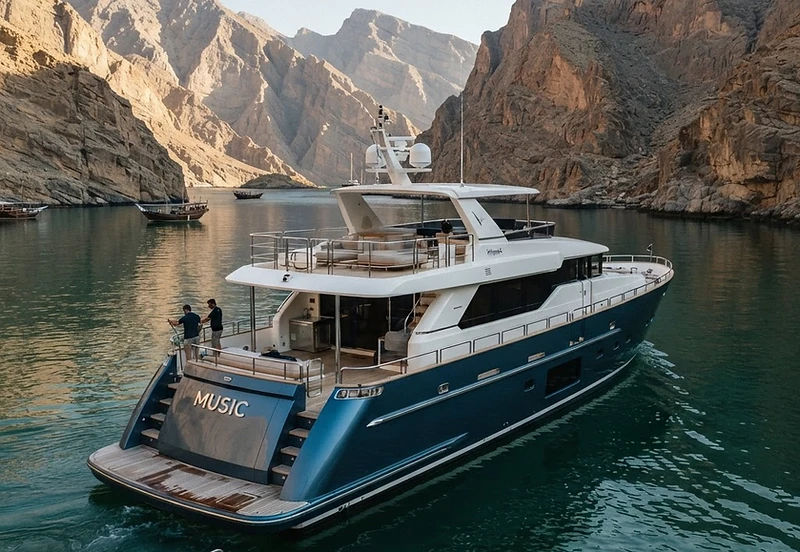
The morning off Khor Ash Sham begins not with the guttural rumble of cold-start engines, but with a profound, almost jarring silence. As we cast off the lines from the limestone cliffs of the Musandam Peninsula, the 45-meter yacht—a custom-built vessel drawing on the naval architecture of the Dutch firm Vripack—glides out of the anchorage on pure battery power. There is only the subtle, rhythmic lap of water against the hull and the distant, haunting cry of a gannet echoing against the sheer mountain walls that plunge directly into the sea. This is the luxury of the modern age: the ability to exist within a wild, untouched landscape without imposing the mechanical violence of a combustion engine upon its stillness.
The Architecture of Efficiency
Stepping onto the aft deck as the sun bleeds over the jagged peaks of the Ru’us al Jibal, one notices that the engineering shift has fundamentally altered the interior experience of the vessel. Without the cavernous, heat-generating engine rooms that traditionally demand massive ventilation shafts, the designers have reclaimed that volume, carving out space for a lower-deck wellness suite that feels entirely detached from the ship’s motive force. The yacht functions less like a machine and more like a floating villa, anchored by its ability to linger in these fragile, sound-sensitive fjords without the persistent low-frequency vibration that once defined the long-range charter experience.
The glass-and-steel architecture of the superstructure feels liberated. Large panes of structural glass, unsupported by heavy steel bulkheads, offer an uninterrupted horizon. In the salon, the absence of engine noise allows for a conversation held in whispers, even while underway. It is a refinement of form; the yacht reads less as a heavy craft of displacement and more as a pavilion suspended over the turquoise depths of the Strait of Hormuz. Here, the engineering is invisible, leaving only the aesthetics of light, water, and shadow.
The Stillness of Telegraph Island
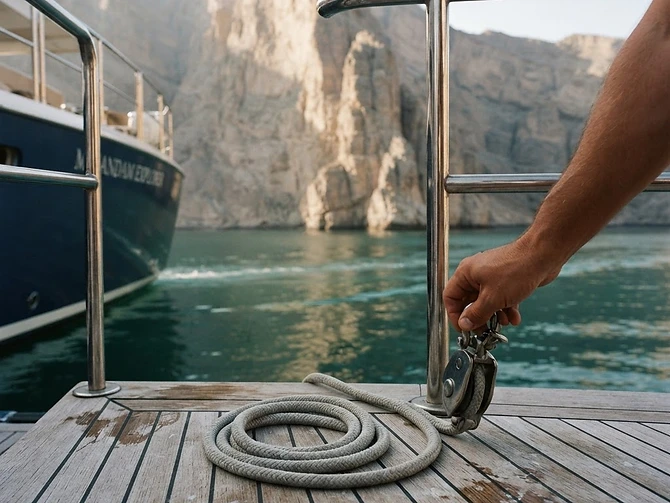
By midday, as we drift toward the sheltered, history-steeped inlets of Telegraph Island, the rhythm of the voyage takes hold. The captain cuts the auxiliary systems entirely, allowing the yacht to sit in perfect, dead-water stillness. The only sound is the light slap of the tender bumping against the bathing platform and the distant, metallic chime of a galley knife against a cutting board as the chef prepares fresh snapper sourced from a local Khasab fisherman. On the aft deck, the air is clean—devoid of the acrid trace of diesel exhaust that usually clings to the salt spray of a cruising vessel.
We linger on the teak, watching a school of needlefish break the surface in perfect unison. It is a moment of total containment: the world outside the fjord is a blur of high-speed commerce and global transit, while here, time is measured only by the tide and the slow, deliberate rotation of the sun. The silence allows one to actually hear the environment—the shifting of stones on the seabed, the rustle of wind through the arid scrub, and the patient, rhythmic breathing of the sea against the limestone.
As the sun begins to slip behind the rugged peaks, the hybrid system engages with a soft, electronic hum for the short run back toward the vicinity of Khasab. There is no soot on the white hull, no oily slick on the glass-calm surface, and no disruption to the marine life that thrives in these shadow-drenched channels. The transition is not merely technical; it is a return to a more primitive, intimate mode of exploration, where the power to move through the water feels borrowed, light, and entirely respectful of the ancient, unforgiving coast it traverses.






