
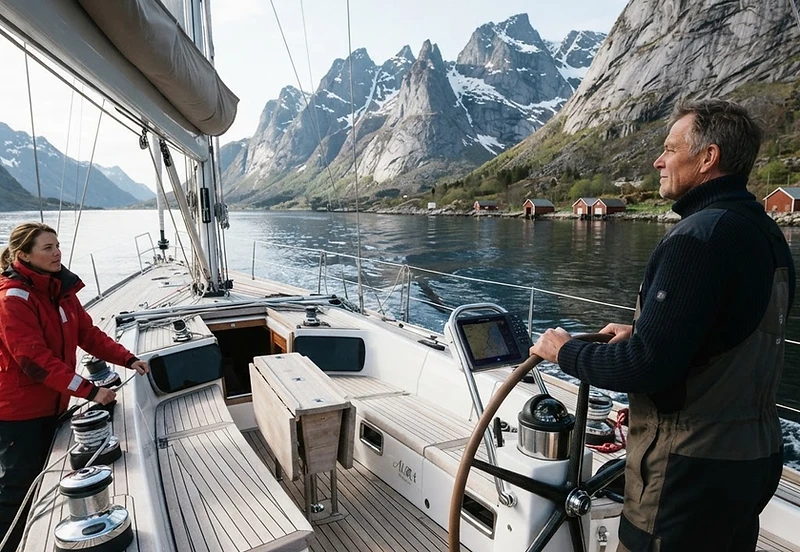
The light in the Helgeland archipelago does not so much fade as it recalibrates. Standing on the teak aft deck of a Nautor's Swan, watching the silhouette of the Seven Sisters mountains sharpen against a bruising, violet sky, one becomes acutely aware of the stillness that defines these waters. Here, miles north of the industrial pulse of the continent, the sea serves not as a highway, but as a sanctuary of depth and silence. My Patek Philippe Nautilus, its stainless steel case cold against my wrist, serves as the only necessary bridge between the wild, shifting currents outside the hull and the controlled, internal rhythm of our passage.
Shelter and the Mechanics of the Coast
Entering the harbour at Sandnessjøen, the practicalities of high-latitude cruising become immediate. The port provides a vital respite, offering profound protection from the prevailing north-westerly winds that can funnel through the fjords with unexpected ferocity. The quay walls are robust, constructed to handle the heavy commercial traffic of the coast, which translates to secure berthing for yachts with significant draft. The seabed here, largely composed of stable silt and stone, offers excellent holding for those choosing to swing on a hook in the outer reaches of the bay, though the sheer drop-off of the nearby fjords necessitates a keen eye on the depth sounder.
Infrastructure and the Living Deck
Reliability is the currency of the Helgeland. Sandnessjøen offers consistent 400V shore power, essential for maintaining the heating systems of a climate-controlled vessel. Fresh water is easily accessible, and the waste management facilities—while utilitarian—are rigorously maintained to ensure the pristine nature of these waters remains uncompromised. For the crew, the local provisioning is focused: clean, hearty ingredients found at the local markets. We finished our evening with a bottle of Gaja Barbaresco, the complex, nebbiolo-driven notes providing a necessary warmth against the lingering chill of the Arctic air, served in thin-rimmed crystal as we watched the tide slide silently against the pilings.
Maintenance access is supported by local marine workshops capable of handling mid-sized mechanical and hydraulic issues, though for specialized work on carbon rigs or complex navigation arrays, most captains prefer to coordinate with the larger yards in Bergen or further south. The security is quiet but effective; the docks are well-lit, and the local harbor master operates with the characteristic Norwegian blend of unobtrusive diligence and absolute authority. It is a place that rewards the prepared, a harbour that demands respect for the water’s edge and the atmospheric pressures that define this northern threshold.
As the moon crests the granite peaks of the coastline, the vessel settles into the water with a rhythmic, almost imperceptible sway. The watch remains, kept by the faint, steady pulse of a mechanical movement in the dark, a testament to the fact that even in the furthest reach of the archipelago, life at sea remains a pursuit of perfect, measured intervals.






