
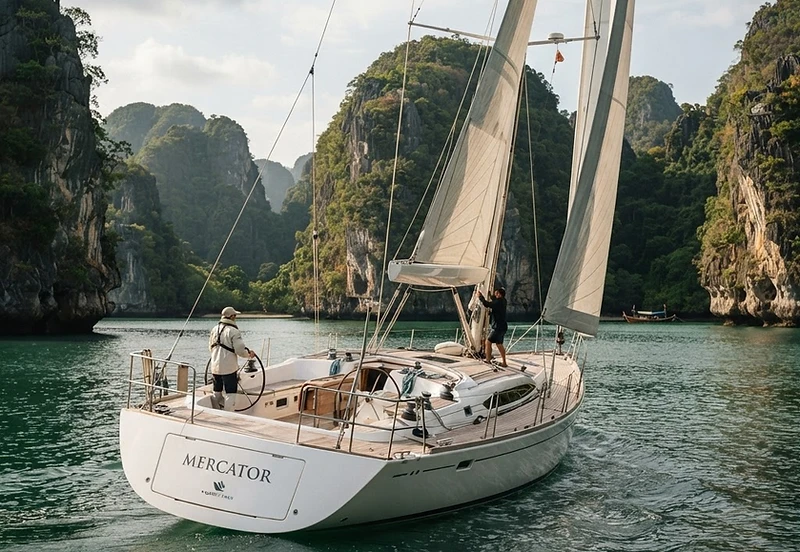
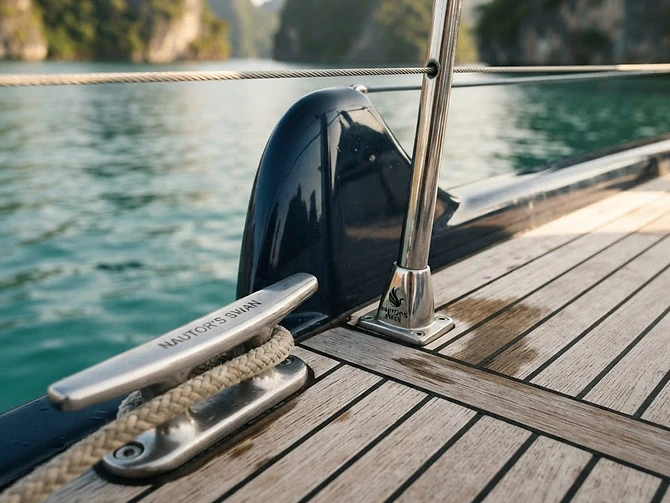
The Andaman Sea does not so much welcome a vessel as it envelops it. Stepping aboard the Nautor's Swan 78 at Kawthaung, the transition from the frantic humidity of the mainland to the pressurized stillness of the yacht is immediate. For the next fourteen days, our world is defined by the teak-lined geometry of the deck and the shifting, verdant silhouettes of the Mergui Archipelago. We aren't simply cruising; we are calibrating our existence to the cadence of the tides, moving through a chain of over eight hundred islands where navigation requires as much intuition as it does radar. To navigate these waters is to accept that charts are merely suggestions, and the real map is drawn in the changing hue of the water—from deep cobalt to the pale, translucent jade of the shallows.
The Geometry of the Morning Watch
Life aboard follows a rigorous, almost monastic ritual that feels entirely natural within the expanse of the Andaman. Mornings begin long before the sun crests the jagged limestone karst of Lampi Island. There is a specific, cool quality to the air at 05:00, marked by the faint, bracing scent of salt spray and the rhythmic, low-frequency hum of the yacht's generators. We gather on the aft deck, the teak still damp with dew, to observe the horizon as the light shifts from bruised violet to a sharp, metallic gold. It is a time for quiet introspection, punctuated only by the clink of ceramic against the cockpit table. This is where the day’s rhythm is set; there is no urgency here, only the deliberate checking of the paper charts and the soft, purposeful consultation with the captain regarding the day’s short hop to the next hidden anchorage. The silence is profound, interrupted only by the distant, melancholic call of a hornbill echoing from the dense, untouched jungle of the shore.
Anchored in the Moken Silence
By midday, the Nautor's Swan rests in the shallows off Macleod Island, her anchor chain held taut against the outgoing tide. The afternoon is defined by the grace of deceleration. We move from the sun-drenched foredeck to the protected shade of the cockpit, observing the traditional Moken boats—the kabang—as they navigate the narrow channels with a tactile, ancestral familiarity that our electronic suites simply cannot replicate. They move like water over water, ghosting through the reef-strewn shallows with an elegance that humbles our modern engineering. Lunch is a simple affair, served at the exterior dining table: freshly caught grouper seared over a low flame, served with a sharp citrus glaze and glasses of chilled lime water. It is a moment of profound stasis, where the only movement is the slight, rhythmic roll of the hull against the turquoise water. The luxury here is not in ornamentation, but in the radical simplicity of isolation; the yacht becomes a capsule of refined domesticity in a wild, largely uncharted theatre.
As the sun dips behind the forested ridges of the archipelago, the colors of the sea deepen into an intense, bruised indigo. We retreat to the bridge, watching the radar clear as we settle for the night. The life aboard—the transition from the active, wind-driven navigation of the morning to the communal, candle-lit quiet of the evening—is what tethers us to this remote expanse. We leave the Mergui with the realization that the true luxury of a two-week charter is not the destination itself, but the slow, deliberate reclamation of one's own time. Against the infinite, uncaring backdrop of the Andaman, the vessel provides a sanctuary of human intent, a small but impeccably appointed stage upon which we have played out a fortnight of perfect, uninterrupted passage.






