
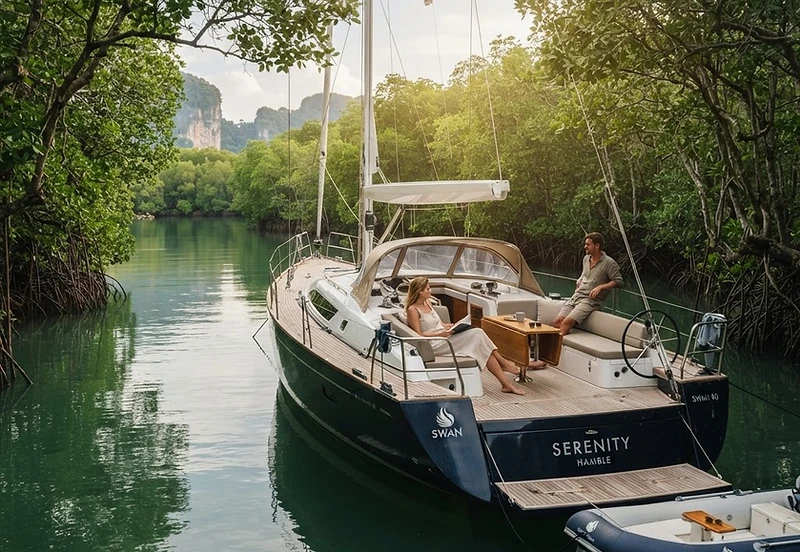
Steering the Nautor’s Swan 80 through the limestone cathedrals of Phang Nga Bay requires a particular kind of reverence. As we navigated toward the secluded fringes of Koh Yao Yai, the emerald water shallowed to a crystalline transparency that mirrored the hanging gardens of the Karst cliffs. The helm felt heavy with the morning’s tidal pull, a physical dialogue between the hull and the Andaman current that demanded constant, minute adjustments. There is a specific, metallic clarity to the sound of a chain paying out in this silence—a sharp, mechanical rattle that dissolves instantly into the humid air, marking the transition from the kinetic energy of the passage to the suspension of the anchor watch. It is a moment of profound relief when the vessel finds her footing, swinging gently as the currents wrap around the limestone monoliths that stand like silent sentinels protecting the island’s northern reaches.
The Rhythm of the Aft-Deck Ritual
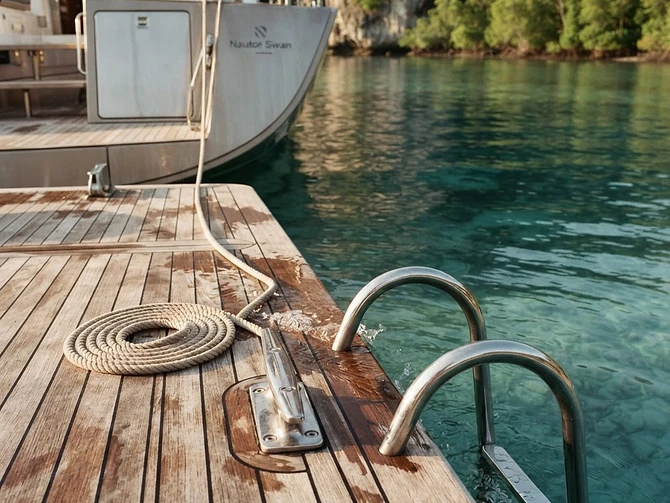
Life aboard finds its cadence in these moments of arrival. Once the Swan settled into her station, the transition was not merely a change in geography, but a shift in the internal rhythm of the vessel. We gathered on the teak aft deck, the wood still radiating the heat of the noon sun. Our stewardess offered a chilled infusion of lemongrass and kaffir lime, served in hand-blown glasses that caught the low-angled light. This is the essence of the yachting life: the ability to strip away the velocity of travel and replace it with the deliberate pace of an afternoon spent watching the long shadows lengthen across the swim platform. True luxury, in this context, is the quiet authority of the crew—the silent adjustment of an awning to capture the cooling breeze, or the effortless deployment of the passerelle, executed with such precision that the guest is barely aware of the effort. We sat in silence, observing the way the water changed from deep, opaque turquoise to a luminous, shallow green, watching for the subtle wake of a sea eagle or the distant splash of a rising fish.
Disconnection and the Archipelago Pulse
As the afternoon progressed, the crew readied the tender for a short run to a private, unnamed beach along the western coast of Koh Yao Yai. There is no urgency in this place; the geography dictates the speed of life. We glided toward the shore, the silence of the outboard motor barely disturbing the stillness of the cove. Stepping onto the sand, one feels the immediate shift in gravity—a removal from the mechanical world of the vessel back into the primal pulse of the archipelago. We watched a local longtail boat pass in the distance, its outboard motor providing a low, rhythmic thrum that underscored the stillness of the anchorage. We did not speak of itineraries or waypoints; we spoke of the light, of the way the limestone softened in the dusk, and of the unique, isolated gravity of these islands. To be anchored here is to understand that the yacht is not just a vessel for transit, but a mobile sanctuary that allows us to curate our own environment against the dramatic, rugged backdrop of the Thai coast. Even as the wind picked up, swirling the scent of salt and damp earth, the protection of the bay remained absolute, a testament to the wisdom of selecting an anchorage that feels like a secret kept by the sea itself.
As the sun dipped behind the jagged horizon, the Nautor's Swan turned slowly on her anchor rode, framing the silhouette of the uninhabited islets in our salon windows. The day closed as it began: with the quiet, confident hum of the ship’s systems, a soft reassurance that we were held securely by the seabed, drifting in the gentle, saline pulse of the Andaman. Here, tethered to the limestone, the world feels expansive yet contained, a perfect circle of horizon and teak that invites us to linger long after the stars have begun to chart their own course across the southern sky.






