
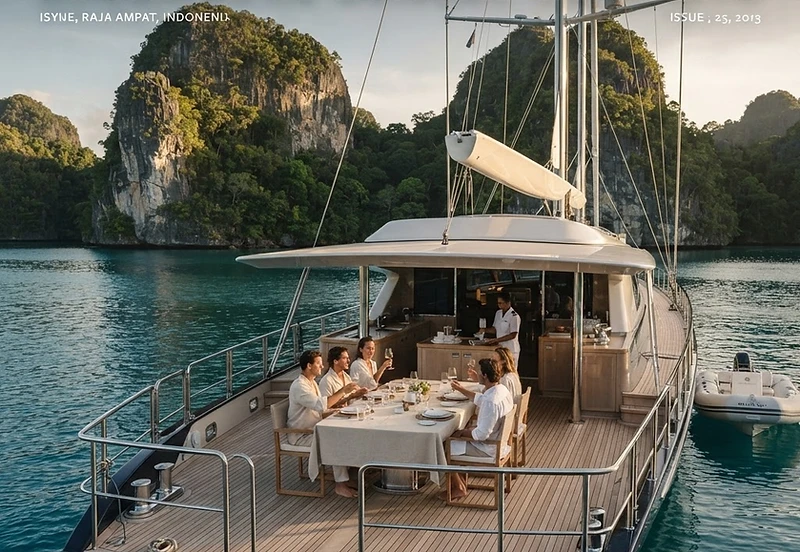
The approach to the Wayag archipelago in northern Raja Ampat is a navigation of constant, precise adjustments. From the bridge of our 50-meter Perini Navi, the labyrinth of karst islands appears as a jagged, impenetrable wall of verdant green rising directly from the turquoise shallows. We held our breath as the depth sounder traced the dramatic rise from deep, abyssal ocean blue to the translucent, sediment-rich floor of the inner lagoon. There is a specific, tactile rhythm to anchoring here; the chain does not merely rattle, it echoes against the ancient limestone cliffs, a reverberating sound that signals the definitive transition from the long passage to the profound, heavy stillness of the anchorage.
The Geometry of the Aft Deck
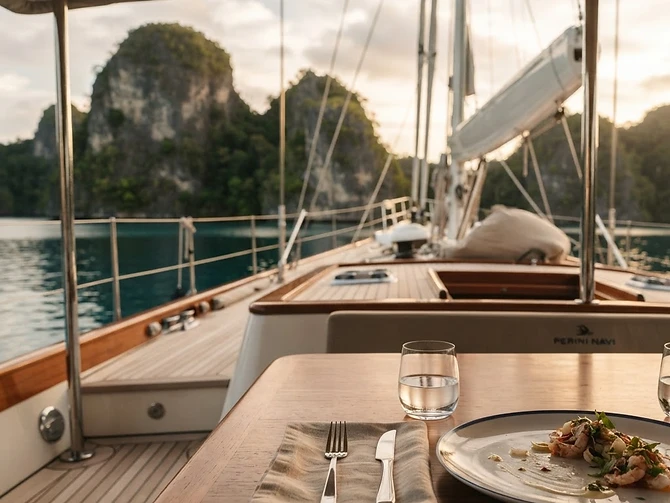
Life aboard during these remote charters is dictated by the arc of the sun and the silent, gravitational swing of the tide. By late afternoon, the equatorial heat shifts from an oppressive weight to a golden, manageable glow that illuminates the teak decking. On the aft deck, the crew began the familiar, practiced ritual of setting for dinner, folding crisp, white linens that stood out in sharp, clean relief against the deep, polished mahogany of the cockpit table. This is the essential heart of the yachting experience—the ability to curate an environment that feels domestic and grounded, even when the nearest civilization is a hundred miles of open water away. We watched as the stewardess placed a simple, hand-painted ceramic bowl of local pomelo and starfruit at the center, a subtle, fragrant nod to the Indonesian harvest that awaited us. Everything here is an exercise in scale, where the human element is softened by the sheer verticality of the surrounding rock.
Dining Within the Karst Shadows
As the sun dipped behind the western monoliths, the temperature dropped, and the stillness of the bay deepened until the water became a perfect, obsidian mirror. Dinner was a lesson in unhurried consumption, a slow-paced affair where the horizon seemed to vanish entirely. We were served a steamed red snapper, caught just hours earlier by a local fisherman who had paddled a wooden outrigger toward our stern earlier that afternoon. The fish, seasoned only with shaved ginger, chili, and lime, felt like the only appropriate meal for such a landscape. There was no pretense in the plating; the focus remained entirely on the proximity to the water and the transparency of the ingredients. We sat for hours as the stars began to pinprick the sky above the limestone pinnacles, the yacht gently yawing on its anchor rode. It is in these moments, with the hull groaning softly against the current and the scent of salt air mingling with the citrus on the table, that the true luxury of the yachting life reveals itself—not in the gold leaf or the velvet, but in the rare, absolute permission to simply exist in a place that has not yet been fully defined by a map.
By morning, the lagoon had turned a brilliant, searing cobalt, reflecting the cloudless sky. We weighed anchor with a sense of reluctance, the rhythm of the trip pulling us further into the archipelago toward the mangroves of Gam. The charcoal-colored limestone, the warm teak, and the white sails are merely the vessels for this movement; the experience itself is found in the transition, the slow-motion navigation between one limestone shelter and the next, and the quiet satisfaction of a meal shared while the world drifts silently by the transom.






