
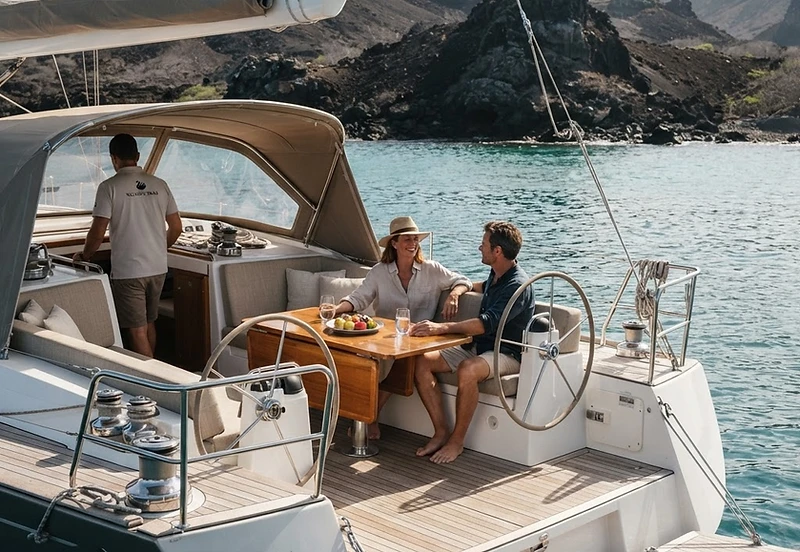
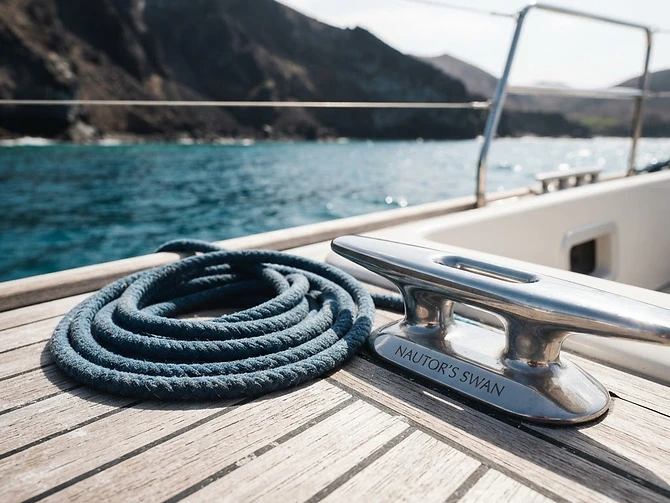
The descent from the bridge of the Nautor’s Swan, as she sat poised in the deep, ink-blue swells off the coast of Fernandina, felt less like a transit and more like an initiation into a prehistoric silence. The Galápagos, for all their fame, reveal their true, untamed character only when you leave the charted channels and find a sandbank—a mere sliver of crushed coral and basalt—that appears on no tourism map. Our tender, a sturdy carbon-fiber RIB, cut through the current with a sharp, rhythmic slap against the hull, leaving the yacht riding high and graceful at anchor, a white silhouette against the jagged, volcanic spine of the island.
The Geometry of the Anchorage
Life aboard a vessel of this caliber is defined by the precision of one's approach to the coast. As we maneuvered toward the sandbar, the depth sounder chirped a rapid, cautionary cadence until the water shifted from deep navy to a translucent, electric turquoise. Anchoring here is not merely a task of logistics; it is an exercise in restraint. The crew moved with the quiet efficiency of long-practiced sailors, ensuring that our ground tackle would leave the delicate, shifting seafloor undisturbed. There is a profound comfort in the mechanical reliability of a modern sailing yacht, yet standing on that isolated bank, surrounded by the haunting, barren beauty of Fernandina, the technology felt miles away. The only reality was the salt spray on our skin and the distant, low rumble of the island’s volcanic landscape.
Dining in the Wake of the Current
Lunch on the bank, while structurally simple, adhered to the quiet rigors of life at sea. The stewards had unpacked a low, teak-topped table, weighted against the stiff Pacific breeze that whipped across the equator. The meal was an exercise in lightness: chilled ceviche prepared with locally sourced grouper, brightened with lime and a hint of fiery ají, served alongside crisp, chilled hearts of palm. We ate with the sand shifting beneath our bare feet, the sound of the surf acting as the only punctuation to our conversation. There was no pretense here. When one dines on a sliver of land surrounded by thousands of miles of ocean, the experience is stripped of the superfluous. The ritual is found in the freshness of the catch, the attentive, unobtrusive pace of the service, and the awareness that the tides are currently deciding our departure time.
The Return to the Vessel
As the afternoon light began to sharpen, lengthening the shadows of the volcanic cliffs, we retreated to the water. A short swim back to the tender brought us into the cooling spray of the slipstream. Watching the Swan as we approached, I was struck by how perfectly she belonged to the seascape—a masterpiece of Finnish naval architecture that seemed, in this harsh, brilliant light, to be the only sensible vessel for these treacherous waters. Climbing back over the swim platform, the transition from the wild, salt-scoured sandbank back to the polished teak of the cockpit was seamless. We settled into the evening watch, the lines tightened, the sails furled against the coming dusk, and the rhythm of the ship returned to the steady, reassuring thrum of a world moving on the water.
As the sun dipped behind the western silhouette of the island, turning the Pacific into a sheet of hammered copper, we pulled the hook. The Galápagos do not offer comfort easily, but they grant a kind of clarity that stays with you long after the charts are stowed. We left the sandbank as we found it: untouched, solitary, and waiting for the next turn of the tide.






