
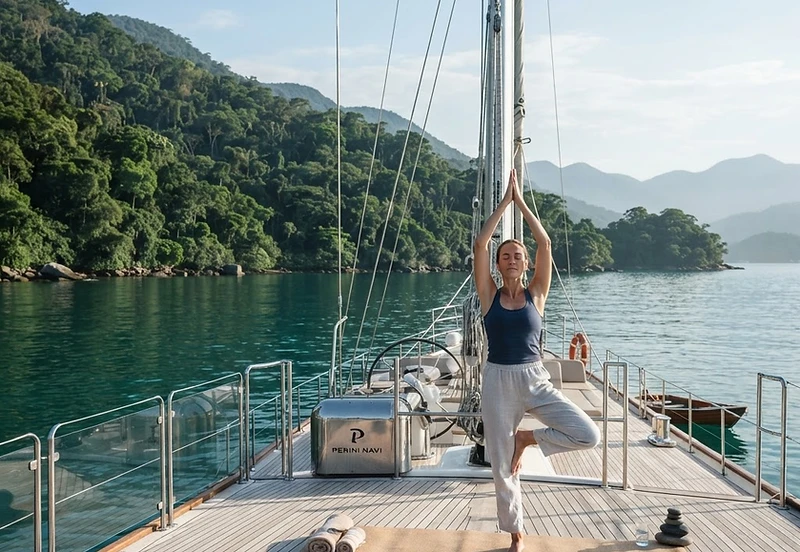
The morning transit through the narrow channels between Ilha Grande and the mainland is a study in precise navigation, the deep-draft hull of our 45-meter Perini Navi slicing through water so still it holds the reflection of the Atlantic rainforest with unsettling clarity. We were aiming for the sheltered basin of Saco do Céu, a place where the mountain walls rise abruptly from the sea, creating a natural amphitheater that seems to swallow the outside world. As the anchor chain rattled through the hawsepipe—a rhythmic, industrial sound that always signals the true start of a voyage—the tension of the open passage evaporated. We were finally stationary, swinging gently on the tide.
The Sundeck as Sanctuary
Life aboard a vessel of this pedigree is often defined by the urgency of the schedule, yet the true luxury lies in the intentional deceleration. By mid-afternoon, the sun hung heavy over the canopy of the forest, casting long, fractured shadows across the teak decking. It was time to convert the sundeck from a navigation station into an arena for restoration. The crew moved with that practiced, near-silent efficiency that defines a well-run ship; portable massage tables were braced against the bulwarks, and the scent of cold-pressed coconut oil began to mingle with the omnipresent salt air of the bay.
There is a singular clarity to receiving a treatment while suspended over a tropical anchorage. You hear the slap of the water against the hull—a sound that anchors the body in space—and the occasional distant cry of a toucan from the thickets of the Ilha Grande shoreline. My therapist, a local professional familiar with the humidity of the region, worked with movements that mirrored the ebb and flow of the tide outside. As she moved to release the tension held in my shoulders, my gaze remained fixed on the mast-top of a nearby Nautor's Swan, its own flag lazily testing the direction of the shifting thermal winds. It was an experience of profound disconnection from the mainland, yet complete synchronization with the environment.
The Long Exhale
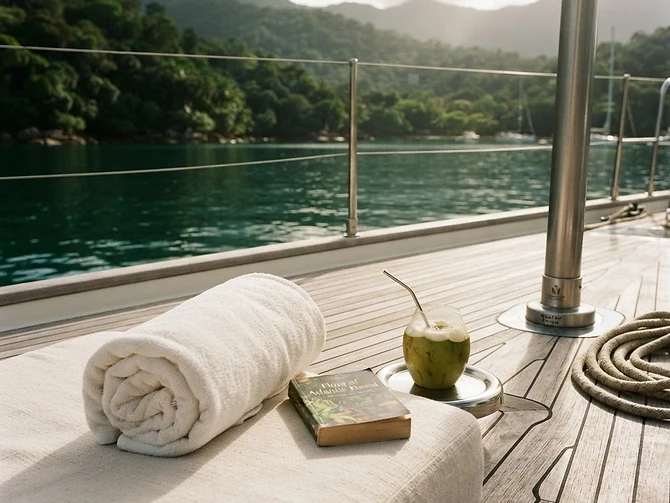
As the treatment concluded, the ritual of the long exhale began. We moved to the aft deck to find a platter of fresh açai berries and sliced papaya, sourced that morning from a small boat-vendor in Angra dos Reis. The transition from the focused intensity of a therapeutic session back into the casual rhythm of yachting is seamless, provided one respects the pace. We watched as the sky shifted through the bruise-colored transitions of a coastal sunset, the water in Saco do Céu turning into a dark, mirror-like obsidian. There were no grand plans for the evening, only the quiet acknowledgement that we had reached a pocket of the world where the hours are measured not by the clock, but by the swing of the anchor.
The captain emerged from the bridge, his presence understated, merely noting the change in barometric pressure as the land breeze began to descend from the mountains. Over a light glass of chilled water, we spoke about the morning’s run down the coast and the prospect of weighing anchor for Paraty at dawn. In these moments, the yacht ceases to be a machine and becomes a living, breathing shelter. The spa afternoon was not merely an indulgence; it was a recalibration, ensuring that as we move into the next phase of our journey along the Costa Verde, we do so with the stillness of the anchorage still held firmly in our bones.






