
The Absence of Engine Noise
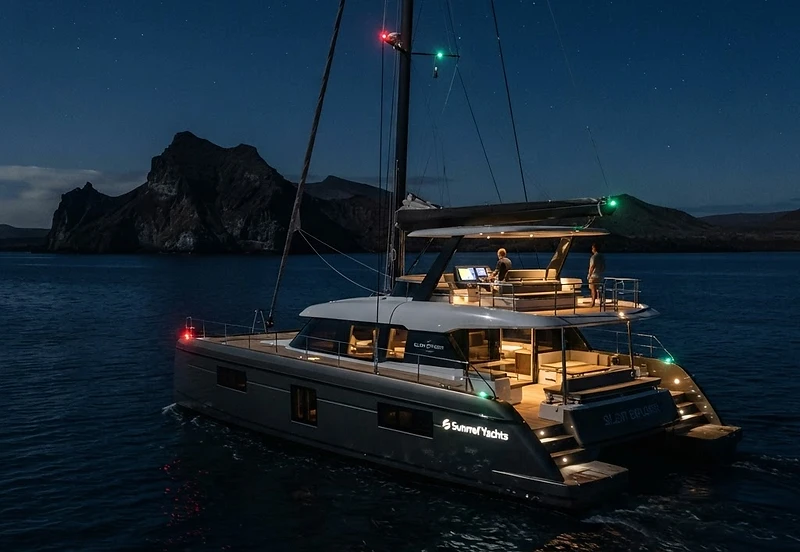
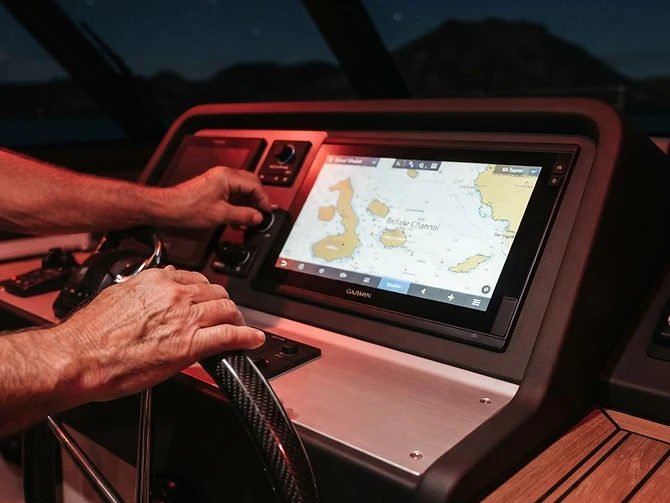
There is a peculiar, sharpened tension in the air when the diesel hum finally cuts out, replaced only by the percussive lap of the Pacific against the carbon-fiber hulls of our Sunreef 80 Eco. We are three hours out of Puerto Ayora, tracking the dark, monolithic silhouette of Santiago Island against a horizon swallowed by the southern night. To navigate the Bolivar Channel in near-total silence is to experience the Galápagos not as a vessel passing through, but as an intruder drifting within the archipelago's primordial volcanic architecture. The persistent, low-frequency vibration that typically informs a mariner of their propulsion’s health—that rhythmic, mechanical thrum—has been excised, leaving a vacuum of sound that forces one to rely entirely on the flicker of the Garmin chart plotter and the crisp, bioluminescent wake trailing off our stern. The sea here is thick, nutrient-rich, and alive; without the churning of traditional props, we can hear the water rushing past the foils, a liquid rushing that sounds remarkably like wind through high mountain pines.
Refined Rhythms Beneath the Southern Cross
Life aboard during a night passage demands an intentional recalibration of the senses. Without the mechanical drone to mask the environment, the ritual of the midnight watch becomes an exercise in profound, almost meditative attention. Below deck, the salon is bathed in the low-wattage, amber glow of recessed lighting, a sharp, warm contrast to the obsidian indifference of the Pacific outside. We forgo the typical hurried, utilitarian meal of an offshore passage for something more deliberate and grounded. We sit on the aft deck, where the night air is cool and heavy with the scent of brine and damp basalt, to share a platter of locally caught snapper ceviche, cured in a sharp, citrus-forward reduction of Galápagos lime and fermented chili. There is no urgency in the galley; the crew moves with a fluid, learned grace, understanding that in this cathedral of silence, every clink of heavy silver against china and the soft fold of a linen napkin carries an unexpected, structural weight. We dine not by the constraints of the clock, but by the slow, electric crawl of the boat as it rides the Humboldt Current, feeling the subtle, rhythmic pitch of the deck as we clear the western headlands of Isabela.
The Static Coast
By 03:00, the black mass of the shore begins to resolve into the jagged, basalt teeth of the coastline. The electric motors hold us in a steady, hushed cadence, allowing us to distinguish the distant, percussive roar of sea lions hauled out on the rocks—a sonic texture usually lost to the vibrations of traditional propulsion. As we approach our intended anchorage in Caleta Tagus, the anchor windlass, now drawing from our silent battery bank, operates with a startling, frictionless efficiency. The chain bites into the seabed with a metallic splash that seems impossibly jarring against the ancient quiet of the island. We kill the last of the power, leaving the vessel to pivot slowly on the shifting tide. For a long, suspended moment, the only things that exist are the cold, sharp air, the faint, sulphurous whisper of volcanic dust blowing off the island, and the realization that we have entered this sanctuary without disturbing a single note of its nocturnal song. As the tide turns, the vessel settles into the dark water, leaving behind the modern world to drift into the absolute stillness of the bay.






