
The Geometry of the Trade Winds
The transition from the open, chaotic fetch of the Sir Francis Drake Channel into the sheltered indigo of the Bight at Norman Island is a study in relief. Beneath our keel, the 32-metre custom gulet—a vessel built with the heavy, hand-finished aesthetic of a Bodrum shipyard—finds her steady state. There is a distinct, resonant groan of the anchor chain paying out, a sound that signals the end of the day’s work and the beginning of the evening’s gravity. To sail these waters on such a craft is to be reminded that the sea is not merely a medium for speed, but a vessel for patience. We are tethered to the seabed, the hull rising and falling on a swell so minor it feels like the island itself is breathing.
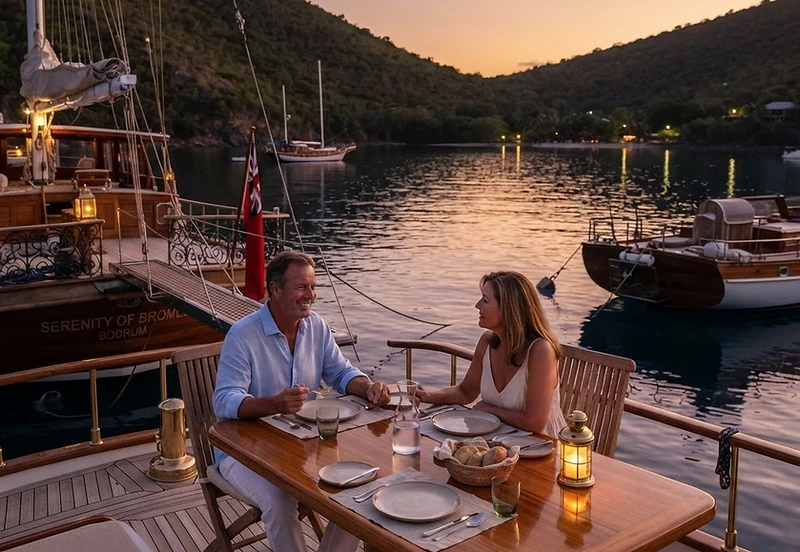
As the sun dips behind the jagged ridge of the island, the light shifts from a piercing, crystalline gold to a bruised, violet-grey. This is the hour when the crew transitions from sail handling to service, a silent, practiced movement that avoids the clutter of modern, overly-automated motor yachts. On deck, the varnish—wiped clean of the day’s salt crust—glows under the soft spill of ambient deck lighting. The wind drops, leaving only the faint scent of drying teak and the distant, rhythmic slap of the Caribbean against the hull. It is a moment of profound stillness, earned only by the nautical miles accumulated since dawn.
The Aft Deck Liturgy
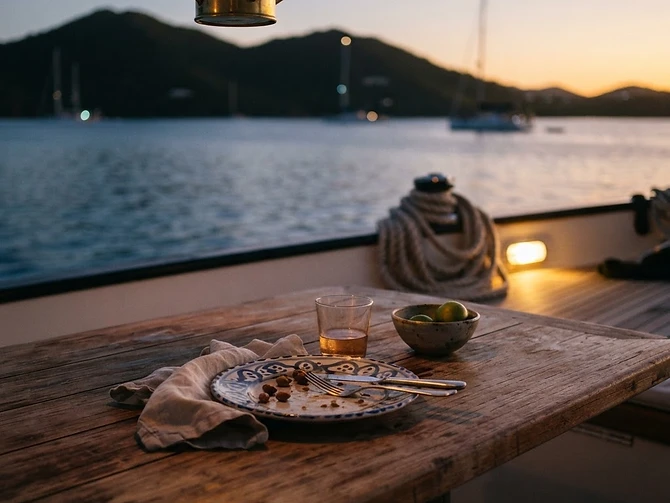
Dinner on the aft deck is not merely a meal; it is an extension of the voyage, an architectural engagement with the surrounding dark. The table, a massive slab of polished mahogany, is set with deliberate, pared-back simplicity. There is no urgency here. As the stewards bring out bowls of locally caught snapper, citrus-cured and accented with the sharp, bright heat of Scotch bonnet peppers, the conversation naturally recalibrates to the pace of the water. One hears the hiss of a propane burner from a smaller sailing yacht anchored a cable’s length away, a reminder that we are part of an ancient, moving community of seafarers.
The ritual of the meal is governed by the yacht’s swing. Every few minutes, a gentle rotation reminds us that we are floating. We watch the masthead light of a nearby Nautor’s Swan trace a slow, lazy circle against the backdrop of the Virgin Gorda horizon. There is a specific comfort in this: the knowledge that the ship is as much a part of this cove as the limestone cliffs of the Indians, visible as a dark silhouette in the gloom. We talk of the morning’s passage near Cooper Island, of the way the rigging sang under the pressure of the trade winds, and of the decision to hold our ground rather than push toward St-Barthélemy before nightfall. The sea, in its vast, indifferent complexity, has granted us this temporary sovereignty.
By the time the final course is cleared, the sky has opened into a vault of unfiltered stars. The yacht is silent, save for the occasional tick of a cooling engine block and the hypnotic, rhythmic lapping of the tide against the rudder. We sit in the dark, watching the anchor light of our neighbors, feeling the slow, persistent pulse of the Atlantic push through the channel. There is nothing left to navigate; the day has been fully charted, and the ship holds us in the hollow of her wooden bones until the morning breeze calls us to weigh anchor once more.






