
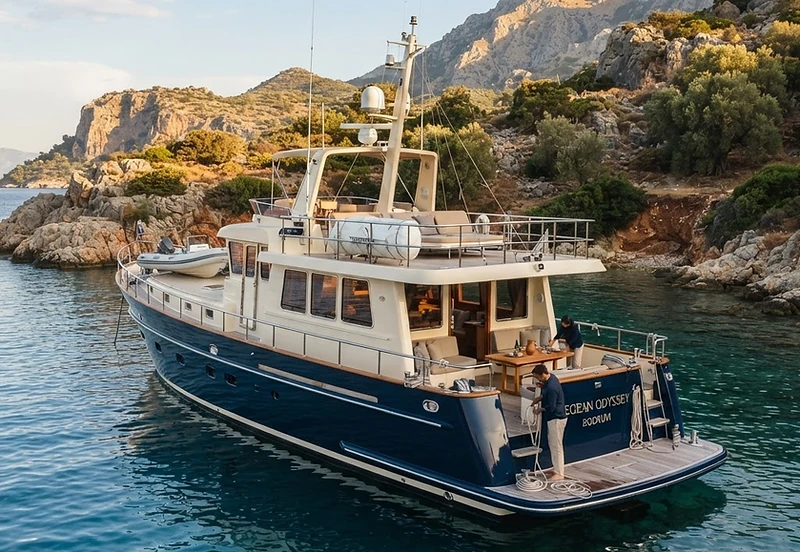

The Geometry of the Morning Watch
The dawn air in the Gulf of Gökova carries a sharp, resinous scent—the intersection of parched limestone cliffs and the cooling salt of the Aegean. Aboard our vessel, a 45-meter explorer yacht originally engineered for high-latitude ice-breaking but now finding her soul in the Mediterranean, the transition from slumber to the morning watch is marked by the subtle, rhythmic hum of the stabilizers. We are navigating the intricate, shallow passages between the islands, a stark departure from the ice-choked corridors of the north, yet the demand for precise station-keeping remains. As the helmsman adjusts the heading toward the long, protective shadow of Sedir Island, the vessel cuts a clean, purposeful wake through water that shifts from deep, bruised indigo to a startling, translucent turquoise.
Life aboard this vessel is a choreographed dance of functional stillness. The morning ritual is not defined by the grandiosity of the deck, but by the quiet efficiency of the crew and the tactile comfort of the common spaces. We move from the bridge to the main salon, where the smell of freshly ground Turkish coffee punctuates the salt air. There is no urgency here, only the measured pace of a yacht that knows her own draft and the depth of every hidden channel. We are not merely traveling; we are settling into the vessel’s cadence, a momentum that demands we match our own breathing to the slow, periodic rise and fall of the hull against the Aegean swell.
The Rituals of the Afternoon Shift
By midday, the heat of the Turkish sun turns the deck into a sanctuary of teak and deep, cooling shade. The transit continues past the dramatic headlands of Akyaka, where the wind begins to funnel down from the mountain slopes, testing the vessel’s poise in the chop. This is the moment when the rhythm of the charter truly settles; we transition from the mechanical focus of the transit to the sensory ease of the anchor watch. We drop the hook in a secluded bight, the sound of the chain running out against the windlass a rhythmic, metallic rattle that echoes sharply against the surrounding canyon walls.
Lunch is served on the aft deck, a deliberate assembly of local sea bass, flash-grilled until the skin is brittle and golden, served with wild foraged greens and a robust drizzle of cold-pressed oil from a nearby village grove. There is a quiet art to dining under a custom canvas awning while the yacht performs her lazy, pendulum swing at anchor, the conversation hushed to mirror the stillness of the cove. We watch the tender depart toward the shore, a small, white spark against the rugged, sun-bleached coastline, tasked with nothing more than the gentle exploration of a hidden sea cave.
The Quiet Horizon
As the sun begins its descent behind the jagged ridges, the vessel seems to exhale. The austere, industrial lines of the superstructure, crafted with the utilitarian durability of a Dutch-built explorer, catch the soft, amber light, softening the harshness of the aesthetic. We find ourselves in the sky lounge, watching the distant lights of Bodrum begin to flicker like fallen stars along the dark arc of the coastline. The day’s passage is complete, the main engines silenced, replaced by the organic, rhythmic lap of water against the swim platform.
The luxury here is not found in the excess of decor, but in the profound absence of external noise. It is the feel of a freshly varnished handrail beneath the palm, the way the vessel holds her position against the incoming tide, and the unspoken confidence that tomorrow will bring another hidden bay and another stretch of sapphire water. In the final moments of the day, as the last of the warmth retreats from the teak deck, the yacht remains a singular, steady point in the vast, darkening architecture of the sea.






