
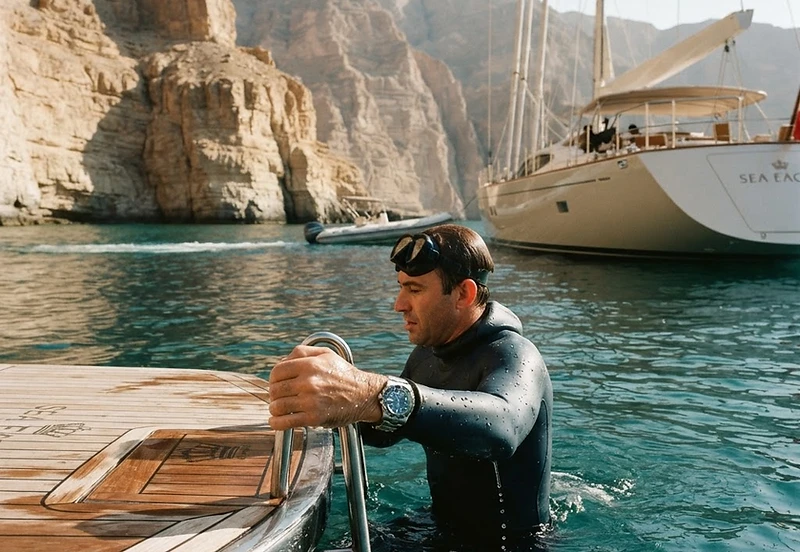
The morning light in the Musandam Peninsula does not so much break as it pours over the limestone fjords, a viscous, honeyed gold that turns the Gulf of Oman into a mirror of hammered brass. We were anchored in a secluded khawr, the 45-meter Royal Huisman cutting a lonely, elegant silhouette against the towering, arid cliffs. The engine room had fallen into its customary post-passage silence, leaving only the rhythmic slap of water against the hull and the distant, lonely call of a Socotra cormorant. I sat on the aft deck, the teak beneath my feet still cool from the night, winding the crown of my 1970s Rolex Submariner. The friction was familiar, a slight resistance that felt like gripping a well-worn mooring line.
The Geometry of Exposure
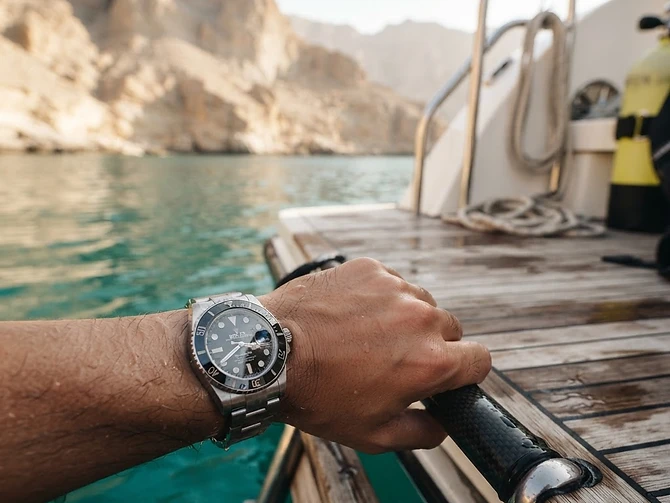
There is a specific honesty to a watch that has spent its life at sea. It is not merely a tool for marking the minutes; it is a mechanical ledger of the vessel’s passage. The bezel, once a deep, ink-black, has faded to a soft, ghostly slate-grey, a transformation wrought by decades of relentless Arabian sun and the caustic bite of salt spray. The indices, which surely once glowed with an aggressive, pristine white, have matured into a warm, toasted parchment color. Looking at the dial, I am reminded of the afternoon we spent navigating the shallow banks near Abu Dhabi, the water shifting from cobalt to a brilliant, transparent turquoise. Every scratch on the lugs tells a story of a narrow channel, a hurried mooring in the bustle of Yas Marina, or the inevitable, clumsy collision with a stainless steel cleat during a heavy swell.
Living with the Salt
Life aboard requires a certain surrender to the elements. We do not polish the patina away; we allow it to accrue, treating the hardware of our daily lives with the same respect we afford the teak decks and the gleaming chrome fittings of our tenders. Down at the dive deck, the smell of damp neoprene and brine hangs heavy in the humid air. As I prepared for a descent, checking the gaskets and the seal of the screw-down crown, I noticed a fellow crew member looking at his own timepiece—a vintage Blancpain Fifty Fathoms, its surface marred by the persistent chemistry of the sea. There was no need for conversation. We acknowledged the shared aesthetic of the worn, recognizing that true luxury is not found in the sterile gleam of a shop window, but in the quiet endurance of objects that have truly seen the world.
The Long Horizon
Returning to the surface as the heat of the day began to intensify, I pulled myself onto the swim platform, the water cascading off my arms. The watch remained on my wrist, a constant, heavy companion. It tracked the arrival of the afternoon shamal, the sudden breeze that stirred the glassy anchorage into a series of jagged, frothing whitecaps. We would soon weigh anchor, heading north toward the Straits of Hormuz, the vessel’s stabilizers humming in anticipation. As the shadows of the cliffs lengthened across the water, I watched the seconds sweep across the faded dial. The watch was not just keeping time; it was holding the memory of this specific, shimmering blue, keeping pace with the tide as we slipped quietly away from the coast, a speck of brass and steel moving toward the next horizon.






