
The Softening of the Steel
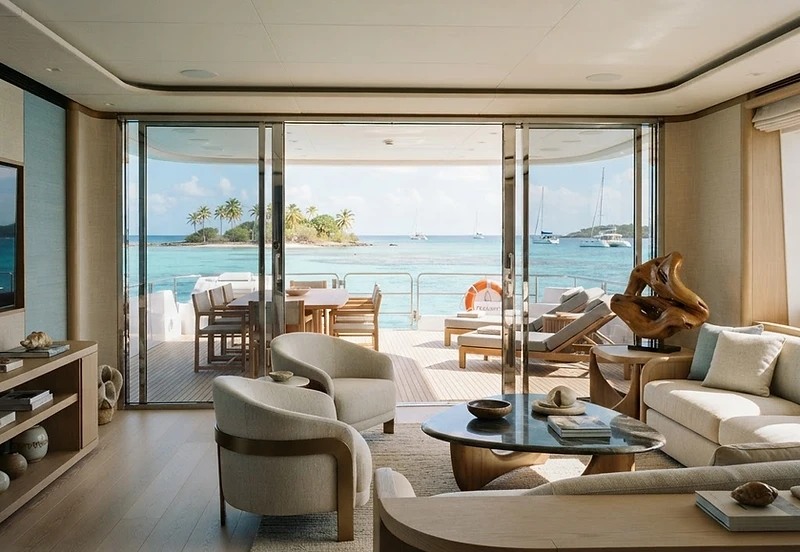
The dawn air in the Tobago Cays carries a particular weight—a mixture of drying salt, crushed coconut husk, and the cool, heavy breath of the Atlantic pushing against the outer reef. Aboard the 60-meter Feadship currently ghosting toward the anchorage, the transition between the kinetic energy of the sea and the living space is nearly imperceptible. This is the precise handiwork of Rémi Tessier, an architect-designer who treats the internal volume not as a series of cabins, but as a direct extension of the shoreline. The bulkheads have been stripped of the expected lacquer and gilt, replaced by bleached ceruse oak and sand-blasted stone that mirrors the calcified, sun-bleached coral floors of the nearby shallows.
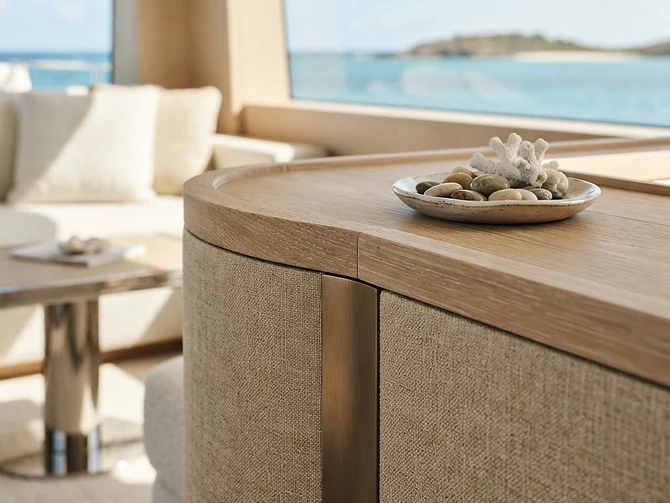
Standing in the main salon, one is struck by the deliberate absence of sharp corners. The cabinetry, meticulously joined by the shipyard’s master carpenters, mimics the organic, wind-worn contours of the limestone cliffs on Petit Rameau. It is a masterclass in spatial restraint. Tessier’s philosophy is anchored in the belief that when the sea outside is this vivid—an electric, pulsating turquoise that defies any painter’s palette—the interior should do nothing more than hold the light and offer a quiet reprieve. The furniture sits low, tethered to the deck as if by the same unseen currents that hold the vessel to its mooring, ensuring that the visual horizon is never once broken.
Living at the Water’s Edge
By midday, the tender is lowered for a run to the outer reef, yet the interior remains the undeniable anchor of the day. The architecture here functions as an active cooling mechanism; the cross-ventilation, engineered into the very flow of the corridor panels, captures the trade winds and funnels them through the living spaces with a persistent, gentle draft. It is a house afloat, but one built with the acute understanding that at any moment, the anchor will be weighed and the scenery will shift. There is no heavy ornamentation here to be lashed down in anticipation of a squall; instead, every surface is integrated into the structure itself. The lighting is deeply recessed, glowing with the soft warmth of a setting sun, and the art is sparse—a single piece of driftwood, smoothed by decades of Caribbean swell, mounted on a bulkhead that vibrates gently with the rhythmic hum of the stabilizers.
We sit for a late lunch, a simple plate of grilled mahi-mahi caught off the stern by the crew less than an hour prior, served on stone surfaces that retain the cool, deep-earth temperature of a cliffside cellar. A conversation drifts toward the challenges of maintaining such austere materiality in a humid environment, yet the finish—a proprietary matte sealant—defies the salt air entirely. It feels lived in, not by a clutter of objects, but by the natural movement of people and the slow, rhythmic passage of time.
The Quiet Calibration of the Sea
As evening approaches, the Cays begin to lose their sharp definition, the water turning to a deep, bruised violet. The interior of the yacht undergoes its final, subtle transformation. As the sun dips behind the distant, darkened silhouette of Mayreau, the interior ambient light adjusts in a measured, pre-programmed sequence. It is a soft shift, like the closing of a shutter at the end of a long, bright day. The space, which felt airy and expansive at high noon, now retracts, becoming a private sanctuary. There is a profound stillness here, a sense that we are not merely floating on the surface but are part of the very geometry of the bay.
The anchor chain grumbles once, a deep, metallic sound that echoes through the hull, announcing a slight shift in the evening tide. Below decks, the air remains perfectly still, perfumed by a hint of cedar and the vast, infinite salt of the open Caribbean. I run a hand along the edge of the salon table—a single piece of reclaimed timber, its grain mirroring the exact ripples we navigated to arrive here. There is nothing else to be done, no other place to be, as the darkness of the sea pulls its heavy blanket over the glass.






