
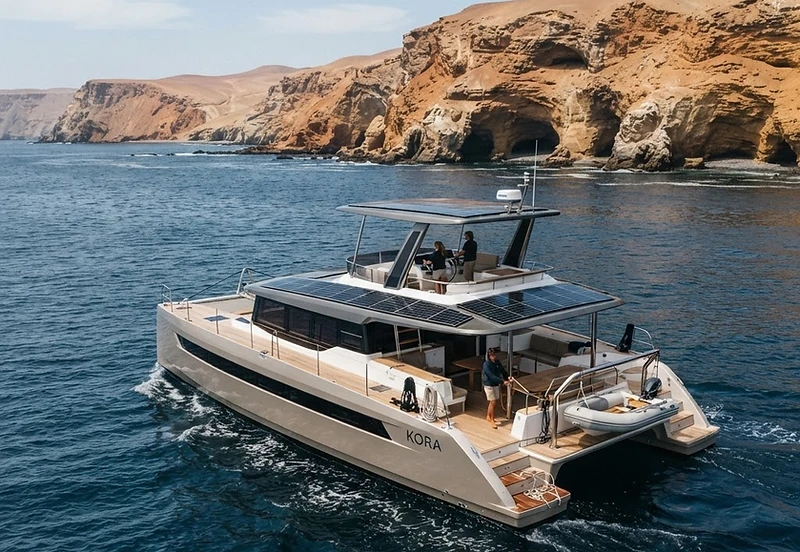
The morning light over the Paracas Peninsula does not break so much as it reveals, carving the jagged, ochre cliffs from the deep, bruised indigo of the Humboldt Current. Aboard, the transition is near-total; our vessel—a custom 35-meter ketch with integrated, thin-film solar-skin sails—catches the dawn with a silent, almost reverent hunger. There is no coarse tremor of a cold-start engine, no soot-stained exhaust plume to bruise the sterile, salt-crusted air. We are simply moving, propelled by the photons cascading onto our carbon-fiber arrays, ghosts gliding toward the limestone arches of the Islas Ballestas.
The Geometry of the Solar Reach
Steering through these waters, where the ocean teems with life—an occasional humpback breach, the frantic, mechanical diving of cormorants—one gains a profound appreciation for the absence of mechanical interference. To sail under solar-electric power alone is to reclaim the sea as a sensory landscape rather than a machine-governed transit. The hull slices through the chop with a rhythmic thrum that is purely hydrodynamic, a sound usually masked by the aggressive dissonance of diesel drives. I found myself standing at the helm, the teak wheel vibrating with the direct force of the Pacific current rather than the hum of a gearbox, observing how the intense desert heat radiating from the Peruvian mainland creates a shimmering mirage against the frigid, nutrient-rich upwelling of the coast. It is a fragile equilibrium, maintained by the precise geometry of our sails and the seasoned patience required to read the wind alongside the shifting light.
Culinary Currents and the Cold-Water Harvest
By midday, our energy reserves are at their peak, allowing us to drop anchor near a secluded cove accessible only by our carbon-fiber tender. The culinary heart of this region is defined by the uncompromising, icy freshness of the Humboldt’s harvest. Our galley team had secured conchas de abanico—the prized, exceptionally sweet scallops native to these bays—from a local artisan fisherman near the port of El Chaco, harvested just as the sun cleared the coastal mountains. We sat on the sheltered foredeck to enjoy them prepared as a classic tiradito, the translucent slices of scallop dressed in a vibrant, lime-heavy leche de tigre and a subtle, smoky infusion of aji amarillo. The heat of the chili acted as a necessary, electric counterpoint to the brisk, mineral-rich sea breeze that defines the Paracas climate. Following this, the chef served a simple, pan-seared fillet of lenguado, its delicate, flaky meat echoing the clean, austere environment that sustained our journey, finished with a mere drizzle of olive oil and a dusting of local sea salt.
Rituals of the Desert Shore
As evening pulled the shadows long across the arid expanse of the Paracas National Reserve, the yacht returned to a gentle, controlled swing at anchor. The solar batteries, having spent the daylight hours drinking in the relentless high-altitude equatorial sun, provided the hushed, refined energy required for the evening’s quietude. There is a distinct, low-impact luxury in knowing that our passage across this ancient, rugged coastline has left nothing behind but a transient wake of bubbles and the fading memory of a meal shared in the lee of the cliffs. Sitting on the aft deck, watching the final rays ignite the desert sands into a deep, burning terracotta, the wind eventually fell away to nothing. The sea became a seamless, polished mirror, holding the first emerging stars of the Southern Cross in its cold, dark palm, a final, breathless moment before the desert night took hold.






