
The Quiet Geometry of the Mid-Deck
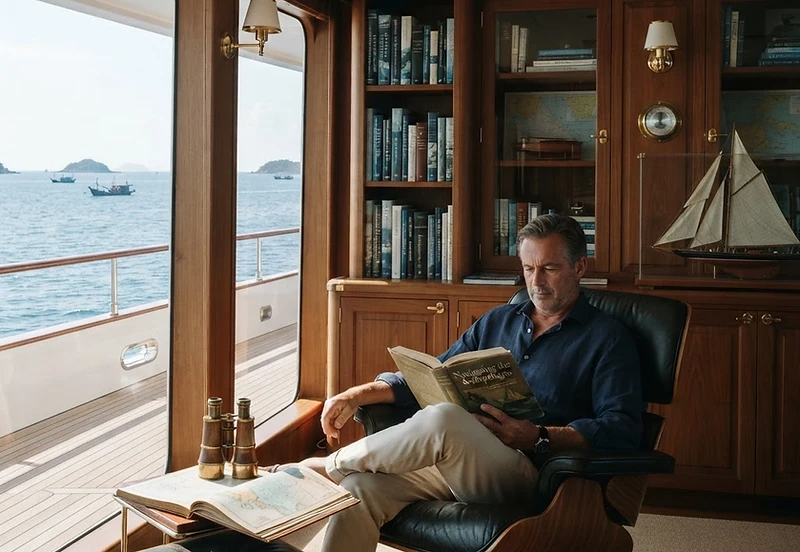
The dawn air off the Sanya coast possesses a particular, humid weight, smelling faintly of salt and the distant damp earth of the Hainan interior. As the Feadship rests at anchor, the rhythmic slap of the South China Sea against the hull acts as a metronome, marking a pace of life that feels intentionally removed from the burgeoning glass towers of the nearby Phoenix Island. Within the vessel, the owner’s study is a marvel of spatial negotiation. It is a library that functions less like a repository and more like a ship within a ship, its cabinetry crafted with the precision of a master naval architect to withstand the perpetual list and pitch of an open-water passage.
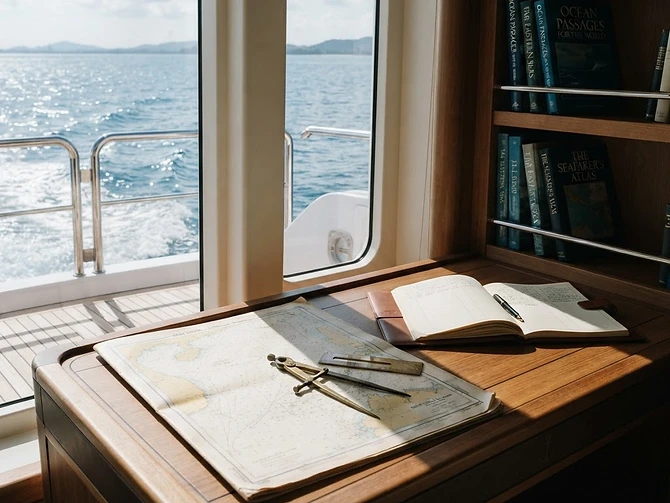
Here, the wood is not merely decorative; it is structural. The desk, hewn from polished teak and anchored to the steel bulkhead, faces a sweeping, frameless window that frames the jagged silhouette of the surrounding limestone islets. To inhabit this room is to understand that the architecture of a superyacht is essentially the art of contained atmosphere. Just as a seaside villa in Wenchang might use traditional courtyards to capture the monsoon breeze, this room uses its orientation to catch the meridian light, turning the act of reading into a study of shifting horizons. Every book is secured by a subtle, custom-milled brass rail, a nod to the reality that this house afloat is intended to traverse the deep water, not merely reside in the lee of the harbour.
Reflections on a Floating Archive
One evening, as the anchor chain groaned beneath the weight of a sudden shift in the current, I sat in the Eames chair, watching the interplay of shadows cast by the brass reading lamps against the mahogany panelling. There is a specific intensity to reading at sea. When you are two hundred nautical miles from the nearest port, the contents of a shelf—histories of early maritime exploration, annotated charts of the South China Sea, volumes of poetry—take on a weight they lack on land. They become anchors in their own right. The room is designed with the same rigorous efficiency one finds in the best of naval concepts: the transition between the desk, the soft leather seating, and the library wall is seamless, eliminating unnecessary movement while maintaining an elegant sense of flow.
My host, having just returned from a late tender run to Yalong Bay to check on the local mooring conditions, joined me with a glass of cool, filtered water. We spoke of the vessel’s recent transit from Hong Kong, the way the stabilizers had held true through a building swell off the shelf. We did not discuss the mechanics of the yacht, but rather the way the library felt at that moment—a sanctuary of stillness carved out of the chaotic, shifting temperament of the ocean. It was a lived experience of architecture, where the boundaries between the interior space and the external seascape dissolved entirely. The study is a bridge, navigating the gap between the nomadic life of the sailor and the static comfort of the scholar.
As the stars emerged over the South China Sea, reflecting off the dark, mirror-like surface of the teak deck below, the library felt suspended in time. The low, melodic hum of the vessel’s systems, the sharp, dry scent of aged vellum intermingling with ocean salt, and the gentle, persistent rock of the sea created a singular environment. In the quiet, the vastness outside ceased to be daunting and became, instead, the ultimate reader’s backdrop, a final sentence written in light upon the water.






