
The Outer Reef at Dawn
The dawn over the Whitsunday Islands is never loud; it is a gradual thinning of the horizon, a shift from indigo to a bruised, electric violet. We were anchored in the lee of Hook Reef, our 40-meter expedition yacht swinging lazily on the tide. From the flybridge, the water clarity was such that the shadow of the hull appeared to hover above the seafloor, an optical illusion that persists even after years of deep-sea cruising. There is a specific, metallic scent to a morning like this: the sharp tang of salt-crusted stainless steel mixed with the humid, sweet promise of the coming heat.
We had spent the previous evening tracking the isobaric lines, adjusting our heading to place us precisely over the drop-off of the Great Barrier Reef. By 07:00, the dive tender was lowered, the water rippling against its rubberized tubes. Diving here is a study in controlled tension. Below the surface, the transition from the turquoise shallows to the abyss of the Coral Sea is abrupt. Within ten minutes, the silence was broken only by the rhythmic intake of our regulators. Then, the shadow arrived. An Oceanic Whitetip, moving with an economy of motion that makes all human propulsion seem clumsy, circled the perimeter of our group. It was an encounter not of aggression, but of mutual observation—a wild, visceral check-in at the edge of the continental shelf.
The Galley and the Coast
Returning to the yacht felt like crossing a threshold between two worlds. The deck crew, efficient and quiet, assisted with the heavy gear, the salt already drying into white crystalline patterns on our neoprene. By noon, we were navigating the passage back toward the mainland, bound for the quiet anchorage near Airlie Beach. Life aboard a vessel of this caliber is defined by the rhythm between high-stakes exploration and the measured, restorative rituals of the galley. Our chef, an expert in the region’s maritime terroir, was already preparing for the evening service, the scent of crushed kaffir lime and native lemongrass wafting through the companionway.
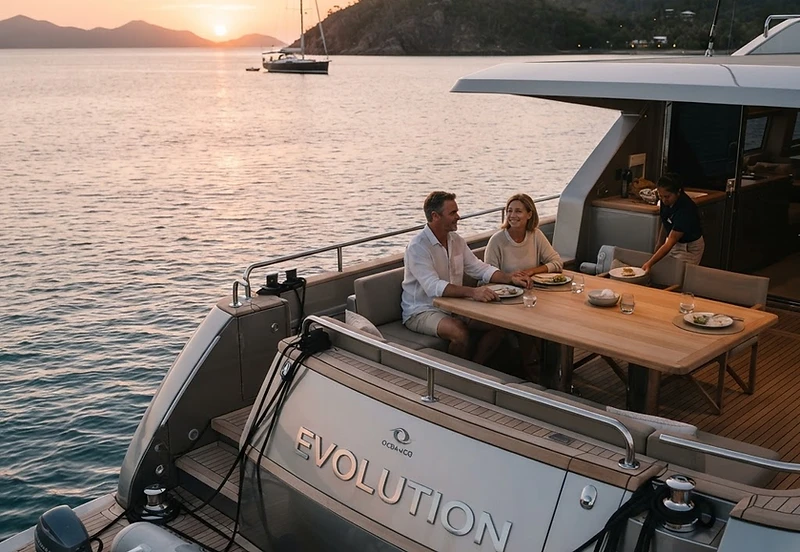
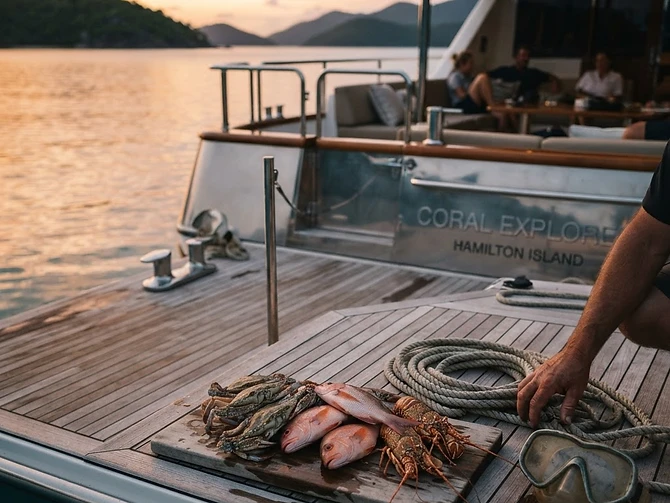
For dinner, we opted for a local catch: Goldband Snapper, sourced from a small-scale fisherman near Hamilton Island who still relies on traditional handlines. It was served with minimalist precision, seared in cold-pressed macadamia oil and finished with a pinch of hand-harvested sea salt from the Bowen coastline. We paired this with native finger limes, their citrus caviar providing a bright, acidic counterpoint to the buttery richness of the fish. Dining on the aft deck, watching the lights of distant yachts blink like constellations in the anchorage, we discussed the dive—the way the shark navigated the currents, the intricate architecture of the reef, and the sheer scale of the environment we were merely passing through.
There is a unique humility in yachting that only the remote reaches of the Queensland coast can bestow. As the night deepened, the only sounds were the soft slap of water against the hull and the rhythmic, metallic creak of the anchor chain. We retired to the main saloon, the interior designer’s choice of brushed teak and raw natural linens reflecting the earthy tones of the sandbanks we had traversed earlier that day. There were no grand claims; there was only the shared knowledge of the depths we had visited and the quiet, sustained grace of a life tethered to the sea.






