
The Threshold of the Hebridean Surge
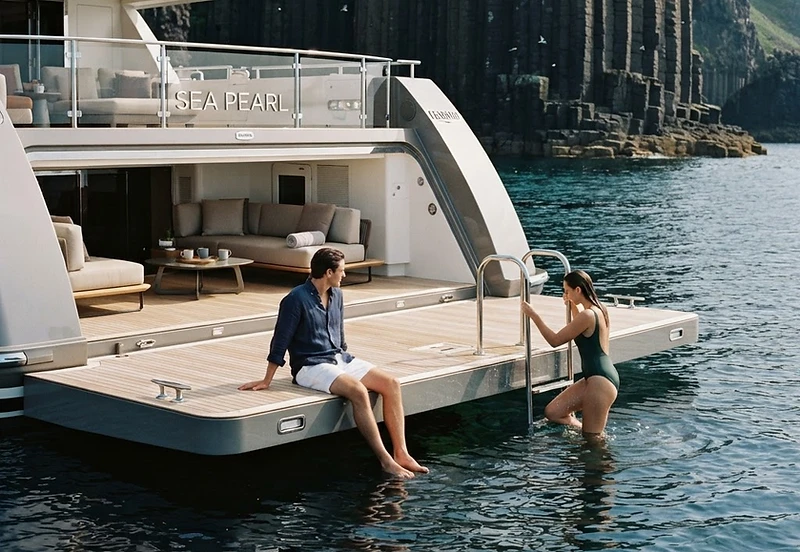
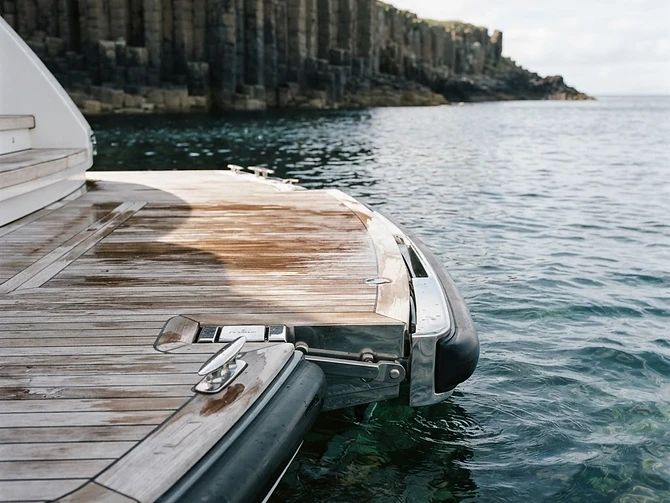
The dawn air off the Sound of Mull carries a particular, sharp salinity, a cold clarity that forces you to breathe deeper. We were anchored in a quiet bite of water tucked behind the basalt columns of the Treshnish Isles, the 55-metre Feadship Sea Pearl resting in a perfect, glassy stillness. To look at her from the tender is to understand the modern superyacht not merely as a machine of propulsion, but as a sophisticated piece of kinetic architecture. The aft section, usually a rigid, imposing wall of painted steel, had been transformed. The transom door had pivoted downward to become a flush, teak-laid terrace, suspended inches above the dark, peaty water. It is a spatial revelation: the moment a naval architect creates a room that has no ceiling and, for all intents and purposes, no floor, effectively extending the interior living space into the liquid topography of the Inner Hebrides.
Engineering the Fluid Interior
This beach club is less a luxury convenience and more a deliberate manipulation of gravity and space. As I stepped onto the platform, the subtle, rhythmic oscillation of the yacht against her chain was magnified, turning the entire club into a sensory instrument. The design, executed with the uncompromising precision one expects from the Feadship yard at Aalsmeer, integrates the indoor gymnasium and dive store directly into this externalized space. One moment you are selecting a carbon-fibre mask from a rack in the climate-controlled hold; the next, you are stepping out onto the sun-warmed, salt-dusted teak to face the rugged, heather-clad hills of the islands. The transition is seamless, a masterclass in how to merge the interior geometry of a luxury vessel with the raw, chaotic coastline of Scotland. There is a palpable weight to the architecture here—the muted hydraulic hum of the rams, the sheer, industrial solidity of the stainless-steel hinges—that anchors the observer to the world even as the tide shifts and swells beneath the feet.
The Weight of the Horizon
By midday, the wind had picked up, sending a fetch across the channel that licked at the edges of the platform, testing the rigidity of the engineering. We sat there, drinking tea brewed from water drawn from the vessel’s onboard filtration system, watching a pair of otters navigate the dense kelp beds near the anchor chain. The beach club here is an architectural paradox: it provides the total privacy and control of an interior salon while remaining entirely vulnerable to the shifting elements. It is where you feel the yacht most acutely as a residence, rather than a transient vessel. There is no separation between the refined, calculated lines of the design and the sudden, dramatic presence of the sea. It forces a quiet engagement with the environment; you do not just sail these waters, you inhabit the interface. As the sun began to dip behind the cliffs of Staffa, casting a long, bruising purple shadow across the deck, the platform finally began its slow, mechanical retraction. The architecture folded back into itself, sealing the warmth of the vessel against the encroaching night and leaving only the rhythmic, hollow slap of the Atlantic surge against the hull to remind us where we were.
As the last of the light bled from the sky, the vessel returned to its closed, monolithic state, leaving the water once again to the silence of the Hebridean dark.






