
On a 60-metre motor yacht, true luxury is no longer defined by gilded surfaces or ornate flourishes, but by the deliberate, near-invisible orchestration of space. As the vessel crests the horizon, cutting through the Aegean at a steady twelve knots, the interior becomes a study in kinetic architecture. Here, the boundaries between the sea and the living environment are not merely blurred; they are entirely dissolved. The challenge of the 60-metre platform—a size that balances substantial technical volume with the human desire for an intimate, tranquil retreat—lies in the tension between structure and the vast, fluid horizon outside.
The Geometry of Light and Flow
In the contemporary design vernacular, the master suite and primary salons serve as the vessel’s heartbeat. Architects now favor open-plan configurations that prioritize unbroken sightlines, utilizing floor-to-ceiling glass to anchor the interior firmly within the seascape. I remember a morning off the coast of Milos, watching the light sharpen against the bulkheads; by minimizing vertical obstructions and tucking lighting tracks into recessed coves, designers have achieved a sense of weightlessness. Materiality is the silent language of this space. Bleached oak, honed limestone, and brushed brass are curated not for their individual prestige, but for how they absorb and reflect the shifting Mediterranean sun. It is a choreography of light that transforms the mood of the room; by noon, the salon feels like a bleached extension of the deck, and by dusk, it retreats into a warm, amber-hued sanctuary.
The Art of Restrained Proportion
Refinement on this scale demands an acute understanding of human proportion. Every corridor and bulkhead is calculated to facilitate ease of movement, ensuring the yacht feels intimate even at its maximum dimensions.
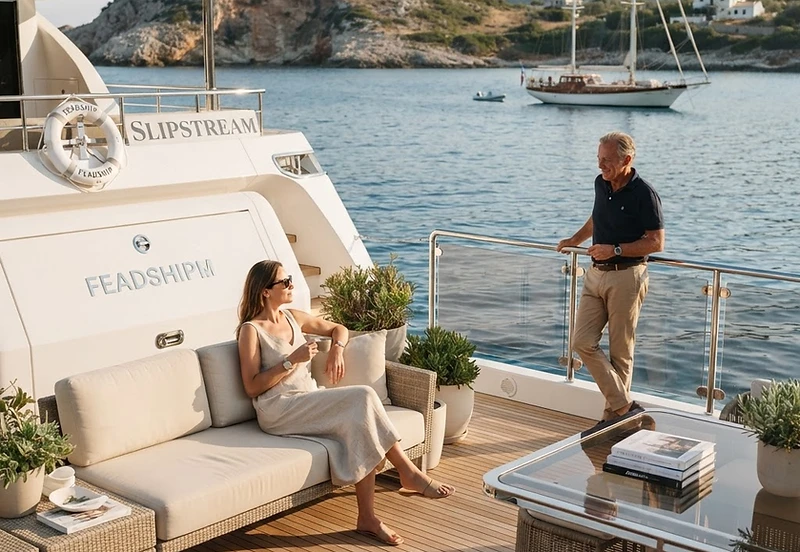
True elegance is the absence of effort, a space that breathes in harmony with the rhythm of the waves.Furniture is almost exclusively bespoke, low-profile, and integrated directly into the structural architecture to prevent any sense of visual clutter. I recall an evening sitting in the aft lounge, where a curved, custom sofa is bolted low to the teak flooring; the result is an uninterrupted horizon line that draws the eye directly to the water. This anchoring of furniture to the deck plane is more than a design choice—it is a functional necessity that keeps the occupant focused entirely on the sea beyond the glass. It is a sanctuary where the design is felt as a gentle pressure of comfort rather than seen as a set of aesthetic choices.
Anchorage and the Human Element
The true test of a vessel’s architecture occurs at the anchorage. When the engines cut to silence in a remote bay near Folegandros, the yacht ceases to be a machine and becomes a platform for life. Standing on the bridge deck at dawn, with a simple ceramic bowl of fresh figs and a cup of black coffee, the spatial planning reveals its purpose. The transition from the climate-controlled interior to the salt-air breeze of the deck is seamless, designed so that a guest might move from sleep to the ocean without encountering a single jarring threshold. This is the hallmark of the modern yacht—a vessel that acts as a lens, focusing the owner's experience upon the environment itself. It is a triumph of spatial efficiency, proving that when architecture is executed with restraint, the resulting atmosphere is one of profound, lasting serenity.
Ultimately, the 60-metre yacht represents the pinnacle of modern maritime living. It is a space designed to disappear, allowing the natural world to take precedence. In the hands of a master designer, the vessel becomes a quiet stage, and the sea, in all its mercurial temperament, becomes the only performance that matters.






