
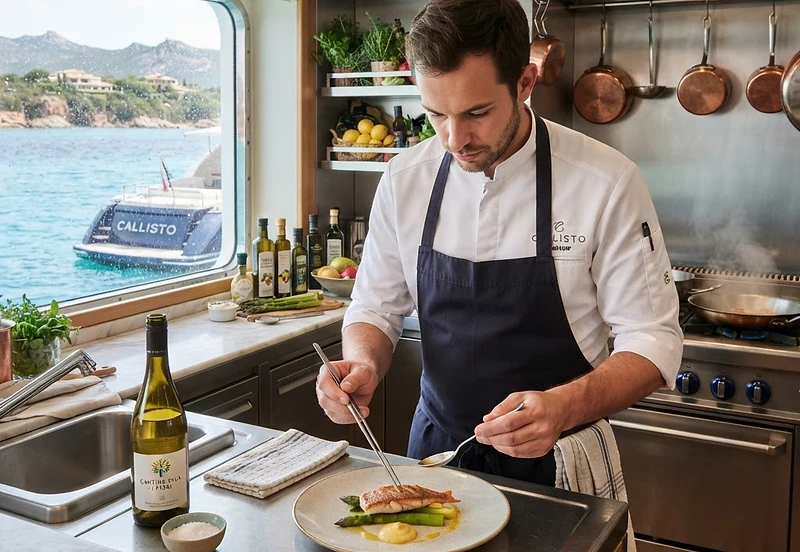
True elegance at sea is often found in the quiet moments of preparation, far removed from the public spectacle of the marina. As a vessel slips past the breaking surf, the galley—once a utilitarian space—becomes the heart of the yachting experience. Here, the challenge is not merely sustenance, but the pursuit of perfection within a confined, rolling geography. It requires a choreography of precision, where the logistics of supply meet the spontaneity of a discerning palate. On board a vessel like the Feadship Vanish, where the scale is vast, the galley remains an intimate, focused theater of motion, balancing the volatility of the ocean with the stillness required to produce a masterpiece.
The Architecture of Provisioning
Provisioning for a long-range crossing, perhaps a transit through the Exumas or a departure from the bustling docks of Antibes toward the Balearic Islands, is an exercise in both engineering and artistry. Before the lines are cast off, the head chef must treat the yacht’s cold storage as a living archive of taste. Sourcing is everything; the most refined vessels prioritize direct relationships with boutique providores, ensuring that ingredients arrive at their peak, often delivered via tender directly to the swim platform. It is a rigorous process of selection—a crate of heirloom tomatoes from a small cooperative near Nice, hand-harvested herbs, or a specific cold-pressed oil from a family estate in Tuscany—that dictates the cadence of the upcoming voyage.
The essence of maritime dining lies in the discipline of sourcing; the ingredients must hold a narrative of the earth and sea long after the coastline has vanished.
The Theatre of the Galley
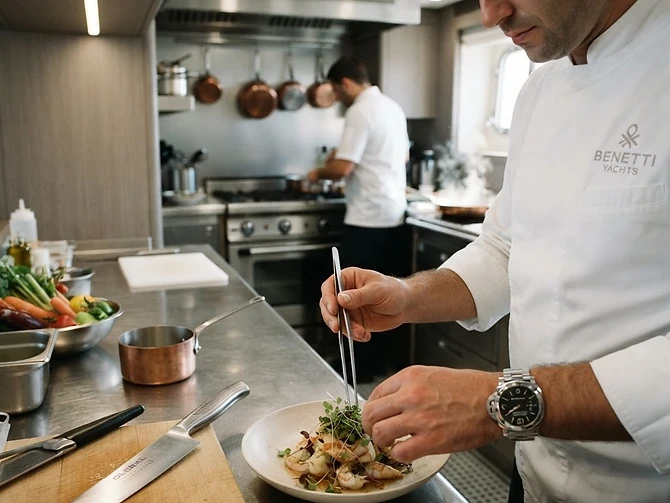
Once at sea, the chef assumes the role of an architect, restructuring menus to accommodate the constraints of the environment. I recall a crossing off the coast of Sardinia where the sea state was particularly unruly. While the hull groaned rhythmically against the swell, our chef was composed, crafting a delicate sea bass carpaccio. The challenge of a rolling galley—where magnetic induction hobs and gimbaled surfaces must do the heavy lifting—demands a restraint that elevates simplicity to an art form. Whether it is a breakfast of freshly caught crudo lightly kissed with yuzu or a dinner served under a starlit canopy on the aft deck, the preparation must be fluid. Modern galley technology—from rapid-chill refrigeration systems to integrated, vibration-dampened induction suites—allows the modern chef to execute complex techniques that were once the sole province of land-based Michelin-starred kitchens. The result is an experience where the movement of the ocean is not a hindrance, but a rhythmic partner to the dining process.
The Intimacy of the Open Sea
Ultimately, the culinary standard of a yacht is a reflection of its owner's philosophy regarding the art of living well. It is about understanding that while the vessel travels through vast, often desolate expanses, the quality of one's surroundings remains absolute. There is a singular thrill in sitting at the table on a boat anchored in a remote bay near the Ionian Islands, knowing that every ingredient on your plate was curated with a level of intention that rivals the most storied restaurants of Paris or New York. By marrying rigorous logistics with a deep respect for seasonal produce, the yachting lifestyle sustains an exquisite intimacy with nature. In this delicate balance, the galley becomes more than a kitchen; it becomes the bridge between the wild horizon and the refined comfort of home.
As the voyage concludes and the yacht returns to the familiar lights of a port like Porto Cervo, the lingering memory is rarely of the vessel’s speed or its technical specifications. Instead, it is the recollection of a singular meal shared against the backdrop of an endless blue, reminding us that the finest experiences in life are those curated with intention and grace.






