
The Lee of the Basin
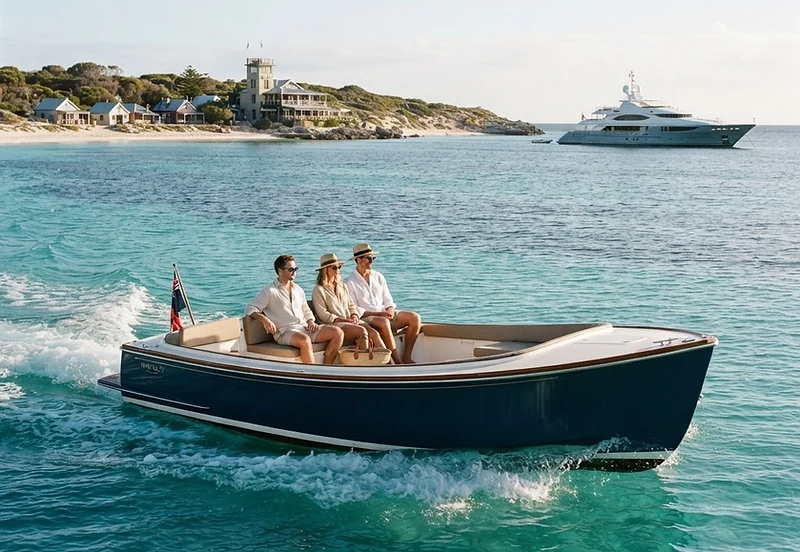
The morning light in the Indian Ocean carries a specific, crystalline weight, a sharpness that cuts through the haze as our tender, a nimble 32-foot Hinckley, leaves the swim platform of the mothership. We are anchored in the protected cobalt of the basin off the north coast of Rottnest Island, known to the Noongar people as Wadjemup. From the bridge, the 140-foot motor yacht had looked like a white sliver against the horizon, but as we steer toward the limestone headlands, the scale shifts. The water transitions from the deep, melancholic blue of the open passage to a startling, translucent turquoise that feels almost solid under the hull. There is a precise, mechanical comfort in the way the tender bites into the chop, the engines humming a low, steady baritone that punctuates the quiet of the morning, while the rhythmic slap of water against the gunwales serves as the only metronome for our approach.
Coastal Terroir and the Shoreline Table
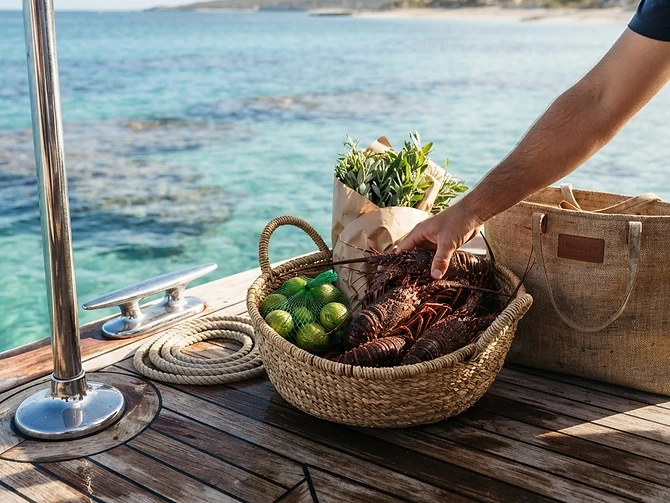
Stepping off the tender onto the jetty at Thomson Bay, the air shifts—the salt of the open sea is replaced by the dry, warm scent of native scrub and the distant, cooling breeze off the mainland. The ritual of the shore-bound lunch in this corner of Western Australia is defined by a rigorous, almost ascetic commitment to the local catch. At Isola, perched where the limestone meets the sea, the menu is an interrogation of the Indian Ocean’s bounty. We begin with Western Rock Lobster, split and grilled simply over woodsmoke, finished only with a squeeze of local lemon and a generous pinch of coarse sea salt harvested from the nearby salt lakes. The meat is sweet, firm, and entirely unadorned, a reflection of the cold, nutrient-rich Leeuwin Current that sweeps up from the Southern Ocean.
We linger over a dish of pan-seared King George Whiting, served with foraged coastal succulents that carry the mineral bite of the spray-drenched shore. It is a meal that demands attention, stripped of pretense, mirroring the life aboard where the complexity of the vessel—the engine room diagnostics, the trim of the stabilizers, the meticulous stowage of the galley stores—is offset by the simplicity of the arrival. There is no urgency here. The kitchen understands that after the morning’s transit, the appetite craves not extravagance, but honesty. The fish, landed only hours prior by local boats, serves as the anchor for a conversation that drifts from the technical specifications of the yacht’s recent refit to the subtle variations in the coastal currents between here and the Fremantle port.
The Quiet Return
As the afternoon wanes, the shadow of the headland lengthens, stretching across the anchorage like a dark finger. We return to the tender, the hum of the engines once again replacing the clatter of the restaurant, and thread our way back through the mooring lines and the lazy, circling gulls. Back on board, the transition is seamless. The stewardess greets us with chilled water, the deck is prepped, and the yacht begins its slow, rhythmic swing as the tide turns. I watch the sun dip toward the western horizon, the sky bruising into shades of violet and ochre, while the scent of the evening's preparations drifts up from the galley. The tender is hoisted, the davits hold their weight in the silence, and the great vessel settles into the evening, cradled by the same water that, just hours before, provided our sustenance.






