
The Architecture of Drift
In the British Virgin Islands, the water possesses a clarity that renders the seabed a vivid, secondary landscape. Navigating this archipelago by catamaran is less a transit between points and more an exercise in spatial fluidity. Unlike the monohull, which heels to the pressures of the wind, the catamaran offers a stable, horizontal grace. Standing on the expansive trampoline of a Lagoon 620, one feels the structural integrity of the vessel as it slices through the turquoise shallows, a balanced platform that demands little more from its occupants than a willingness to observe the changing gradients of the blue. There is a sense of detachment here—not from the sea, but from the terrestrial urgency that dominates life on land. The trade winds, consistent and reliable, dictate the pace, pushing the vessel toward the next verdant spit of land with a quiet, persistent energy.
Tactile Navigation and the Morning Stillness
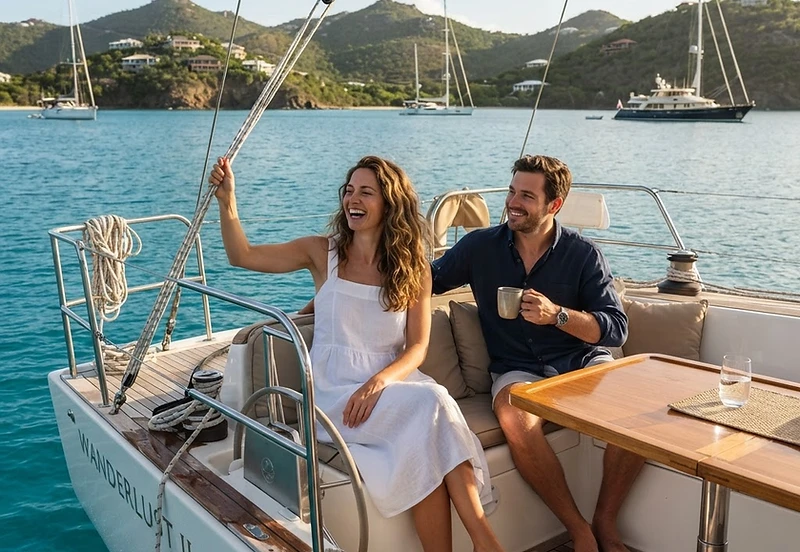
Life aboard is defined by the proximity to the elements. I recall a particular Tuesday morning off the coast of Peter Island; the world was entirely composed of shades of aquamarine and gold. The ritual—coffee taken in the cockpit while the anchor chain hums against the quiet tension of the current—is the grounding element of the day. There is an inherent efficiency to the layout of these yachts; every cabinet, every handrail, and every sun-drenched deck space has been calibrated for the Caribbean climate. Sun-bleached teak floors meet the stark white fiberglass of the hulls, a juxtaposition that mimics the contrast between the pale, powdery sands of White Bay on Jost Van Dyke and the deep, volcanic greens of the surrounding crags. One does not simply sail through the BVI; one inhabits the intervals between the islands.
The sea does not hurry, yet everything is accomplished with the rhythmic certainty of the tide.
By early afternoon, the focus shifts to the bays. Navigating into the hidden bights requires a steady hand and an eye for the shifting bottom, but the catamaran’s shallow draft grants access to anchorages that larger, deeper-keeled vessels must bypass. We slipped into a quiet curve near Norman Island, dropping anchor in the shadow of the cliffs. Whether watching the light shift across the monumental granite boulders of Virgin Gorda or sharing a simple lunch of fresh snapper and lime, the catamaran serves as a mobile observatory. There is a profound luxury in the absence of a fixed address; you arrive at the sunset as easily as you arrived at the dawn. The yacht acts as an extension of the littoral environment, a vessel designed to blur the boundary between the artificial comfort of the cabin and the raw, salt-heavy air of the archipelago.
The Weight of the Horizon
As the stars begin to assert their authority over the unlit horizon, the stillness of the anchorage becomes absolute. The transition from the brilliant, blinding glare of midday to the indigo velvet of evening is a sensory reset. Standing on the aft deck, the only sound is the gentle slap of water against the hulls—a sound that, over the course of a week, replaces the cadence of one’s own heart. To experience the British Virgin Islands from the deck of a catamaran is to engage with the archipelago on its own terms, moving with the trade winds rather than against them. It is a reminder that travel, at its most refined, is not about the destination, but about the quality of the light as it falls upon the sails at the close of another day at sea.






