
The Geometry of the Night
The Anegada Passage is rarely a gentle stretch of water. It is a deep, unforgiving corridor between the Atlantic and the Caribbean Sea, where the swell gathers momentum from thousands of miles of open ocean. We were aboard a 50-meter Perini Navi, her hull slicing through the indigo dark with the quiet confidence of a seasoned explorer. As the sun dipped below the horizon, losing its hold on the Virgin Gorda cliffs, the interior of the yacht underwent a fundamental transformation. In the daytime, she is a showcase of teak and glass, a vessel designed to mirror the turquoise expanse of the BVI. But at night, she becomes something altogether different: a floating, self-contained architecture.
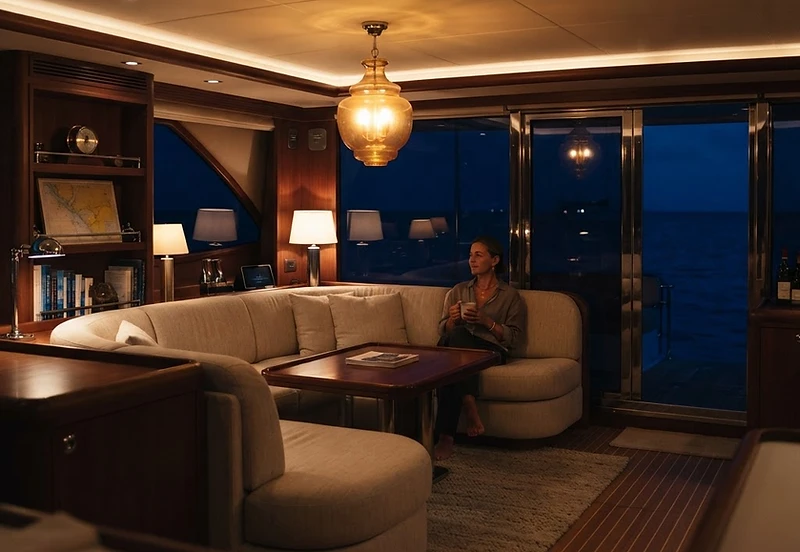
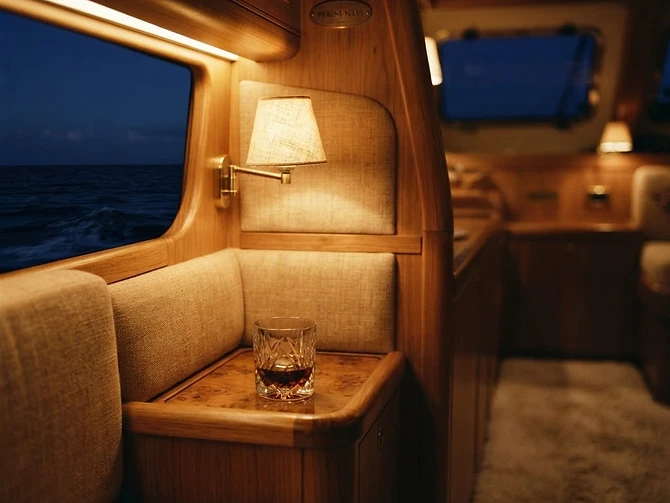
Great lighting design on a yacht is not merely about brilliance; it is about the intentional concealment of the source. Our designer, working with the principles applied to the finest villas in Gustavia, had recessed the LED arrays behind coves of bleached oak. There were no harsh glare points, only a gentle, amber wash that mimicked the warmth of a hearth. As the vessel pitched, the light did not move with her; it remained anchored to the structural planes, creating a steady, horizontal datum against which the erratic rhythm of the sea was measured. It is the same discipline one finds in the stone-walled villas of the French West Indies, where floor-level uplighting accentuates the rough-hewn mortar, grounding the structure in its local geography.
The Saloon as a Sanctuary
By midnight, the transition was complete. Below deck, the illumination was reduced to a low-Kelvin glow, an intentional choice that preserved our night vision for the bridge. In the main saloon, the light was focused exclusively on the seating groupings, leaving the vast expanses of the ceiling in shadow. This architectural choice draws the eye downward, reinforcing the sense of being held, protected within a hull that felt more like a residence than a piece of heavy machinery. I sat with a glass of chilled mineral water, listening to the hum of the stabilizers and the rhythmic, percussive slapping of the wake against the transom. The distinction between the yacht and the static architecture of a coastal residence blurred; here, the walls were moving, yet the domesticity remained absolute.
We passed the flickering distant lights of St-Barthélemy to the southeast, a mere suggestion of humanity against the infinite black of the passage. The contrast was startling: the artificial intimacy of the interior, designed with the precision of a master architect, versus the terrifying, beautiful emptiness of the sea. There is a specific, profound dignity in this—the ability to carry a curated, human space across the most chaotic environments on the planet. It is not about the fixtures themselves, but the intent behind them: the creation of a stable, human-centric environment in the middle of a shifting, oceanic dark.
Eventually, the crew dimmed the final circuit on the aft deck, leaving only the soft, bioluminescent-blue of the submerged transom lights flickering beneath the rudder. We watched the water churn, a silent, ghostly wake trailing into the dark, until the horizon simply ceased to exist, leaving us suspended in a vessel of our own quiet making.






