
The Architecture of the Open Horizon
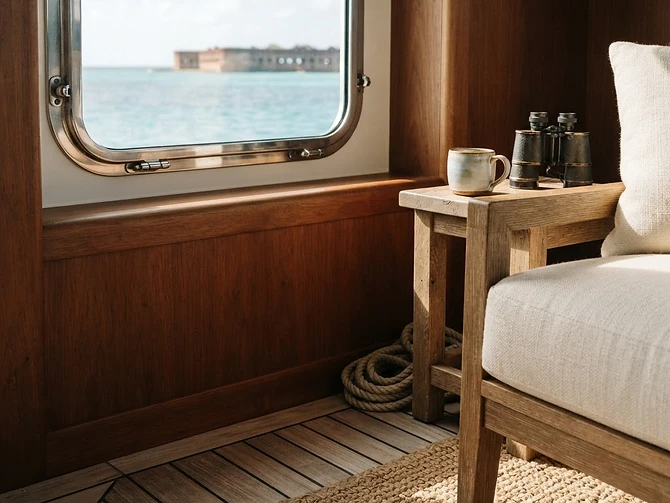
The transition from the salt-sprayed deck of a custom expedition vessel—perhaps a purposeful explorer built by Damen or a robust Nautor's Swan—into the interior is less a shift in space than a fundamental realignment of the senses. As we cleared the Rebecca Shoal light and set a course for the Dry Tortugas, the horizon flattened into a singular, bruised line of purple and charcoal. Out here, seventy miles west of Key West, the ocean sheds its casual vacation veneer and demands a visceral, mechanical respect. The interior of the yacht serves as the essential foil to this intensity. Designed with the same spatial rigor as a limestone-walled villa or a high-end coastal residence in Coconut Grove, the cabin is meant to be a fixed point in a moving world. The joinery, often executed in warm, oil-rubbed teak or sustainable walnut, provides a tactile groundedness that counters the constant, rhythmic heave of the hull. It is here that the concept of the superyacht as a mobile house finds its most honest expression: walls are not merely partitions but structural anchors designed to cradle the inhabitant amidst the relentless pulse of the Gulf Stream.
The Thermal Equilibrium of the Cabin
Stepping into the main saloon at midnight, the temperature differential is immediate. While the wind whistles through the rigging with a sharp, high-latitude chill that belies our position in the subtropics, the interior remains a steady, protected sanctuary. The design—informed by the principles of high-performance architecture—uses deep-cushioned seating and recessed, warm-spectrum cove lighting to create a sense of compression and intimacy. We sat over a late-night supper of locally sourced snapper, prepared with a light citrus reduction, and chilled melon, the conversation hushed to match the muffled, rhythmic drone of the generators. There is a specific, quiet weight to a well-designed yacht interior when at sea; the cabinetry does not merely store gear, it locks in a micro-climate of silence. Much like a finely crafted cliffside villa that uses mass to manage heat and light, this cabin uses density and shadow to command the space. One feels the structural integrity of the bulkheads, a reminder that this vessel is not merely floating, but actively holding its ground against the immense, shifting weight of the water.
Reflections on the Oolite Anchorage
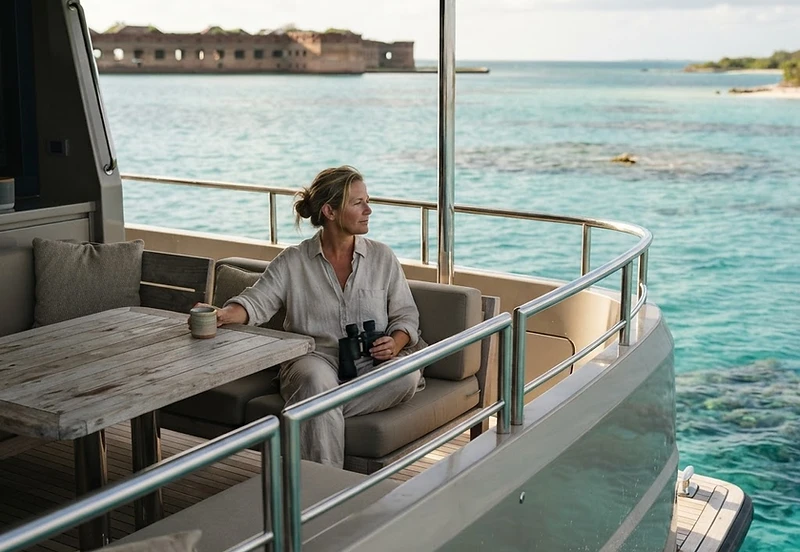
By dawn, the anchor chain had finally settled into the silty, sandy floor of the Garden Key anchorage, the sound of the windlass a percussive, metallic punctuation in the stillness. Standing on the bridge deck, the perspective shifts again; the interior is no longer a retreat from the world but a glass-walled observatory framing the brooding, brick ruins of Fort Jefferson. The aesthetic of the ship remains in perfect, deliberate dialogue with its surroundings—the cool, clean lines of the custom deck furniture echoing the precise, geometric masonry of the nineteenth-century fort on the horizon. It is a moment of profound alignment, where the expertise of naval architects and residential interior designers converges. As the morning light hits the water, the yacht is revealed for what it truly is: a vessel that respects the wildness of the Tortugas, not by overcoming it, but by providing a bridge between the raw, shifting elements outside and the serene, wood-lined silence within. We drank our coffee in the galley, watching the cobalt of the Gulf deepen, and felt, for a brief hour, entirely at home in the middle of nowhere.






