
Off the coast of Saint-Tropez, the sea possesses a peculiar viscosity under the high sun, turning the Gulf into a basin of pressed glass. At the center of this field, a sixty-meter motor yacht sits at anchor, its steel hull a sharp, monochromatic interruption to the soft blue horizon. There is a profound stillness in its presence; it is an object defined not by the urgency of transit, but by the discipline of its stationary state. The yacht does not merely occupy the water—it edits the surrounding space, creating a private coordinate within the public theater of the Côte d’Azur, anchored firmly in the lee of the Cap Saint-Pierre.
The Geometry of the Hold
To watch a vessel of this scale maneuver toward a specific anchorage in the Pampelonne Bay is to witness a choreography of immense power restrained by absolute precision. The captain guides the yacht with the delicacy of a watchmaker, the thrusters barely disturbing the surface as the anchor chain—a heavy, rattling lung—descends into the crystalline depths. Once secured, the transformation is total. The vessel ceases to be a machine of passage and becomes a stationary island. It commands its own gravity, drawing the gaze of passing day-boats while remaining entirely indifferent to the frantic rhythms of the mainland. The yacht acts as an architectural intervention, carving out a sanctuary that feels as permanent as a villa on the headlands, yet gifted with the ability to chase the sun.
The Refinement of the Deck
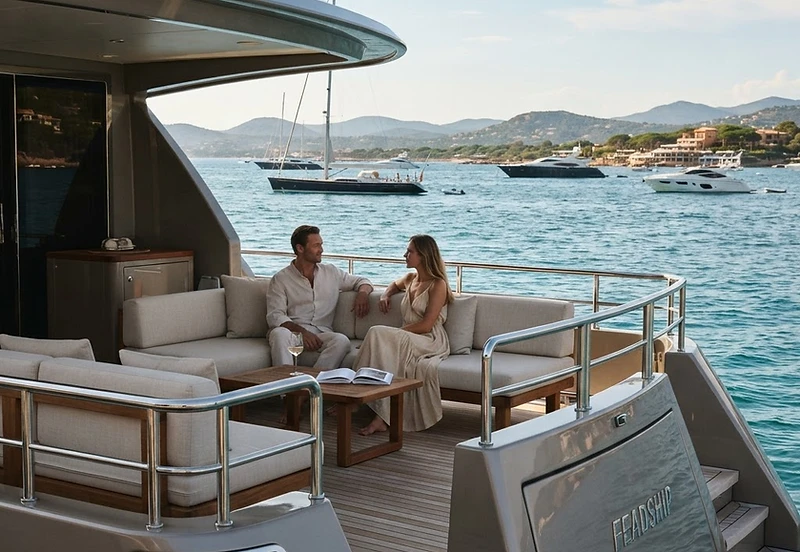
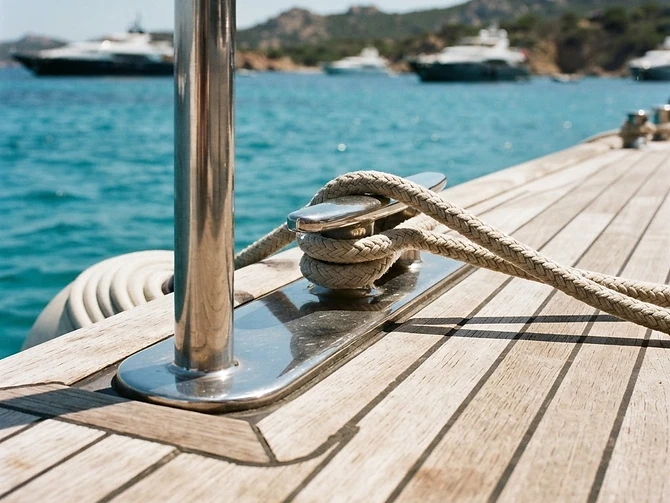
On board, the architecture of leisure is articulated through subtle material transitions. The bleached teak decks provide a grounding warmth against the cool, industrial precision of the vessel’s superstructure, designed with the clean, muscular lines typical of a Feadship build. Between the shadow-cast depths of the interior lounges and the exposed intensity of the sundeck, the yacht acts as a series of deliberate volumes. Design is not merely about aesthetic flourish; it is about the modulation of light and breeze. I recall standing on the aft deck mid-morning, the air thick with the scent of brine and a faint, lingering trace of freshly ground espresso. A steward moved with a phantom-like efficiency, placing a silver platter of chilled melon onto a low glass table without a single sound. In that moment, the crew’s presence was felt only by the perfection of the environment; the vessel’s interface with the sea remained entirely uninterrupted by the clatter of mundane existence.
The horizon is not a destination, but a perimeter for the day’s quiet theater.
An Equilibrium of Light
As the afternoon transitions toward the golden hour, the yacht’s silhouette deepens, its lines sharpening against the cooling sky. This is the hour when the vessel ceases to be a machine and becomes a sculpture of light. The reflection off the water dances against the underside of the flybridge, casting rhythmic, flickering patterns that bridge the gap between the built environment and the organic fluid beneath. It is a moment of total equilibrium, a testament to the fact that when one travels at this altitude of luxury, the most sophisticated movement is the art of staying perfectly still. Watching the distant lights of Club 55 begin to pulse like a syncopated heart against the darkening shoreline, one realizes the yacht is not merely anchored in water, but in time itself, a sanctuary of deliberate design suspended in the shifting tides of the Mediterranean.
As the stars begin to punctuate the indigo expanse, the isolation of the bay feels absolute. The vessel, a shimmering fortress of steel and light, remains our private anchor in a world that never stops moving.






