
The Geometry of the Passage
To navigate the British Virgin Islands by catamaran is to subscribe to a distinct philosophy of movement. Unlike the monohull, which heels to the will of the wind, the catamaran maintains a level horizon. This stability—this refusal to yield to the sea—defines the guest experience. The dual hulls act as a bridge between disparate landmasses, turning a transit between the salt-sprayed reefs of Anegada and the granite boulders of the Baths into a choreographed event of light, kinetic energy, and salt. Aboard a high-performance Lagoon or a Fountaine Pajot, the sensation is one of gliding; you are not merely crossing the water, but skimming across a glass floor that shifts from the deep, melancholic indigo of the Anegada Passage to the luminous, neon emerald of the shallow banks.
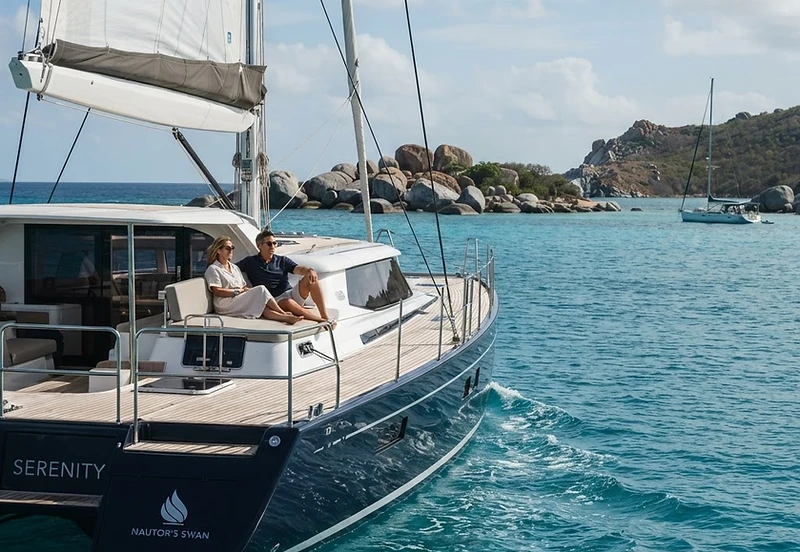
On deck, the architecture is stripped of non-essentials. The trampoline, suspended between the two bows, becomes the primary viewing platform. Here, the boundary between the vessel and the turquoise expanse dissolves. It is a space designed for the observation of refraction; as the depth changes, the hull slices through the surface with a hushed, purposeful efficiency. I remember one specific Tuesday, roughly three miles off the coast of Virgin Gorda, where the wind held a steady twelve knots. We lay on the forward netting, the spray cooling our skin, watching a pair of tropicbirds circle the mast. There was no conversation, only the rhythmic thrum of the hulls cutting through the chop—a reminder that the vessel is a precision instrument, designed to turn the chaos of the open ocean into a controlled, elegant trajectory.
Refinement at Anchor
True luxury is found in the absence of noise, both mechanical and social, when the engines are cut and the anchor bites into the white sand.
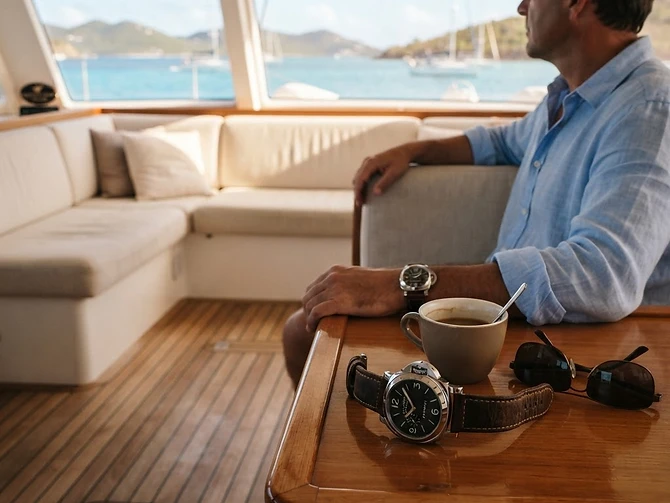
The interior of a high-end charter catamaran is a lesson in compact, bespoke utility. Every hinge is recessed, and every surface is finished to withstand the corrosive grace of the Caribbean air. When the vessel settles into a protected anchorage, such as the quiet, secluded reaches of Cooper Island, the boat transforms from a transit vessel into a private pavilion. Life shifts to the cockpit, a shaded threshold where the morning ritual of espresso is accompanied by the rhythmic, percussive tension of halyards clicking against carbon-fiber masts.
Designers of these vessels prioritize flow above all else. The open-plan connection between the galley and the aft deck creates a continuous plane, allowing for a seamless transition from the preparation of fresh local snapper to the quiet consumption of a meal as the sun dips behind the western hills. The air in the cockpit during these golden hours is heavy with the scent of sea salt and freshly sliced papaya. There is a profound, meditative peace in watching the crew work the lines as the boat settles, the teak decking still holding the day’s warmth beneath your feet. It is here that the true value of the charter emerges: not in the speed of the crossing, but in the clarity of the surroundings.
The Weight of the Horizon
As evening falls, the islands shed their daytime colors, retreating into silhouettes of charcoal and deep violet. The catamaran, anchored on a natural pivot, shifts with the subtle tides, rotating slowly to face the open channel. Within this floating sanctuary, one becomes acutely aware of the vast scale of the archipelago and the intentional restraint of one’s own footprint. The experience is not merely about reaching a destination; it is about the sustained equilibrium of life lived in the middle of a shifting, shimmering, and salt-cleansed world. You realize then that the beauty of the British Virgin Islands is best understood from the water—a silent, constant witness to the tide.






