
The Weight of Stillness
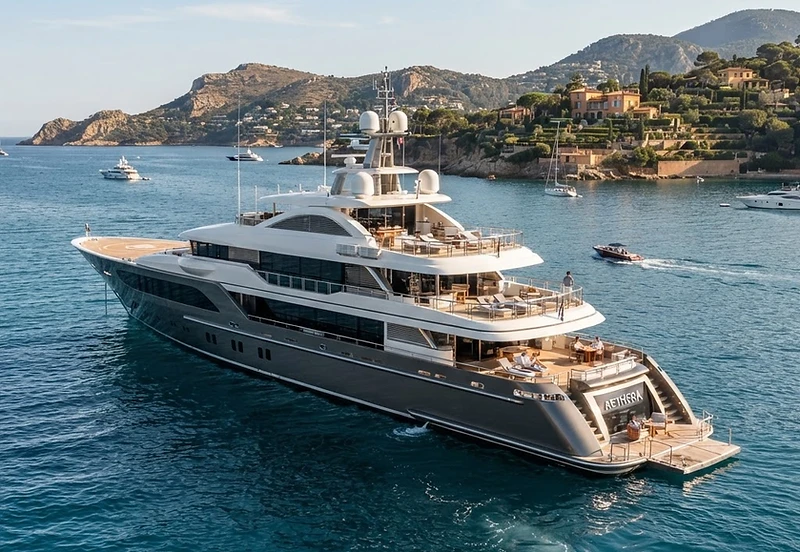
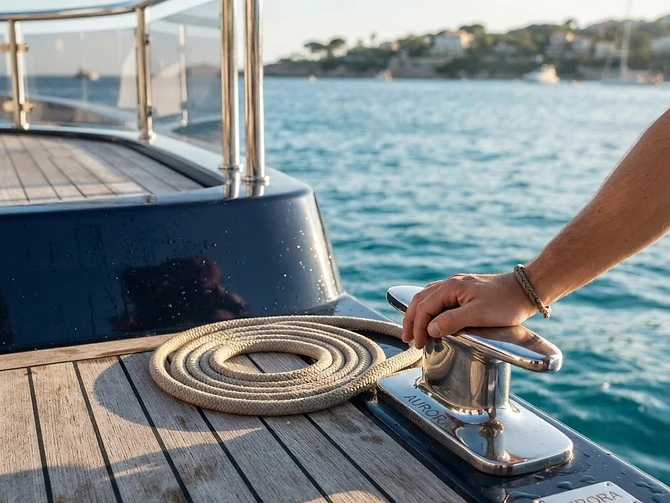
To anchor a substantial vessel in the sapphire expanse off the Baie des Canebiers is an act of deliberate defiance against the kinetic nature of the Mediterranean. As the heavy chain settles into the seabed with a muted, metallic vibration that travels through the soles of one’s feet, the yacht ceases to be a machine of transit and becomes, instead, a permanent architectural installation. From the deck, the chaotic, sun-drenched energy of the nearby port of Saint-Tropez is rendered silent, transformed into a distant, impressionistic smear of pastel ochre and white canvas. The yacht, in this instance a sleek 45-meter Perini Navi, functions not as a vehicle, but as a horizontal terrace governed by a logic of extreme precision, where every seam of teak planking and brushed-steel fixture serves to frame the shifting light of the afternoon.
I recall sitting on the aft deck as the wind died away completely, leaving the water as glass. The chef had brought out a simple platter of figs and local almonds, the sharp, earthy sweetness cutting through the salinity that clings to the air. There was no sound save for the rhythmic, distant slap of a tender’s wake hitting the hull—a gentle reminder that, while we had opted for the stillness of the anchorage, the wider world was still very much in motion. It is in these moments of forced pause that one truly understands the scale of a vessel; it is a private island carved out of the public blue.
Tactile Landscapes
Life aboard this vessel in its stationary state is defined by a rhythmic, almost meditative isolation. The water, a deep, saturated cobalt, acts as the primary material of the environment, mirroring the hull’s sharp lines and soft shadows. One does not merely sit on the aft deck; one inhabits a curated intersection of shade and solar intensity.
The yacht is a singular, drifting room, detached from the shore but tethered to the tide, where the only movement is the slow oscillation of the sun across the glass-topped dining tables.The interior spaces reflect this restraint, meticulously stripped of the superfluous to allow the blue brilliance of the bay to penetrate the salon. The interplay of light—refracted off the water and dancing across the white leather upholstery—creates a shifting, luminous architecture that feels both grand and intensely intimate.
To reside on the water is to engage in a constant negotiation with the elements. We spent the mid-afternoon watching the light deepen, the shadow of the mast sweeping across the deck like the hand of a sundial. It is a study in how volume can be hollowed out to accommodate nothing but clarity and the passage of time. There is no urgency to explore the shoreline or to traverse to the next bay; the satisfaction lies in the capacity to remain perfectly, elegantly stationary.
The Geometry of Return
As evening approaches, the transition is marked by a subtle shift in color temperature. The metallic surfaces of the superstructure catch the dying light, casting long, geometric silhouettes across the stern deck. There is a profound sophistication in this suspension—a refusal to participate in the rapid, cyclical movement of the coast. To remain anchored is to claim ownership of a specific coordinate in the vast, indifferent blue, transforming a piece of engineered steel into a sanctuary of stillness that remains entirely, and defiantly, contained.
When the sun finally dips below the horizon, the village of Saint-Tropez begins to glow with a different kind of intensity, a cluster of golden embers against the encroaching dark. From the safety of our mooring, the transition from the private world of the yacht to the public world of the mainland feels like a crossing between two distinct realities. Ultimately, the yacht at anchor provides a rare form of psychological decompression. It is not about the speed of arrival, but the dignity of the arrival’s end, where the act of anchoring becomes the true destination of the voyage.






