
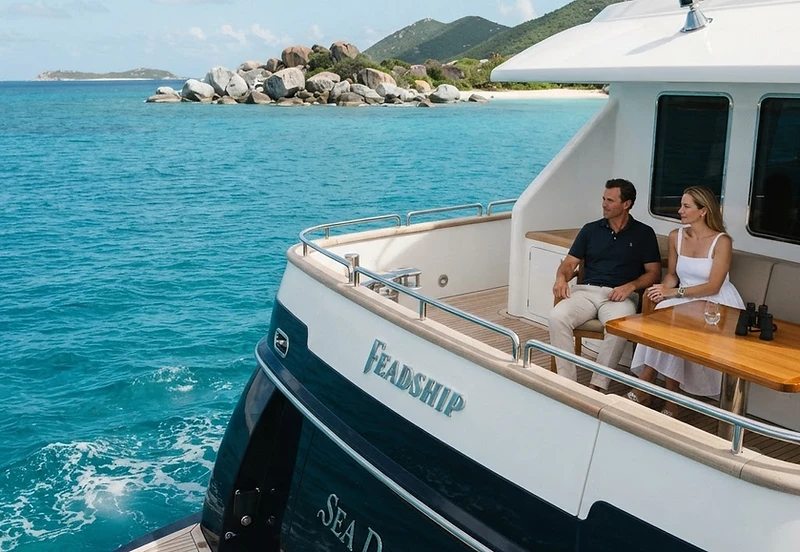
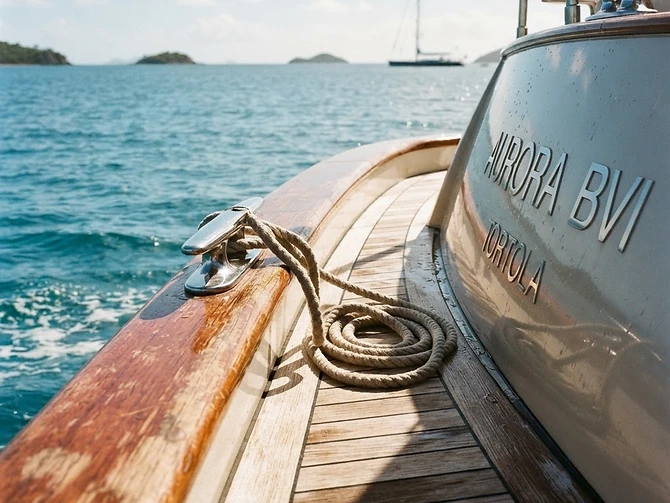
There is a specific, untethered quality to life aboard a multihull in the British Virgin Islands that renders the concept of the mainland entirely irrelevant. As the twin hulls of our Lagoon 52 slice through the translucent, turquoise shallows of the Sir Francis Drake Channel, the architecture of the yacht becomes more than a vessel; it is a mobile observatory, stripping away the superfluous to leave only the essential geometry of sail, salt, and sun. Unlike a traditional monohull, which demands a constant, physical negotiation with the sea's incline, the catamaran offers a stable, expansive platform—a floating living room that remains perpetually level even as the horizon shifts beneath a brisk trade wind.
The Geometry of the Open Deck
Life in this archipelago is defined by the fluid transition between the interior salon and the vast, exposed netting at the bow. At midday, when the sun is at its zenith, the foredeck becomes an exercise in intentional, minimalist living. Observation is the primary occupation here. The architecture of the catamaran provides a 360-degree vantage point, where the distance between the galley and the open water is bridged by a single, seamless glass bulkhead. There is no friction in the movement; one is either inside the protected shade of the bridge deck, perhaps leaning against the mahogany trim with a glass of chilled water, or entirely immersed in the rhythmic, kinetic pulse of the Caribbean current as it rushes beneath the bridge deck.
I remember one such Tuesday, anchored off the northern tip of Virgin Gorda. The air smelled of damp salt and the faint, sweet scent of sea grape. From my seat on the teak-laid cockpit, I watched the crew manage the lines with a practiced, almost silent grace. We were not rushing to any port; we were simply existing in the space between the islands, a luxury that only becomes apparent when you stop checking the clock and start checking the barometer.
Anchored in Kinetic Repose
Even at rest, the vessel exerts a unique gravitational pull on its surroundings. Dropping anchor in a secluded cove near the iconic boulders of The Baths or off the quiet, windswept reach of Anegada, the boat pivots slowly with the changing tide, acting as a pendulum that traces the invisible, shifting contours of the bay. This is the true art of the mooring. In these moments of stillness, the silence is not empty; it is a rich, textured silence filled with the low-frequency hum of the standing rigging and the soft, percussive slap of water against the fiberglass underbelly.
The beauty of the catamaran lies in its refusal to fight the environment, choosing instead to drift in a state of suspended harmony.
It is a refinement of the travel experience, a way of inhabiting a landscape without ever truly arriving or needing to depart. One afternoon, while anchored near the Bitter End Yacht Club, I found myself watching a lone tender ferrying supplies to a nearby sailboat. The contrast between our stillness and their activity was profound. While they were busy securing their logistics, we were busy securing our peace. We spent the afternoon reading in the shade of the bimini, the boat offering a cool, white sanctuary against the fierce tropical heat.
As evening approaches, the sky transforms into a bruised, shifting palette of violet and molten gold, and the vessel becomes a lighthouse unto itself, its interior lights glowing softly against the darkening sea. The choice to cast off and drift, to follow the whim of the current rather than the rigidity of a schedule, is the ultimate luxury. It is not a luxury defined by material excess, but by the sovereignty of time—measured only by the fading light and the unwavering, patient whisper of the wind against the mainsail.






