
The Anatomy of a Temporary Boundary
In the quiet folds of the Cyclades, where the Meltemi wind often dictates the tempo of the day, a single hull can fundamentally alter the perception of space. Anchored in a narrow limestone inlet near the jagged reaches of Polyaigos, our 42-meter Perini Navi does not merely sit; it anchors the landscape, turning the white, calcified cliffs into a private amphitheater. The water, a startling, crystalline turquoise, laps against the teak decking with a rhythmic consistency that underscores the profound stillness of the afternoon. It is a dialogue between man-made engineering and geological permanence, a momentary pause in the relentless cycle of the Aegean.
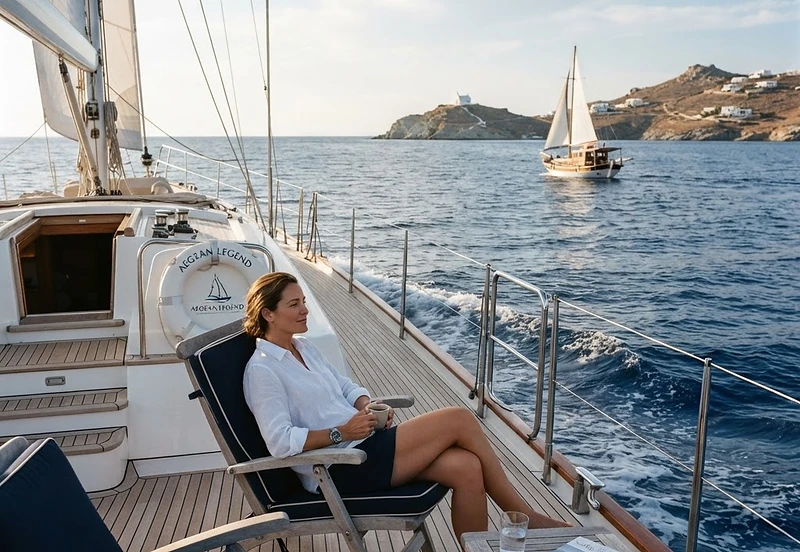
On deck, the sensory experience is stripped of artifice. The heat of the sun is tempered by the cool, saline respiration of the sea, creating a climate that feels both immediate and timeless. The rigging, held in high tension, barely hums as the breeze curls over the surrounding ridges, leaving the cove in a state of suspended animation. I recall a specific Tuesday afternoon spent observing the captain negotiate the anchor drop; the precision required to tuck a vessel of this scale into such a confined, protected basin is a testament to the marriage of tradition and technical mastery. As the chain rattled out and finally went taut, the yacht became a point of focus in an otherwise sprawling, unmapped expanse, a floating sanctuary defined by salt and shadow.
The Geometry of Repose
To reside at anchor in the Cyclades is to practice a form of elective isolation. Without the forward kinetic energy of a transit, the yacht reveals its true architectural intention: the balance of load, buoyancy, and structural grace. From the aft cockpit, one observes the interplay of light as the sun traces a slow, blistering arc across the bleached white stone. The yacht acts as a meridian, a fixed point against which the fluid, moving surface of the sea can be measured and understood. There is a particular pleasure in the morning routine here—the sharp, bracing tang of a double espresso served on the sundeck before the wind picks up, the only sound the gentle slap of water against the waterline and the distant, lonely call of a goat from the cliffs above.
The anchor holds not just the chain, but the very possibility of silence in a world increasingly loud with motion.
As evening approaches, the transition is subtle but absolute. The golden hour bleeds into the rock faces, turning the landscape into a study of deep amber and violet shadow. The vessel sits lower in the water, its mass shifting with the gentle tide, fully integrated into the cove’s natural architecture. Tonight, the chef has prepared a simple plate of grilled octopus with wild capers and sea fennel, a meal that tastes of the very coordinates we occupy. There is no urgency to depart for the crowded slips of Mykonos or the bustling ports of Santorini; the anchorage serves as a reminder that the most sophisticated luxury is the ability to command one's own time, anchored firmly in the present.
Ultimately, the experience in these hidden coves is one of alignment. With the sails furled and the hum of the engine extinguished, the vessel is restored to its primary form—a quiet, graceful inhabitant of the tide. In the fading light, the separation between the vessel and the harbor begins to blur, leaving only the rhythm of the swell and the cooling air. It is in this twilight transition, where the horizon dissolves, that the pendulum of the voyage finally stops, leaving one perfectly suspended in the silence of the sea.






